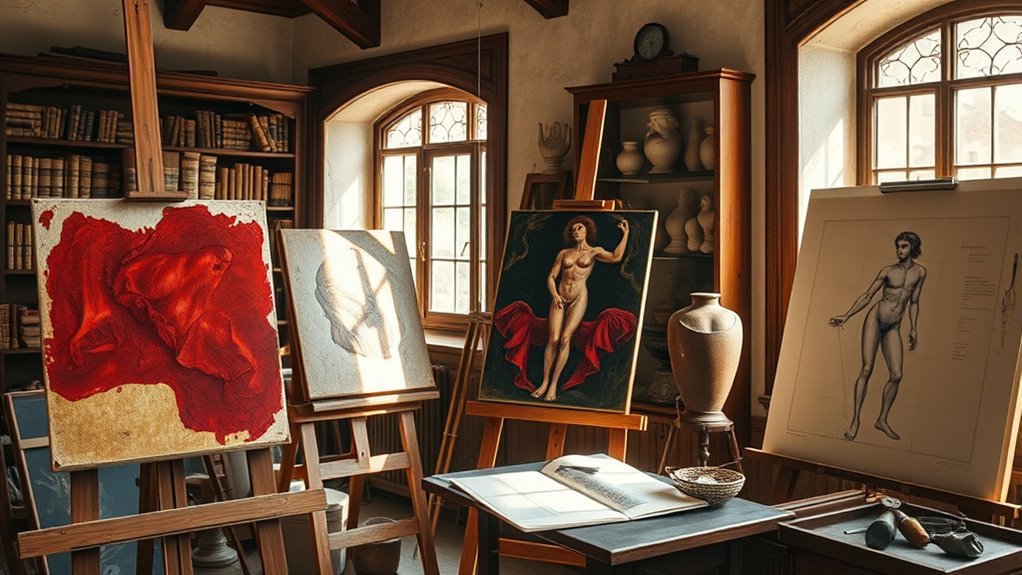

During the Renaissance, Humanism shifted focus to human experience, inspiring artists to explore emotion, individual perspective, and classical ideals. You see a move away from medieval spiritual themes toward realistic depictions of people and nature, using new techniques like linear perspective and chiaroscuro. Artists such as Leonardo and Michelangelo mastered naturalism and anatomy, elevating their craft and changing art’s role in society. Keep exploring to discover how these innovations paved the way for modern artistic expression.

Get art and craft supplies delivered free — and shop member deals
- Fast, free delivery on millions of items
- Access to Prime Big Deal Days deals on October 6–7
- Prime Video, Amazon Music and more included
Key Takeaways
- Humanism shifted focus from religious themes to human experiences, inspiring more personal and expressive artworks.
- Renaissance artists revived classical ideals of harmony, proportion, and beauty, blending them with innovative techniques.
- Mastery of linear perspective, chiaroscuro, and sfumato created realistic, three-dimensional, and emotionally compelling images.
- Artists like Leonardo and Michelangelo elevated their status as creative geniuses, exploring anatomy and new materials.
- Art became more accessible and storytelling-oriented, laying the foundation for modern artistic practices.
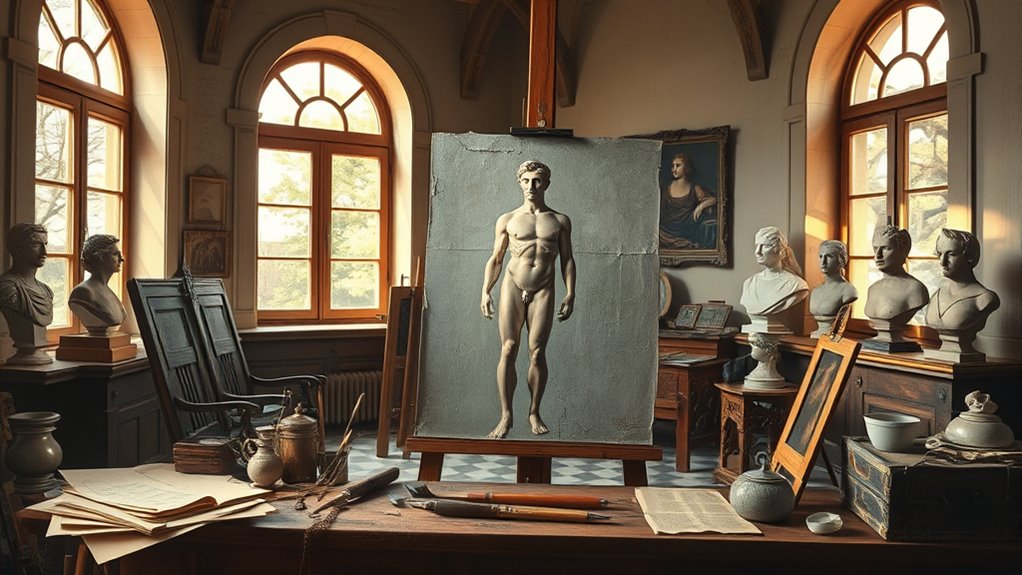
The Renaissance was a pivotal period that transformed art and thought by emphasizing humanism, which placed people and their experiences at the center of cultural expression. This shift led you to see art not just as decoration but as a reflection of human nature, emotion, and intellect. You’ll notice that artists drew heavily on classical influences, revisiting the ideals of ancient Greece and Rome to create works that celebrated harmony, proportion, and beauty. These classical inspirations provided a foundation for artistic innovation, encouraging artists to explore new techniques and perspectives. You might observe how figures in Renaissance paintings appear more realistic and three-dimensional, thanks to the mastery of techniques like linear perspective and chiaroscuro, which add depth and realism to their work.
During this period, artists didn’t just copy classical themes; they reinterpreted them through artistic innovations that pushed the boundaries of traditional art. For example, the invention and refinement of linear perspective allowed you to create a convincing sense of space, making scenes appear more lifelike and immersive. This innovation changed how you see compositions, giving you a new way to experience a story or emotion within a painting. Similarly, the development of sfumato—a technique that uses subtle gradations of tone—enabled artists like Leonardo da Vinci to create soft, atmospheric effects, bringing a sense of realism and intimacy to their portraits and landscapes. These techniques represented a significant departure from medieval art’s flatness and stiffness, emphasizing naturalism and human emotion.
The Renaissance also encouraged you to think differently about the role of the artist. Artists like Michelangelo, Raphael, and Leonardo became celebrated for their inventive approaches and technical mastery. They combined classical influences with innovative methods, producing works that are both inspired by the past and groundbreaking for their time. They also explored anatomical accuracy, which allowed them to depict the human body more convincingly and expressively. The use of new materials, improved understanding of anatomy, and experimental compositions all contributed to the artistic innovations that define this era. As a result, art became more accessible and relatable, emphasizing individual perspective and emotional depth.
Top picks for "renaissance humanism birth"
As an affiliate, we earn on qualifying purchases.
Frequently Asked Questions
How Did Renaissance Humanism Influence Scientific Discoveries?
Renaissance humanism influenced scientific discoveries by encouraging you to question traditional beliefs and rely on empirical observation. You’re motivated to develop a scientific methodology rooted in direct evidence and experimentation. This shift allows you to analyze nature more critically, making breakthroughs possible. Humanism fosters curiosity and individual inquiry, leading to innovations in astronomy, anatomy, and physics, ultimately shaping modern science through a focus on observation and rational thought.
What Role Did Patrons Play in Renaissance Art Development?
Patrons played a pivotal role in Renaissance art development through their influence and art sponsorship. Your patron’s support provided artists with the resources and freedom to create innovative works, often reflecting their own tastes and ideals. This patron influence shaped the themes and styles of the period, encouraging artistic experimentation. By commissioning masterpieces, patrons helped elevate art’s status, ensuring its lasting impact and fostering a vibrant cultural environment during the Renaissance.
How Did Renaissance Art Differ From Medieval Art Styles?
Picture a world shifting from the shadowy, symbolic glow of medieval symbolism and gothic aesthetics to the vibrant, realistic scenes of Renaissance art. Unlike medieval works, which often focus on spiritual symbolism and stylized figures, Renaissance art emphasizes perspective, anatomy, and human emotion. You’ll notice a move toward individualism and naturalism, capturing the real world with depth and detail, breaking free from the flat, symbolic style of the Middle Ages.
Were Women Actively Involved in Renaissance Artistic Movements?
Women artists and female patrons played a significant role in Renaissance artistic movements, though their involvement was limited compared to men. You might notice women like Sofonisba Anguissola and Artemisia Gentileschi gaining recognition for their work. Female patrons, such as Isabella d’Este, supported artists and commissioned artworks. While opportunities were restricted, these women actively contributed to and shaped Renaissance art, breaking barriers in a chiefly male-dominated field.
How Did Technological Advances Impact Renaissance Artistic Techniques?
Sure, technological advances like optical enhancements and printmaking innovations didn’t just make artists’ lives easier—they revolutionized their entire craft. You now get sharper perspectives and more detailed images, all thanks to these breakthroughs. These tools democratized art, spreading Renaissance ideas faster than ever. So, instead of divine inspiration alone, your masterpieces owe a lot to clever inventions, proving that progress in tech often paints the true picture of artistic evolution.
Conclusion
As you stand on the cusp of this transformative era, you realize that humanism isn’t just reshaping art—it’s rewriting the very way you see the world. The breakthroughs of the Renaissance hint at even greater innovations yet to come, whispering promises of a future where creativity knows no bounds. With each stroke and idea, you sense that this rebirth is only the beginning, leaving you enthusiastic to discover what masterpieces and ideas will emerge next.
Halloween Picks
halloween
As an affiliate, we earn on qualifying purchases.