If your studio has limited space or equipment, the floor press is a convenient choice because it requires minimal setup and provides a safer, beginner-friendly option. The tabletop press offers more versatility and better muscle isolation but needs a sturdy surface and more space. Consider your clients’ safety, training goals, and available resources. To find out which exercise suits your studio best and how to optimize your setup, explore further details below.

Get art and craft supplies delivered free — and shop member deals
- Fast, free delivery on millions of items
- Access to Prime Big Deal Days deals on October 6–7
- Prime Video, Amazon Music and more included
Key Takeaways
- Floor press requires minimal space and equipment, ideal for small or limited studio environments.
- Tabletop press offers versatility for multiple exercises, suitable for gyms with varied setup options.
- Floor press provides a safer, beginner-friendly option with a lower injury risk due to limited range of motion.
- Tabletop press allows targeted muscle focus and better control for advanced or rehab clients.
- Choose based on your studio’s space, equipment availability, and specific training goals.
As an affiliate, we earn on qualifying purchases.
Understanding the Setup and Execution of Tabletop and Floor Presses

To effectively perform tabletop and floor presses, understanding their setup and execution is essential. Begin by choosing a comfortable press grip that allows control and safety, typically shoulder-width apart. Set your body firmly against the surface, whether on a sturdy tabletop or the floor, ensuring your back remains flat. When executing the movement, focus on maintaining a steady exercise tempo—lower the weight slowly to maximize muscle engagement and press up explosively to complete each rep. Keep your elbows at a slight angle to avoid shoulder strain. Proper setup involves aligning your wrists and controlling your breathing. Mastering this foundation helps you execute each press consistently, reducing injury risk and optimizing muscle activation during your workout. Additionally, maintaining proper alignment is crucial for ensuring effective force transfer during the press.
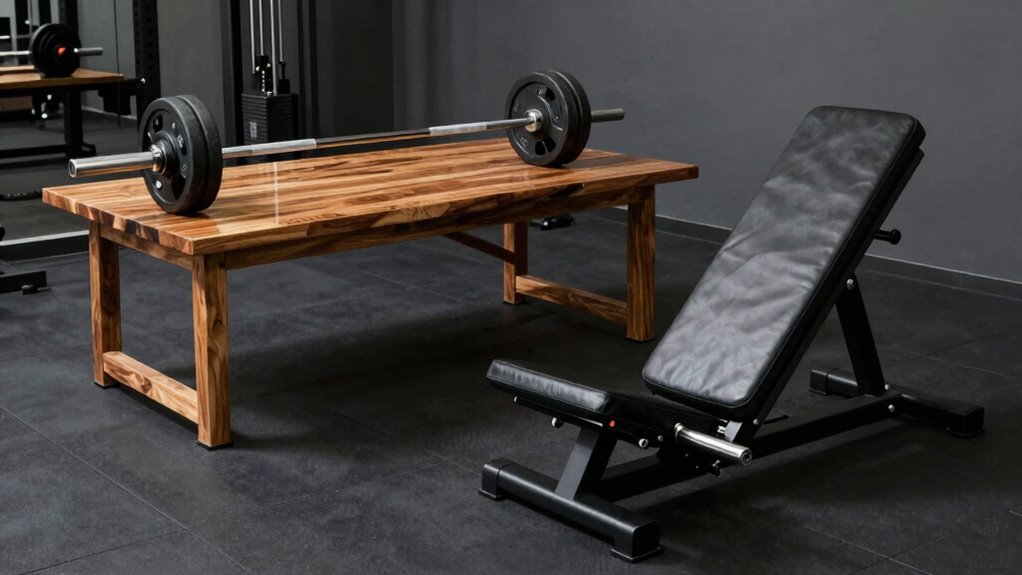
tabletop weight lifting platform
As an affiliate, we earn on qualifying purchases.
As an affiliate, we earn on qualifying purchases.
Which Press Is Better for Small Studio Spaces?

Sure! Here’s the revised text with the requested changes:
—
When choosing between tabletop and floor presses for a small studio, space considerations play a significant role. The floor press generally requires less room, making it ideal for tight spaces. It’s compact, easy to set up, and leaves more room for other equipment. Additionally, the open road offers endless opportunities for exploration, just like how the tabletop press, while slightly larger, offers greater equipment versatility, allowing you to perform a wider range of exercises. Integrating smart home technology can enhance your workout experience by automating routines and monitoring your performance. Moreover, understanding cookie preferences can help improve your browsing experience while researching equipment. Furthermore, the discussion around Universal Basic Income highlights how emerging technologies could reshape our economic landscape, potentially influencing consumer choices in fitness equipment. Incorporating auditory processing techniques can also enhance your focus and effectiveness during workouts.
Consider these points:
- Floor press maximizes space efficiency
- Tabletop press enhances training variety
- Both options support effective workouts in limited areas
If your goal is to optimize space without sacrificing training options, the floor press might be better. But if you want more exercise options in a slightly larger footprint, the tabletop press offers valuable versatility.
As an affiliate, we earn on qualifying purchases.
Equipment Needed for the Tabletop and Floor Press
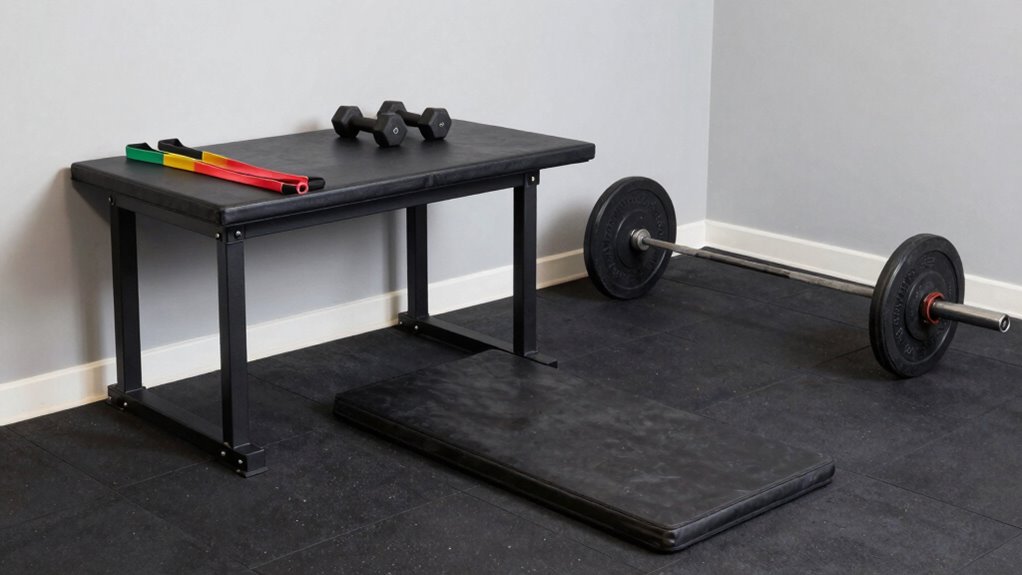
Both the tabletop and floor presses require essential equipment, but the specific items differ based on the setup. For the tabletop press, you’ll need a sturdy surface or platform, adjustable weights, and possibly resistance bands for training modifications. Incorporating innovative content formats can further enhance your training experience. The floor press, on the other hand, needs a flat, stable floor, a barbell or dumbbells, and optional pads for comfort. Utilitarian principles can guide how you choose the weights and intensity for your workouts to maximize effectiveness. Equipment variations allow you to customize your workout intensity and style. Here’s a quick comparison:
| Equipment Type | Tabletop Press | Floor Press |
|---|---|---|
| Surface/Platform | Elevated, stable platform | Flat floor |
| Weights | Adjustable weights, bands | Barbells, dumbbells |
| Comfort/Support | Padding, straps | Padding for elbows and wrists |
Incorporating eco-friendly practices into your equipment choice can enhance sustainability in your workout routine. This setup flexibility helps tailor your workout to your studio’s space and your training modifications.
versatile tabletop workout station
As an affiliate, we earn on qualifying purchases.
As an affiliate, we earn on qualifying purchases.
Safety and Suitability for Beginners: Which Exercise Is Safer?
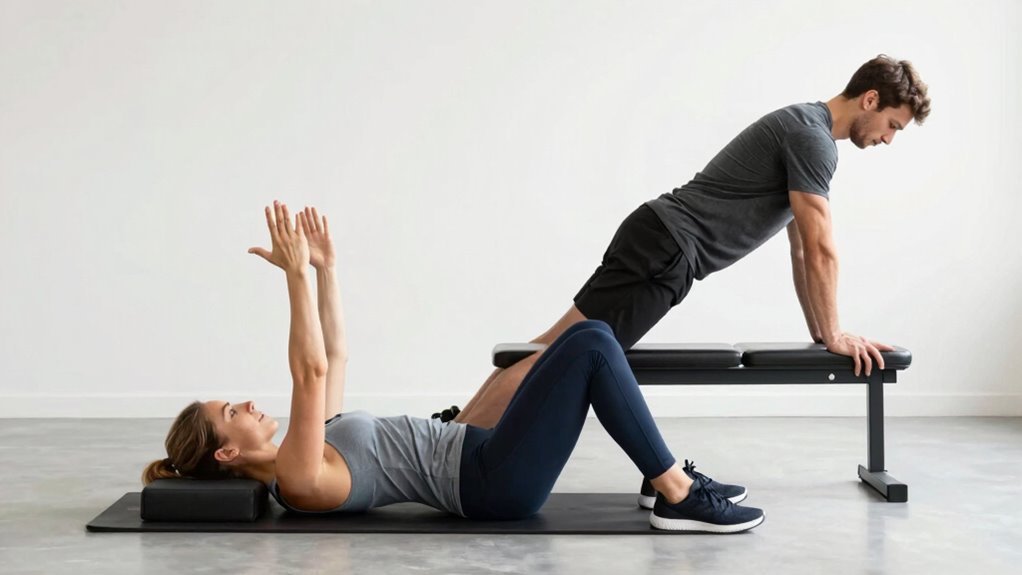
When starting out, safety is key, and you might find that the floor press has a lower risk of injury since it limits your range of motion. The tabletop press can have a steeper learning curve because proper form is more critical to prevent strain. Overall, the exercise that’s safer for beginners depends on your familiarity with weightlifting and comfort level. Additionally, understanding your equipment’s power capacity can help ensure you’re using the right gear for your fitness journey.
Risk of Injury
Is one exercise inherently safer than the other for beginners? Not necessarily, but the risk of injury varies based on technique and setup. The tabletop press tends to be more controlled, reducing shoulder strain, while the floor press limits range of motion, which can prevent overstretching. To minimize injury risks, focus on proper form, start with lighter weights, and incorporate nutrition tips that support workout recovery. Keep these in mind:
- Use correct technique and avoid overloading weights
- Prioritize controlled movements over speed
- Incorporate adequate nutrition to aid recovery and reduce soreness. Additionally, using lightweight foundations can help you maintain a healthy balance in your fitness routine. Remember, engine upgrades can also improve performance, just as proper techniques enhance your lifting. It’s essential to understand best practices for any exercise to ensure safety and effectiveness.
Both exercises carry potential risks if done improperly, so listen to your body and progress gradually. Additionally, understanding traditional techniques in strength training can enhance your overall safety. Engaging in mindfulness practices can also help you maintain focus and reduce the likelihood of injury during workouts. Safe training practices protect you from injury and help you build strength effectively.
Learning Curve
Choosing the safer exercise for beginners depends largely on your familiarity with proper technique and comfort level. The floor press generally has a gentler learning curve because it simplifies movement, requiring less equipment versatility. It limits the range of motion, making it easier to control and less risky for newcomers. The tabletop press, on the other hand, offers more training variety and mimics the traditional bench press more closely, but it demands greater technique and stability, which can be challenging initially. If you’re just starting out, the floor press’s straightforward setup makes it a safer choice. As you gain confidence and technique, exploring the tabletop press can diversify your training. Ultimately, choose the exercise that aligns with your current skill level while progressively building your strength and stability.
Muscle Engagement and Upper Body Strength Gains
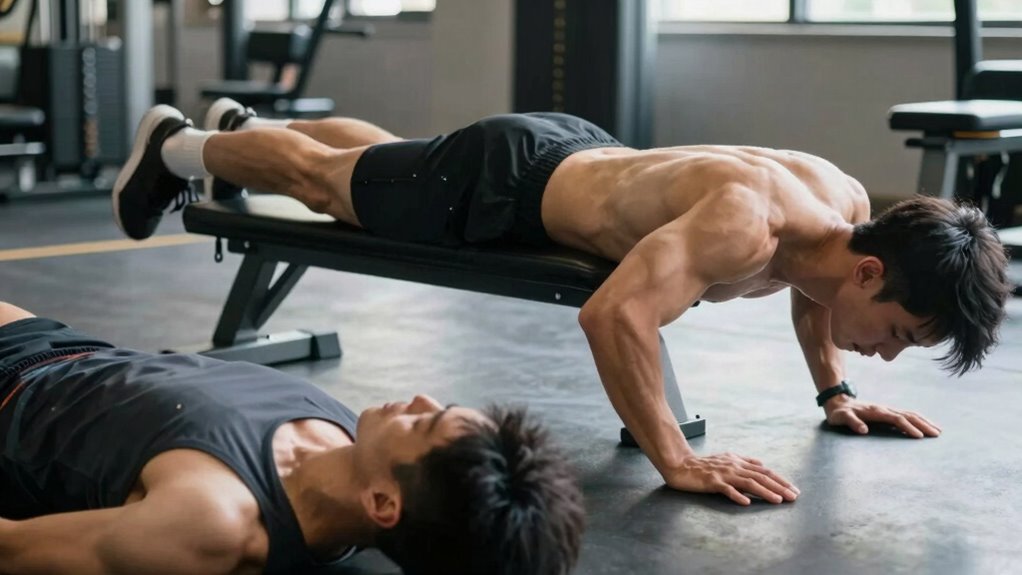
Both the tabletop and floor press target key upper body muscles, but they engage these muscles differently, impacting your strength development. The tabletop allows for a greater range of motion, activating more chest and shoulder muscles, especially with different hand positioning and grip variations. Meanwhile, the floor press limits range but emphasizes triceps and lockout strength. Adjusting hand positioning can shift focus: a wider grip targets the chest more, while a narrower grip emphasizes the triceps. Grip variations, like false or neutral grips, also influence muscle activation, helping you target specific areas or reduce strain. Additionally, understanding user consent management can ensure that you are aware of how your data is used during your training experience. Incorporating GPS trackers can help monitor your training sessions effectively.
To maximize your training results, consider implementing expert recommendations that focus on exercise variations and techniques.
Incorporating effective training techniques can significantly bolster your overall strength outcomes.
- Hand positioning: alters muscle emphasis and joint stress
- Grip variations: change the focus between chest, shoulders, and triceps
- Range of motion: influences muscle activation and strength gains
Additionally, understanding muscle engagement strategies can further enhance your training effectiveness and overall performance.
When to Choose the Tabletop Press Over the Floor Press
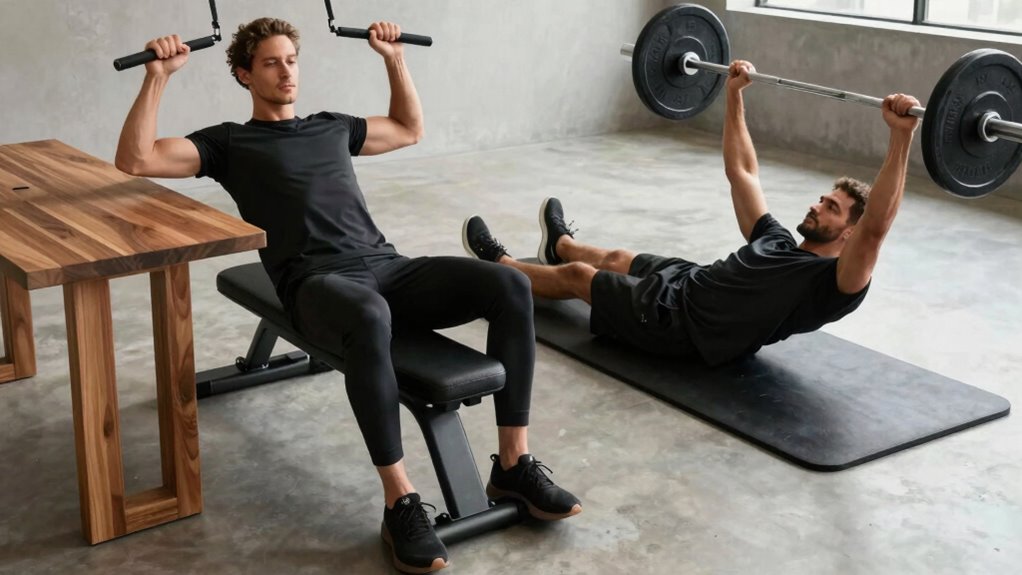
If you’re working with limited space or equipment, the tabletop press might be your best option. It allows for more targeted muscle engagement, especially if you’re focusing on specific upper body muscles. Consider these factors when deciding which press to incorporate into your routine.
Space and Equipment Constraints
Limited space and equipment availability often make the tabletop press the better choice over the floor press. It’s ideal when your studio has limited room for large setups, as it requires less clearance and simpler equipment. The tabletop press offers greater *equipment versatility*, allowing for a variety of exercise variations without needing additional gear. Its compact design fits neatly on a sturdy table or platform, making it perfect for smaller spaces. Additionally, it can be adapted for different angles and grips, expanding your workout options. If your studio struggles with space constraints but still demands diverse workouts, the tabletop press is your go-to. It maximizes functionality while minimizing the footprint, ensuring you get effective training without sacrificing precious space.
Targeted Muscle Engagement
Choosing the tabletop press over the floor press becomes especially advantageous when you want to target specific muscles more effectively. The tabletop setup allows for better control of movement angles, enabling you to isolate muscles like the chest, shoulders, or triceps more precisely. Its appliance compatibility means you can incorporate various attachments or resistance options to enhance focus. Additionally, aesthetic considerations come into play; the tabletop setup often looks cleaner and more organized, aligning with your studio’s visual appeal. This setup also makes adjusting the equipment easier, ensuring proper form and targeted engagement. When your goal is precise muscle activation and a polished look, the tabletop press offers the flexibility and control that the floor press may lack.
Comparing Benefits and Challenges of the Tabletop and Floor Press
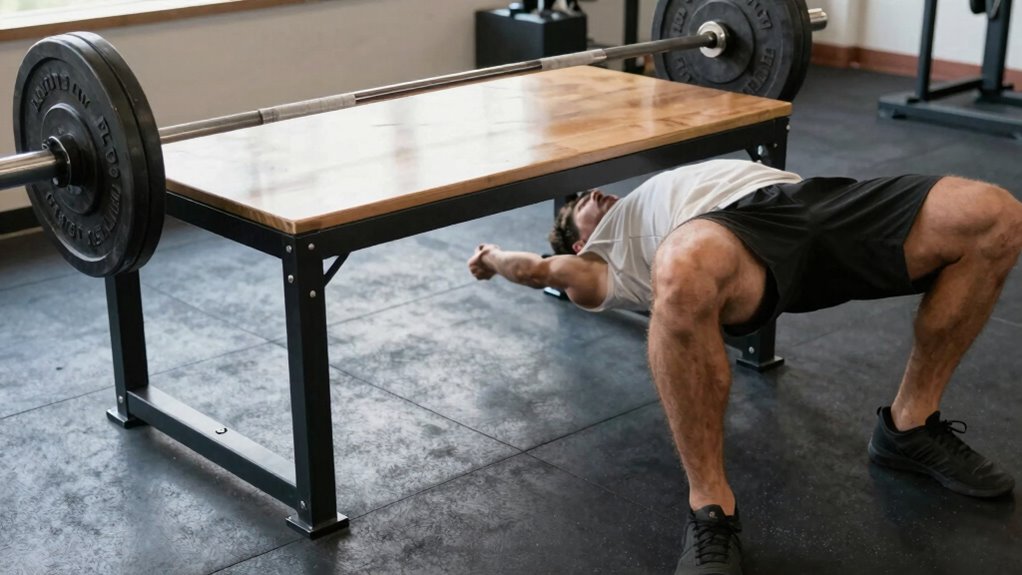
When comparing the tabletop and floor press, it’s important to understand how each exercise offers unique benefits and presents specific challenges. The tabletop press allows for more natural range of motion and easier variations and modifications, making it suitable for different skill levels. Conversely, the floor press limits the range, reducing shoulder strain but also restricting movement. This can be advantageous for athlete-specific adjustments focused on joint safety. Challenges include the need for proper setup and stability, especially in the tabletop press. Benefits include improved control and targeted muscle engagement. For your studio, consider these factors to choose the right tool:
Tabletop and floor presses offer distinct benefits: natural movement versus joint safety and stability. Choose based on your goals and skill level.
- Ease of adjusting resistance
- Suitability for different skill levels
- Impact on joint safety and movement control
How to Decide Which Press Fits Your Training Goals and Studio Setup
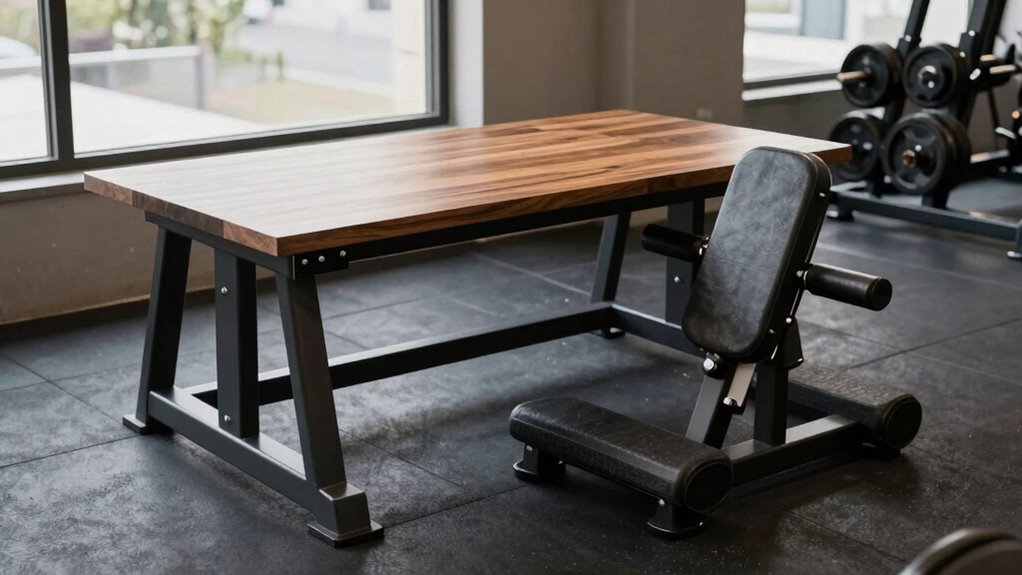
Selecting the right press for your studio depends on aligning its features with your specific training goals and available space. If you want to increase training variety, consider whether a tabletop or floor press offers the diverse movement options you need. For exercise progression, think about how each press allows you to gradually increase load or complexity, helping clients develop strength safely. Floor presses often suit those focusing on raw strength and stability, while tabletop presses can provide more control for beginners or rehab clients. Additionally, evaluate your space constraints—floor presses typically require less room for setup. Ultimately, choose the press that best supports your desired training outcomes and fits seamlessly into your studio environment. Incorporating maintenance & care guides for your equipment can also enhance its longevity and performance.
Frequently Asked Questions
Can Both Presses Be Adapted for Different Fitness Levels?
Yes, both presses can be adapted for different fitness levels. Their equipment versatility allows you to modify weights, range of motion, and repetitions, making them suitable for beginners and advanced users. You can incorporate training progression by gradually increasing resistance or intensity. This flexibility helps you develop strength safely over time, ensuring each individual can work within their capacity while continuously challenging themselves for ongoing improvement.
Are There Any Specific Injuries That Contraindicate Either Press?
Imagine a fragile glass slipping from your grasp—certain injuries make the tabletop or floor press risky. If you have shoulder impingements, rotator cuff issues, or recent chest injuries, these presses could increase injury risk and are contraindicated. You should avoid them or modify your approach. Always consult with a healthcare professional before performing these exercises if you’re dealing with injury or contraindicated conditions, to prevent further harm.
How Do the Presses Affect Shoulder Mobility and Flexibility?
Both presses can improve shoulder stability and joint flexibility when performed correctly. The tabletop press encourages controlled movements, helping you build stability without overstressing your shoulder joints. The floor press limits shoulder mobility slightly but still promotes joint flexibility through controlled range of motion. Regularly practicing either press with proper form helps enhance shoulder stability and maintain healthy joint flexibility, reducing injury risk and supporting overall shoulder health.
What Is the Typical Duration or Number of Sets Recommended?
Think of your workout as a journey where each step builds on the last. Typically, you should aim for 3-4 sets of 8-12 reps, adjusting as you progress in your training. This approach allows for steady training progression while maximizing equipment versatility. As you become stronger, challenge yourself by increasing reps or adding resistance, ensuring your routine remains effective and engaging without overloading your shoulders or compromising form.
Can These Presses Be Incorporated Into a Full-Body Workout Routine?
Yes, you can incorporate both tabletop and floor presses into a full-body workout routine. Their equipment versatility allows you to add exercise variations that target different muscle groups, making your workout more dynamic. Use them for chest, shoulder, and tricep engagement, and pair them with exercises like squats or rows. This approach keeps your routine balanced and effective, ensuring you hit multiple muscle groups in one session.
Conclusion
Choosing between the tabletop and floor press is like picking the right brush for your masterpiece—each offers unique strokes for your fitness canvas. Consider your space, goals, and safety to find the perfect fit. Whether you’re seeking power or stability, understanding these exercises helps you craft a training routine that fits your studio’s rhythm. Ultimately, the right press will be your steady beat, guiding you toward stronger, more confident results.
Fall Picks
fall essentials
As an affiliate, we earn on qualifying purchases.