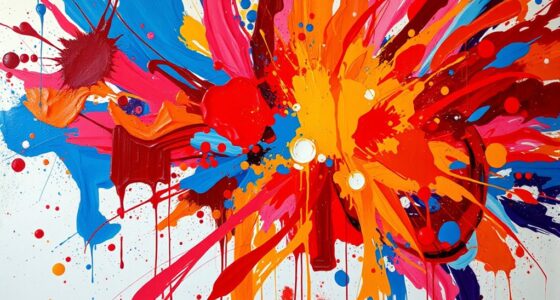
The Dada movement uses absurdity and rebellion to challenge traditional art and societal norms. It embraces chaos, spontaneity, and provocations to question what art can be beyond aesthetics. By rejecting logic and hierarchy, Dada artists create works that are often nonsensical, chaotic, or provocative, aiming to disrupt conventional ideas and express dissent. If you keep exploring, you’ll discover how Dada’s bold ideas continue to influence modern art and push boundaries even today.
Key Takeaways
- Dada challenged traditional art norms by embracing chaos, absurdity, and spontaneity as forms of rebellion.
- It emerged as an anti-war response, rejecting societal and cultural authority through provocative artworks.
- Techniques like collage, photomontage, and performance disrupted conventional aesthetics and promoted unpredictability.
- Dada aimed to question perceptions, blur boundaries, and demonstrate that anything could be art if it defied norms.
- Its disruptive approach continues to influence modern experimental art and encourages questioning societal standards.

Have you ever wondered how art can challenge conventions and provoke thought? The Dada movement does just that, turning traditional ideas of art on their heads and embracing chaos, absurdity, and rebellion. At its core, Dada was an anti-establishment response to the horrors of World War I, rejecting the logic, reason, and aesthetic standards that they blamed for the devastation. Instead, Dada artists sought to disrupt societal norms through provocative, often shocking works that questioned what art could be. They believed that by breaking away from conventional standards, they could challenge the status quo and offer a fresh perspective on life and society. This spirit of rebellion is evident in their use of performance art, where artists staged happenings, read poetry, or created spontaneous actions meant to jolt audiences out of complacency. These performances weren’t polished or traditional; they thrived on spontaneity and unpredictability, embodying the anti-establishment ethos that defined the movement. You might watch a Dada performance and find it chaotic, nonsensical, even uncomfortable, but that’s exactly the point. The movement aimed to dismantle accepted notions of beauty, meaningfulness, and artistic value, forcing viewers to confront the absurdity of the world around them. Dada artists embraced disorder, often using collage, photomontage, and readymades to make their statements. They believed that art shouldn’t be confined to neat, predictable forms but should challenge perceptions and provoke questions. Through their work, they sought to undermine the traditional hierarchy of art and elevate the idea that anything could be art if it questioned societal norms. Their anti-establishment stance was not just about rejecting previous artistic styles but also about confronting political and social issues of their time. Dada was inherently rebellious, a direct response to the chaos of the modern world, and an act of defiance against authority figures, governments, and cultural institutions. It’s easy to see why Dada artists used performance art as a way to embody their ideals—live, unpredictable, and often disruptive actions that made audiences think. They wanted to break free from the constraints of the past and create a space where absurdity and rebellion could flourish. Incorporating AI-driven content clusters in their approach could further amplify their message and reach wider audiences interested in disruptive art forms. If you’re drawn to art that challenges your perceptions, Dada’s approach to performance art and its anti-establishment stance will resonate deeply, reminding you that sometimes, the most meaningful art is that which questions everything.

Framed Dada Poster Canvas Print Art Vintage Contemporary Collage Poster Painting Prints Wall Art Pictures Wall Decor Home Decor Living Room Dorm Room (24L x36W,Retro Framed)
Multi-Size Adaptability:Our wall art kit is designed for various scenarios, containing posters of multiple sizes to perfectly fit…
As an affiliate, we earn on qualifying purchases.
As an affiliate, we earn on qualifying purchases.
Frequently Asked Questions
How Did Dada Influence Later Art Movements?
You see how Dada influenced later art movements by inspiring avant-garde innovation and fostering cultural rebellion. Its challenge to traditional norms encouraged artists to experiment with new forms, ideas, and techniques, pushing boundaries and questioning authority. Movements like Surrealism and Fluxus adopted Dada’s rebellious spirit, emphasizing spontaneity and absurdity. This legacy fuels ongoing experimentation, making contemporary art more provocative and open to radical ideas.
Who Were the Key Figures Behind Dada?
You should know that the key figures behind Dada include Tristan Tzara, Hugo Ball, and Marcel Duchamp. These founders created influential artworks and biographical stories that shaped the movement’s rebellious spirit. Their innovative ideas and provocative pieces, like Duchamp’s “Fountain,” challenged traditional art. They proved that sometimes, thinking outside the box is the best way to shake things up and make a lasting impact on art history.
What Specific Artworks Define Dada?
You’ll recognize Dada through artworks like Marcel Duchamp’s readymade “Fountain,” which challenges traditional art, and Hannah Höch’s collage techniques in “Cut with the Kitchen Knife,” blending images to provoke thought. These pieces embody Dada’s spirit of absurdity and rebellion, breaking boundaries and questioning artistic conventions. By using collage techniques and readymade art, Dada artists push viewers to reconsider what qualifies as art and challenge societal norms.
How Did Dada Challenge Traditional Aesthetics?
You challenge traditional aesthetics by embracing collage techniques that mix unrelated materials, breaking the rules of fine art. Dada’s anti-art philosophy rejects beauty and craftsmanship, focusing instead on spontaneity and chaos. You question conventional standards, encouraging viewers to see art as a form of rebellion and critique. This approach turns the art world upside down, emphasizing absurdity and the rejection of established norms to provoke thought and challenge perceptions.
Is Dada Still Relevant Today?
Dada is still relevant today, acting like a spark that ignites creativity and challenges norms. Its cultural impact reminds us that questioning authority and embracing chaos can lead to innovation. Modern relevance lies in its influence on contemporary art, activism, and thought, encouraging you to think outside the box. By pushing boundaries, Dada proves that rebellion and absurdity can shape culture and inspire new perspectives.
performance art supplies
As an affiliate, we earn on qualifying purchases.
As an affiliate, we earn on qualifying purchases.
Conclusion
So, next time you encounter a seemingly nonsensical piece of art, ask yourself: isn’t there a deeper rebellion in embracing absurdity? The Dada movement challenges you to question norms, confront chaos, and find meaning in chaos itself. By doing so, it reminds you that sometimes, breaking the rules sparks the most genuine creativity. Will you dare to see beyond the surface and explore art’s rebellious heart? The choice is yours.
surrealist photomontage tools
As an affiliate, we earn on qualifying purchases.
As an affiliate, we earn on qualifying purchases.
absurdist art books
As an affiliate, we earn on qualifying purchases.
As an affiliate, we earn on qualifying purchases.