TL;DR

Get art and craft supplies delivered free with Prime
- Fast, free delivery on millions of items
- Prime Video, Amazon Music and more included
- Member-only deals all year
Gemini G.E.L., the Los Angeles print workshop founded in 1966, is marking its 60th anniversary with an exhibition drawn from its archives. Curated by Susan Dackerman and Helen Molesworth, the show examines the workshop as a place for artist dialogue and experimentation, including works that stretch the definition of a print.
Los Angeles print workshop Gemini G.E.L. is marking its 60th anniversary with (Almost) Every Year: Sixty Years of Printmaking at Gemini G.E.L., an exhibition drawn from its archives and curated by Susan Dackerman and Helen Molesworth. The show traces work made at Gemini since its 1966 founding and focuses on how artists used the workshop to exchange ideas and experiment beyond their familiar approaches.
Founders Sydney B. Felsen and Stanley Grinstein established Gemini G.E.L. in 1966. The anniversary exhibition brings together work from across its history, with a chronology that begins with artists including Josef Albers, Man Ray, Robert Rauschenberg, Jasper Johns, Claes Oldenburg, Frank Stella and Ellsworth Kelly. It also highlights artists associated with Los Angeles, among them David Hockney, Ed Ruscha, Ron Davis and Bruce Nauman.
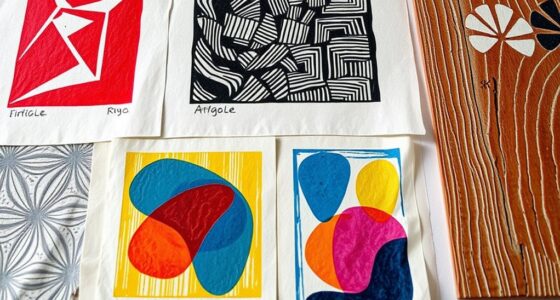
The exhibition groups artists through shared formal interests: Stella and Kelly’s explorations of shape and color, Rauschenberg and Johns’s use of found-object imagery, and works by Toba Khedoori, Julie Mehretu and Analia Saban that investigate linear patterns. Other pairings show artists departing from familiar styles. Joel Shapiro and Richard Tuttle, known primarily for minimalist sculpture, made screenprinted geometric abstractions with exuberant colors and complex arrangements.
Some examples challenge the usual idea of a print as an image on paper. Oldenburg’s Profile Airflow (1969) uses molded polyurethane to create a relief over a two-color lithograph. Johns printed a lightbulb image on lead, while Edward and Nancy Kienholz made sculptures from gasoline containers, giving them the appearance of television sets. In a more recent work, Allen Ruppersberg printed across a 20-foot-long perforated piano-player roll and divided it into four sections.
How Gemini Expanded Printmaking
The anniversary show presents printmaking not just as a way to reproduce images but as a setting for artists to test materials and methods. The works range from lithographs and screenprints to reliefs and objects made with lead, polyurethane and repurposed containers. That range helps explain why the workshop’s history matters beyond a list of prominent names: it documents how artists used collaboration and specialized production to make work they might not have made in their usual studios.
The exhibition also offers a view of changes in Gemini’s artist roster. Women began working at the workshop in the 1980s, with Dorothea Rockburne and Vija Celmins among the early participants, followed by Susan Rothenberg and Elizabeth Murray. According to the source report, the curators said during a gallery talk that the current roster is notable for its gender equality. The exhibition places that development within the institution’s longer history, rather than presenting its archive as a fixed canon.
Popular right now

Breville Bambino Espresso Machine, Brushed Stainless Steel

KitchenAid Artisan 5-Quart Tilt-Head Stand Mixer, KSM150PS, Almond Cream

Dyson V8 Cyclone Cordless Vacuum
As an affiliate, we earn on qualifying purchases.
Six Decades in the Gemini Archive
Gemini opened in Los Angeles in 1966, at a time when the city’s art community was growing and major artists from elsewhere were also working with the workshop. The exhibition’s early years include established figures from New York alongside Los Angeles artists, showing that Gemini’s program connected local practice with a wider art world. Its title, (Almost) Every Year, signals a chronological survey that covers nearly every year of the workshop’s history, rather than claiming a complete record.
The exhibition also follows experimentation across generations. Oldenburg’s molded relief dates to 1969; Bruce Nauman’s one-color lithograph Pay Attention is from 1973; and the Kienholzes’ The Econo-Can, made with a Fresnel lens system, dates to 1977. The source report also discusses Ruppersberg’s piano-roll work and a 2013 piece titled Great Speckled Bird, which uses song lyrics handwritten on vintage motel stationery to evoke classic Americana.
What the Exhibition Leaves Open
The source report does not give the exhibition’s opening and closing dates, admission details or a complete checklist of works. It also does not specify how many artists or objects are included, or provide further detail about the workshop’s present-day operations. The exhibition title indicates that it covers almost every year, but the report does not identify which years are absent or explain why.
The Anniversary Show in Los Angeles
The immediate development is the presentation of (Almost) Every Year: Sixty Years of Printmaking at Gemini G.E.L., with the archive serving as the basis for a historical and thematic survey. Readers seeking practical information about visiting, including dates and access details, will need to consult Gemini G.E.L.’s current exhibition information; those details were not included in the source report.
The show’s account of Gemini’s history will also be read through the works themselves: from early lithographs and screenprints to objects that complicate the boundary between print and sculpture. The source report does not describe any additional anniversary programming or announce what the workshop plans after the exhibition.
Key Questions
What is Gemini G.E.L.?
Gemini G.E.L. is a Los Angeles print workshop founded in 1966 by Sydney B. Felsen and Stanley Grinstein. Artists have worked there across a range of printmaking methods and materials.
What is the 60th-anniversary exhibition about?
(Almost) Every Year: Sixty Years of Printmaking at Gemini G.E.L. draws on the workshop’s archives to survey its history. Curators Susan Dackerman and Helen Molesworth focus on artist dialogue and experimentation.
Which artists appear in the exhibition?
The source report names artists including Josef Albers, Man Ray, Robert Rauschenberg, Jasper Johns, Claes Oldenburg, Frank Stella, Ellsworth Kelly, David Hockney, Ed Ruscha and Bruce Nauman, alongside later artists such as Vija Celmins, Julie Mehretu and Analia Saban.
How does the exhibition stretch the definition of a print?
It includes works made with materials and formats beyond a conventional image on paper. Examples in the report include Oldenburg’s molded polyurethane relief, Johns’s lightbulb image printed on lead, and Allen Ruppersberg’s screenprint on a 20-foot piano-player roll.
When can visitors see the exhibition?
The source report does not provide opening or closing dates, admission details or visiting hours. Check Gemini G.E.L.’s current exhibition information for practical details.
Source: rss