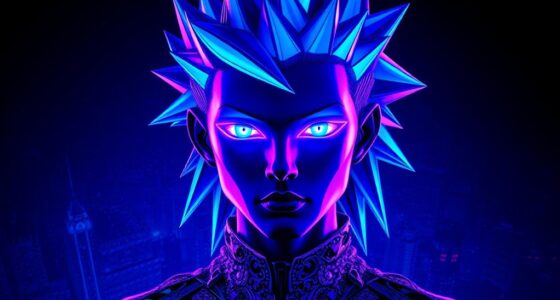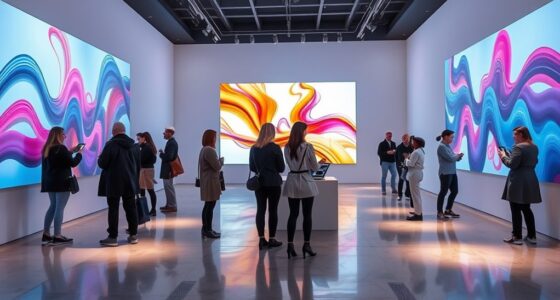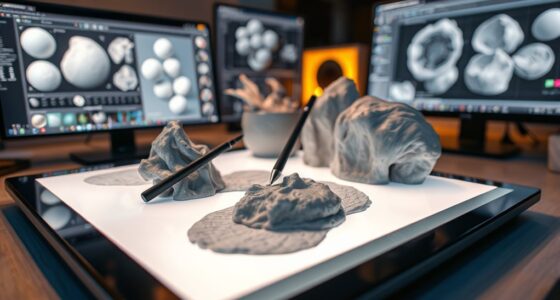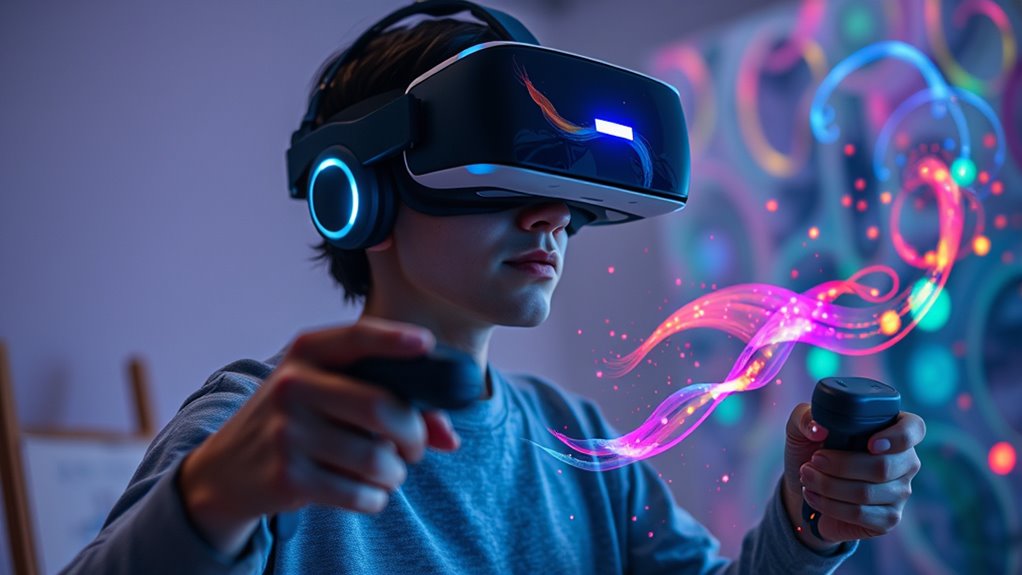

Virtual reality painting lets you create art in a fully immersive 3D environment, giving you the freedom to move around and explore your work from different angles. You can use digital brushes, textures, and colors, mimicking real-world techniques with intuitive gestures. Advanced hardware like high-resolution headsets, motion controllers, and haptic gloves enhance your experience, making it feel natural and engaging. If you want to discover more about this innovative art form, keep exploring how VR transforms creativity.
Key Takeaways
- VR painting immerses artists in a 3D digital environment, allowing creation beyond traditional flat canvases.
- Digital tools like brushes and textures mimic real-world techniques for natural artistic expression.
- Advanced hardware such as high-resolution headsets and haptic gloves enhance realism and tactile feedback.
- Artists can navigate and view artwork from multiple angles, adjusting perspective and depth interactively.
- Multi-user virtual spaces enable collaborative art-making across different locations, expanding creative possibilities.

Virtual reality painting transforms the way you create art by immersing you in a digital environment where imagination takes shape in three dimensions. With VR, you’re no longer confined to a flat canvas or a two-dimensional screen. Instead, you step into a boundless space where your ideas can flourish in a fully immersive environment. This shift hinges on innovative immersive techniques that allow you to interact with digital brushes, textures, and colors naturally, almost as if you’re working with physical materials. The key lies in hardware innovations that make this experience seamless and intuitive. Advanced VR headsets with high-resolution displays and wide fields of view deliver crisp visuals, while motion controllers track your hand movements with precision, translating your gestures into digital strokes instantly. These hardware improvements eliminate lag and enhance realism, making your creative process feel fluid and organic.
As you put on your VR headset, you’re transported to a 3D studio without walls or limits. The immersive techniques employed in VR painting enable you to navigate around your artwork, adjusting perspective and scale effortlessly. You can reach out in space, grab colors, and manipulate shapes in a natural way that mimics real-world painting. The technology empowers you to experiment freely, seeing your work from different angles and depths, which is difficult to achieve with traditional tools. Hardware innovations like haptic feedback gloves further deepen this connection, allowing you to feel textures and resistance, adding a tactile dimension to your digital creations. This sensory input makes the experience more engaging and helps you develop a better understanding of spatial relationships within your art. Additionally, these hardware innovations are designed to reduce fatigue and increase comfort, so you can spend hours immersed in your work without strain. Lightweight headsets and ergonomic controllers mean you don’t have to compromise on comfort to access this new domain of creativity. The combination of immersive techniques and hardware advancements also opens the door for collaborative art sessions, where multiple artists can share the same virtual space, each interacting with the artwork from different locations. This interconnected environment pushes the boundaries of traditional art, fostering new forms of expression.
VR painting headset
As an affiliate, we earn on qualifying purchases.
As an affiliate, we earn on qualifying purchases.
Frequently Asked Questions
What Equipment Is Necessary for Virtual Reality Painting?
To get started with virtual reality painting, you’ll need a VR headset setup, like Oculus Quest or HTC Vive, and compatible controllers. Make sure to calibrate your motion controllers properly for accurate movement. You also need a powerful computer or console to run the software smoothly. Comfortable, well-fitting equipment guarantees you can focus on your art without distractions, making your creative experience seamless and immersive.
How Long Does It Take to Master VR Painting Techniques?
Mastering VR painting techniques varies, but you’ll typically see noticeable skill progression within a few months with consistent practice. The time investment depends on your dedication and previous art experience, but regular sessions help you develop confidence and refine your skills faster. Keep experimenting and learning, and you’ll find yourself creating more complex and impressive 3D artworks as your proficiency grows. Patience and persistence are key to mastering virtual reality painting.
Can VR Artwork Be Printed or Displayed Physically?
Yes, your VR artwork can be physically displayed or printed. You’ll need to export your digital file in a compatible format like OBJ or STL for print compatibility. Once printed, your 3D artwork can be showcased in galleries or as custom pieces. Keep in mind, the quality of the physical display depends on the resolution and details of your VR creation, so optimize your design accordingly.
What Are Common Challenges Faced by Beginners in VR Art?
You’ll stumble over the steep learning curve and struggle with spatial awareness, as if your hands suddenly forgot how to find their way in 3D space. Beginners often find it tricky to maintain control, avoid immersion chaos, or judge depth accurately. It’s like trying to paint in the dark—until you get the hang of it, expect lots of accidental brush strokes and a few hilarious missteps.
How Does VR Painting Influence Traditional Art Skills Development?
VR painting boosts your traditional art skills by enhancing digital skills and expanding creativity. As you explore 3D space, you develop better spatial awareness and technical control, which translate to physical mediums. The immersive environment encourages experimentation and visual thinking, helping you push boundaries. This digital skill enhancement and creativity expansion make your overall artistic abilities more versatile and innovative, complementing and enriching your traditional art practice.
high resolution VR headset for artists
As an affiliate, we earn on qualifying purchases.
As an affiliate, we earn on qualifying purchases.
Conclusion
As you step back into your virtual studio, you realize you’ve just unbarred a new universe where your imagination paints itself across three-dimensional canvases. Virtual reality turns your fingertips into wizard wands, conjuring vibrant worlds that dance beyond the limits of traditional art. With each stroke, you’re not just creating; you’re exploring a boundless cosmos of creativity. Embrace this digital frontier, where your art becomes a living, breathing universe waiting for you to shape it.
VR motion controllers for painting
As an affiliate, we earn on qualifying purchases.
As an affiliate, we earn on qualifying purchases.
haptic gloves for virtual reality
As an affiliate, we earn on qualifying purchases.
As an affiliate, we earn on qualifying purchases.