
TL;DR

Get art and craft supplies delivered free with Prime
- Fast, free delivery on millions of items
- Prime Video, Amazon Music and more included
- Member-only deals all year
A Colossal report published in October 2026 spotlights Timothy Boomer’s close-up photographs of insect galls, small plant growths that provide food and shelter for developing wasp larvae. Boomer says he uses focus stacking to bring the tiny structures into view and edits minimally; the report does not identify a new scientific finding or exhibition.
Nature photographer Timothy Boomer is drawing attention to the varied shapes of insect galls in a report published by Colossal in October 2026. The images show growths induced by cynipid wasps on oak leaves and branches in California, while Boomer describes how he photographs these small structures without substantially altering their appearance.
Galls are growths on plants that can be induced by insects and other organisms. In the examples discussed by Colossal, cynipid wasp larvae trigger growths on host plants. The gall serves as both a protected space and a food source for the developing insect, according to the report. The structures can be tiny, occur in clusters and vary in color and shape.
The photographs include an urchin gall on blue oak, red cone galls on a valley oak leaf, a beaked twig gall and a close-up of a disc gall’s surface. The report places several of the images in Solano and Napa counties, California. It also features an atypical spined turban gall, which Boomer says had darkened tips and more spikes than the form he usually sees.
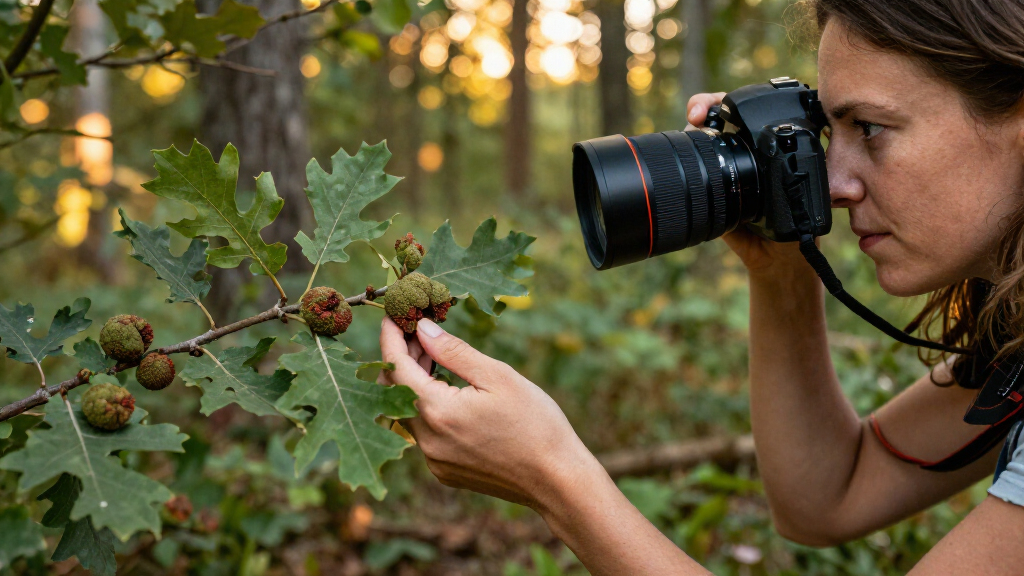
To photograph such small subjects with a shallow depth of field, Boomer uses focus stacking: taking many images at different focus points and combining them digitally. He told Colossal that the process can involve hundreds or sometimes thousands of photographs. The report says he makes minimal edits in Photoshop and aims to show forms that occur naturally.
Making Tiny Plant Galls Visible
Boomer’s images bring small plant structures into view and show how a gall can function as an insect’s food and shelter. The photographs document variation in gall forms and illustrate the relationship between wasps and host plants.
The report also describes the photographic method. Focus stacking combines images taken at different focus points to show detail across a subject that may not be clear in a single shallow-focus image. Boomer says he edits the photographs minimally. The article is an arts and nature report, not a new scientific study.
Popular right now

Sony BRAVIA 5 85-Inch Mini LED 4K HDR Smart TV (K-85XR50)

TCL QM64L 85-Inch QD-Mini LED 4K Smart Fire TV

Shark Rocket Ultra-Light Corded Stick Vacuum, HV301, Gray/Orange
As an affiliate, we earn on qualifying purchases.
How Wasps Shape Their Host Plants
According to the Colossal report, chemicals introduced by developing larvae prompt the host plant to form a gall. The growth can provide resources and a degree of protection while the larva develops; the adult insect then emerges and continues its life cycle. The specific appearance depends on the insect and where on the plant the gall forms.
The report says scientists believe there are at least around 1,300 cynipid species globally. It describes examples associated with different wasps and oak species, including galls on valley oak and blue oak in California. These details provide context for Boomer’s photographs, but the report does not present a census or new research on gall diversity.
““Galls can be brought about by many different organisms, but I tend to focus on the ones induced by cynipid wasps because they are the most visually stunning (at least in my opinion).””
— Timothy Boomer, speaking to Colossal
What the Gall Images Cannot Establish
The report does not provide independent scientific analysis of the photographed specimens. Boomer’s explanation for the atypical spined turban gall is his own account, and he says he is not a scientist; the precise cause and biological process behind that specimen are not established in the material provided. The report also does not give a full image-by-image account of how each gall developed or identify any new findings arising from the photographs.
It is also unclear whether Boomer plans a book, exhibition or other project featuring the work. Colossal points readers to his Instagram account, where it says he also shares photographs of slime molds and flowers.
Where to See Boomer’s Work
Readers can view the featured photographs and the full interview in Colossal’s October 2026 report, or find Boomer’s work on Instagram, as the publication directs. No further announcement, exhibition date or scientific release is mentioned in the source material, so the next step is continued access to the existing photographs rather than a confirmed upcoming event.
Key Questions
What are insect galls?
Galls are growths on plants that can be induced by insects and other organisms. In the wasp examples covered by Colossal, a gall provides a developing larva with food and shelter.
How does Timothy Boomer photograph such small galls?
Boomer uses focus stacking, combining images taken at different focus points. He told Colossal that a photograph can involve hundreds or sometimes thousands of exposures.
Where were the featured galls photographed?
The report identifies locations in Solano and Napa counties, California, including sites near Vacaville and Lake Berryessa. Several images show galls on blue oak or valley oak.
Is the unusual spined turban gall explained scientifically?
Not in the report. Boomer suggests a non-inducing organism entered the gall early in its development, but he presents this as his interpretation and says he is not a scientist.
Where can readers see more of Boomer’s photography?
Colossal directs readers to Boomer’s Instagram account, where it says he also shares images of slime molds and flowers.
Source: thisiscolossal.com