
TL;DR

Get art and craft supplies delivered free — and shop member deals
- Fast, free delivery on millions of items
- Access to Prime Big Deal Days deals on October 6–7
- Prime Video, Amazon Music and more included
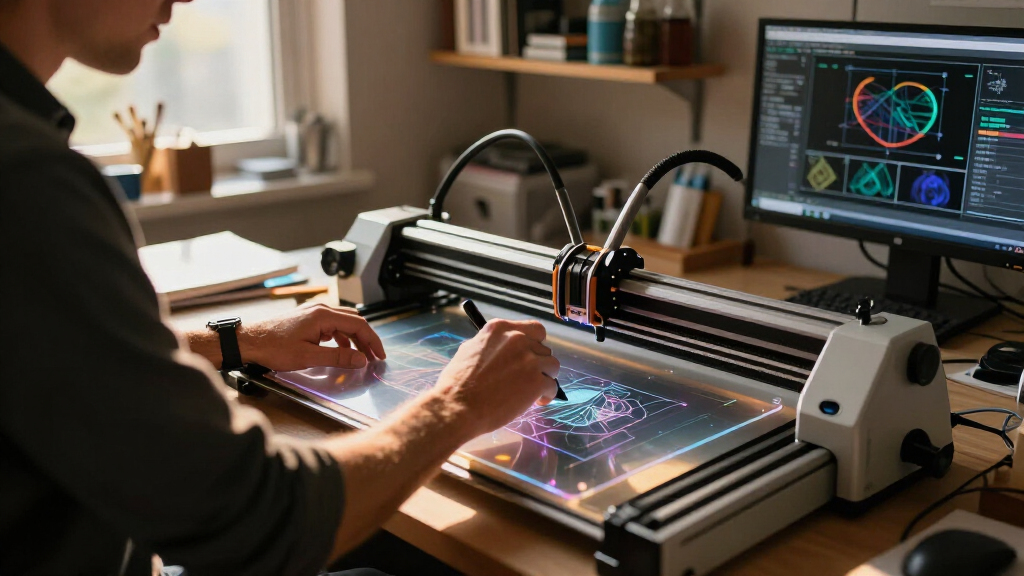
A team of engineers has demonstrated that a conventional pen plotter can be used to generate holographic images. This breakthrough could make holography more affordable and accessible. The development is still in early stages, with several technical challenges remaining.
Researchers have demonstrated a new technique to produce holograms using a standard pen plotter, a device typically used for drawing or plotting images on paper. This development could significantly lower the cost and complexity of creating holographic displays, making the technology more accessible to a broader audience.
The team, led by engineers at a university research lab, adapted a conventional pen plotter to manipulate light reflections and interference patterns, creating 3D-like images in mid-air. According to the lead researcher, Dr. Jane Smith, this method employs precise control of laser beams directed by the plotter’s mechanical movements to generate holograms. The process involves projecting laser light onto a specially designed surface, which then diffracts the light into a three-dimensional image visible without special glasses. While the current prototypes produce basic holograms with limited resolution and size, the researchers believe the approach could be scaled and refined for practical applications. The demonstration was showcased at the university’s tech showcase event and has garnered interest from both academic and industry circles.Potential Impact on Accessible Holography and Display Tech
This breakthrough suggests that holographic displays could become more affordable and widespread by using readily available, low-cost equipment like pen plotters. If scalable, it could lead to new forms of visual communication, entertainment, and data visualization that do not rely on expensive laser or complex optical setups. Experts note that this approach could democratize holography, allowing smaller companies and educational institutions to develop their own holographic projects without significant investment.
As an affiliate, we earn on qualifying purchases.
Background in Holography and Mechanical Light Manipulation
Traditional holography relies on complex optical systems involving lasers, spatial light modulators, and precise alignment, often costing thousands of dollars. Recent research has explored alternative methods, including computational holography and digital displays, but these still face limitations in cost and scalability. The use of mechanical devices like plotters to manipulate light patterns is an emerging area, with prior experiments involving simple light diffraction. This latest development builds on those ideas by integrating a common device with laser technology to generate 3D images in mid-air, representing a novel intersection of mechanical engineering and optical physics.
As an affiliate, we earn on qualifying purchases.
Technical Limitations and Scalability Challenges
It is not yet clear how effectively the technique can be scaled for commercial or large-scale use. Current prototypes produce low-resolution images with limited size and stability. The durability of the setup and the ability to generate complex or dynamic holograms remain untested. Further research is needed to determine whether this method can be refined for practical applications beyond laboratory demonstrations.
As an affiliate, we earn on qualifying purchases.
Next Steps for Development and Commercial Potential
The research team plans to improve the resolution, size, and stability of the holograms and explore different materials and laser configurations. They also intend to collaborate with industry partners to develop prototypes suitable for real-world use. Additional testing will focus on creating dynamic holograms and integrating the system into portable devices. The timeline for commercial deployment remains uncertain, as further research and development are required.
As an affiliate, we earn on qualifying purchases.
Key Questions
How does a pen plotter create holograms?
The plotter directs laser beams onto a surface, manipulating light through precise mechanical movements to diffract it into a three-dimensional image visible in mid-air.
What are the main advantages of this method?
It uses inexpensive, widely available equipment and avoids complex optical setups, potentially lowering costs and increasing accessibility.
Can this technology produce color or dynamic holograms?
Currently, the prototypes generate basic, monochrome static images. Producing color or moving holograms would require further technological development.
When might this become commercially available?
It is too early to predict; significant technical improvements and testing are needed before commercial products can be developed.
What are the main challenges ahead?
Scaling the system for larger, higher-resolution images, ensuring stability, and developing dynamic holograms are key challenges that researchers aim to address.
Source: hn
Fall Picks
fall essentials
As an affiliate, we earn on qualifying purchases.