
TL;DR

Get art and craft supplies delivered free with Prime
- Fast, free delivery on millions of items
- Prime Video, Amazon Music and more included
- Member-only deals all year
Prebuilt AI workstations now often match or beat DIY builds on price, thanks to component shortages and bulk buying. The real choice depends on your need for immediate use, customization, and support, not just cost.
If you’re eyeing an AI workstation, you’re probably wondering: should I build it myself or buy a prebuilt? The usual answer used to be simple — DIY was cheaper, and prebuilts saved time. But today, that’s no longer the case. The AI boom, component shortages, and bulk buying have flipped the script.
Now, the decision is more nuanced. It’s about how much you value immediate productivity, tailored performance, and support. In this article, we’ll compare the real costs, benefits, and tradeoffs of building versus buying a high-powered AI workstation in 2026, so you can make a choice that fits your goals and budget.
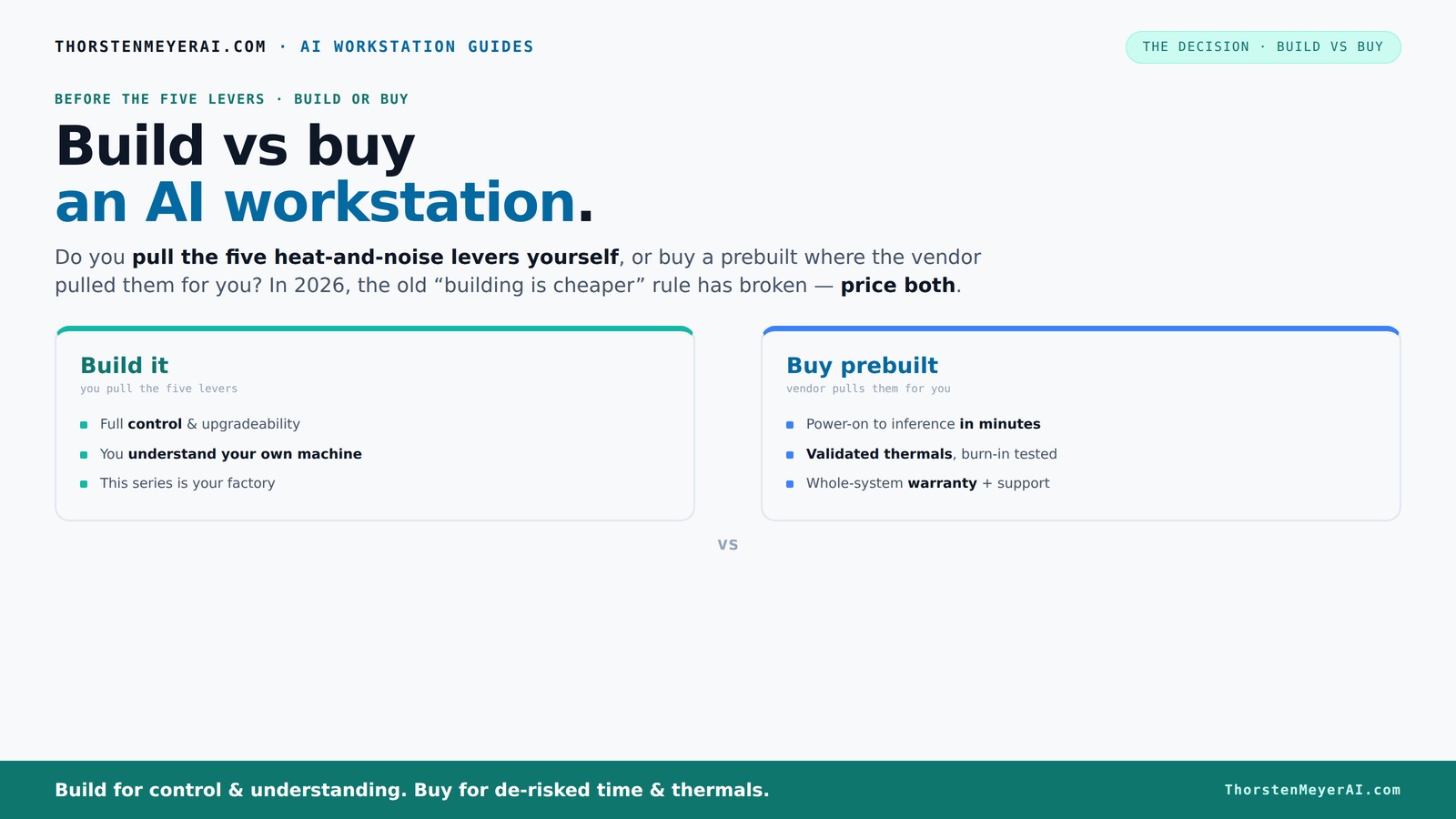
Build vs buy
an AI workstation.
The real question behind this whole series: do you pull the five heat-and-noise levers yourself, or buy a prebuilt where the vendor pulled them for you? And in 2026, the old “building is cheaper” rule has broken. Match your situation in Part 3.
Key Takeaways
- Component shortages and bulk buying in 2026 often make prebuilts cheaper or on par with DIY builds, especially for high-end AI workstations.
- Support, validated thermals, and warranties are clear advantages of buying prebuilt, reducing risk during intensive training.
- Building offers maximum control over noise, heat, and upgradeability, but demands time, patience, and technical skill.
- Always compare specific parts and total costs—assembling your own might not save money if you factor in your time and troubleshooting.
- Focus on GPU VRAM, CPU, and power supply quality to optimize AI workload performance, whether building or buying.
high performance AI workstation prebuilt
As an affiliate, we earn on qualifying purchases.
As an affiliate, we earn on qualifying purchases.
Why 2026 Changes Everything for Your AI Workstation Choice
Building your own AI workstation isn’t automatically cheaper anymore. Due to global chip shortages and high demand, parts like GPUs, DDR5 RAM, and SSDs have skyrocketed in price. A build that used to cost under $1,000 can now push past $1,250, even before factoring in labor or time.
Big vendors bought components in bulk before prices spiked, which is discussed in detail at Build vs Buy a Prebuilt AI Workstation. That means they can offer systems at prices that are tough to beat if you’re piecing it together yourself today. The old rule — DIY saves money — no longer holds true in 2026. Instead, your choice hinges on other factors: speed, support, and how much control you want over every detail.
This shift means that, for many, the decision to build or buy is less about initial cost and more about overall value, including support, reliability, and how quickly you can get your workstation up and running. The tradeoff is clear: building offers customization but often at the expense of time and potential troubleshooting, while prebuilts deliver ready-to-go systems with tested stability, which can be crucial under tight deadlines or demanding workloads.
customizable AI workstation build kit
As an affiliate, we earn on qualifying purchases.
As an affiliate, we earn on qualifying purchases.
The Five Levers of a High-Performance AI Workstation (And Who Pulls Them)
A machine’s heat and noise levels depend on five key levers: undervolting the GPU, matching the cooling system, optimizing airflow, tuning fans, and strategic placement.
When you buy prebuilt, the vendor pulls these levers for you — validating thermals, tuning fans, testing under load, and often adding water-cooling for quieter operation. For example, BIZON systems advertise "up to 30% lower noise and temperature" right out of the box.
If you build, you control these levers yourself. You choose a quiet GPU, install a cooler, optimize airflow — maybe even add water-cooling — to tune it perfectly to your workspace. This gives you the power to customize for your specific AI workload and environment, but it requires expertise and effort.
Understanding these thermal management strategies is vital because heat and noise directly impact your system’s performance, longevity, and your working environment. A poorly cooled system can throttle performance or fail prematurely, while a noisy setup can be distracting in a shared workspace. You can learn more about thermal management at thisdesigngirl.com. The tradeoff lies in the time and knowledge needed to optimize these factors versus the convenience of a pre-tuned system that’s ready to perform without additional tuning.
As an affiliate, we earn on qualifying purchases.
When Buying a Prebuilt Makes Sense Now
If you’re pressed for time or prefer a machine that’s tested and supported, a prebuilt can be the way to go. These systems arrive ready to run, with the OS, AI frameworks, and drivers preinstalled. For instance, a vendor like Lambda tests every system under load, ensuring no thermal throttling — a huge plus for professional AI workloads.
Plus, you get a warranty, quick support, and less hassle, especially if you consider prebuilt systems from vendors like Lambda. Multi-GPU setups, which are notoriously tricky, are handled by vendors who validate power delivery and cooling, reducing your risk of failures during intensive training runs.
In 2026, prebuilts are often priced competitively thanks to bulk buying. For example, a high-end AI system from Puget or BIZON may cost the same or less than assembling your own, especially when considering your time and potential troubleshooting.
Choosing a prebuilt is especially advantageous if you lack the time or technical expertise to assemble and troubleshoot complex hardware, as discussed at Build vs Buy a Prebuilt AI Workstation. The reliability and support provided by these vendors can save you significant headaches, especially during critical project deadlines or when deploying systems at scale. This reliability can be the difference between a smooth project and frustrating downtime.
As an affiliate, we earn on qualifying purchases.
When Building Your Own AI Workstation Still Wins
If you enjoy tinkering, want maximum control, or need a highly tailored setup, building your own remains attractive. It can be cheaper if you already have some parts, or if you want to pick specific components — like a super quiet GPU or a custom cooling loop.
Plus, DIY lets you upgrade over time. Want to add more RAM or swap out the GPU down the line? If your motherboard and PSU support it, you’re golden. For example, choosing a standard ATX case and motherboard means future upgrades are straightforward.
However, the benefits come with tradeoffs. Building your own system requires significant time investment, research, and troubleshooting skills. Compatibility issues, assembly errors, or thermal misconfigurations can lead to delays or costly mistakes. But, if you’re willing to invest the effort, you gain a deep understanding of your hardware, the ability to customize precisely to your needs, and potential cost savings if you already own some parts. This approach is ideal for enthusiasts or professionals who want a deeply personalized setup and are comfortable managing the complexities involved.
How to Evaluate a Prebuilt AI Workstation Before Buying
- Check the GPU quality — is it a high-end NVIDIA A100, or a consumer card like an RTX 4090? Look for reputable brands and reviews.
- Verify the thermal setup — does it have validated cooling, water-cooling options, or noise ratings? Ask for test data or reviews.
- Assess the support and warranty — is there a three- or five-year support plan? What’s covered if something fails?
- Look into upgrade options — can you add more RAM, swap the GPU, or upgrade storage easily?
- Compare price and specs — sometimes a prebuilt with similar specs costs less than DIY, especially when factoring in your time and troubleshooting.
Beyond just checking specs, it’s crucial to understand how the vendor tests and supports their systems, which is covered in detail at thisdesigngirl.com. For example, Lambda’s rigorous burn-in testing ensures the system maintains performance during prolonged AI training, which is not always guaranteed in self-assembled rigs. This kind of validation can prevent costly downtime and performance bottlenecks, making the prebuilt a more reliable choice for demanding workloads.
Key Specs That Matter Most for AI Workloads
When choosing components, focus on GPU, RAM, and VRAM first. AI tasks thrive on parallel processing power and memory bandwidth. For instance, an NVIDIA A6000 with 48GB VRAM is ideal for large models, while a consumer GPU like the RTX 4090 with 24GB VRAM can still handle many workloads.
CPU matters too — a Ryzen 7950X or Xeon W-3400 provides the necessary processing backbone, especially for data preprocessing.
Don’t forget about power supply quality and expandability. A robust PSU ensures stability under load, and a motherboard with multiple PCIe slots makes future upgrades smoother.
Choosing the right specs isn’t just about current needs; it’s about future-proofing your system to adapt to evolving AI workloads. Higher VRAM and powerful CPUs enable handling larger datasets and models, reducing bottlenecks and upgrading costs over time. The interplay of these components determines overall system performance, reliability, and scalability, which are critical for sustained AI research and production environments.
Frequently Asked Questions
Is it cheaper to build or buy an AI workstation in 2026?
It often depends on your specific needs and current component prices. Due to shortages and bulk buying, prebuilts can match or beat DIY costs for high-end systems, especially when factoring in the time and effort of building yourself.Will a prebuilt AI workstation have worse parts than a custom build?
Not necessarily. Reputable vendors use high-quality components and validate thermals through extensive testing. However, some lower-tier parts might be hidden in the power supply or motherboard, so always check specifications carefully.Can I upgrade a prebuilt AI workstation later?
Many prebuilts support upgrades like additional RAM or storage, but some OEM systems use proprietary parts or layouts that limit future GPU or PSU upgrades. Check the upgrade path before buying.How do I evaluate the quality of a prebuilt system before buying?
Look for reputable vendors, detailed specs, thermal validation data, support plans, and user reviews. Confirm that the GPU, cooling, and power supply meet your workload needs for AI tasks.Is a workstation-class GPU necessary for AI workloads?
It depends on your tasks. Large models benefit from high-VRAM cards like the NVIDIA A6000, but many AI workloads can run effectively on consumer GPUs like the RTX 4090, especially if budget is a concern.Conclusion
Choosing between building and buying your AI workstation in 2026 isn’t just about saving money. It’s about balancing speed, support, customization, and peace of mind. If you need immediate power and reliable support, a prebuilt often makes sense — especially with today’s component prices.
But if you want to fine-tune your system, learn the ins and outs of thermal control, or upgrade over time, building your own remains a rewarding challenge. Whichever route you pick, remember: it’s your machine, your rules, and your workload.
Fall Picks
fall essentials
As an affiliate, we earn on qualifying purchases.