

If you want one place to start, I’d choose Autobiography of Red: its myth-based story offers a clear path into Anne Carson’s formally inventive writing. Eros the Bittersweet is a standout for readers drawn to literary ideas, while If Not, Winter suits those interested in Sappho and the force of fragmentary poems. The best choice depends on whether you want a sustained narrative, a translation, a play, or a more associative mix of poetry and essays. Some books welcome a first-time reader more readily; others reward familiarity with classical literature and Carson’s shifting forms. Read on for the full comparison and a pick for each kind of reader.

Get art and craft supplies delivered free with Prime
- Fast, free delivery on millions of items
- Prime Video, Amazon Music and more included
- Member-only deals all year
Key Takeaways
- Autobiography of Red is the most approachable starting point in this lineup because its linked verse novel gives readers a continuing story as well as Carson’s formal surprises.
- Eros the Bittersweet is the clearest choice for readers who want Carson’s thinking about desire and literature rather than a primarily narrative experience.
- If Not, Winter makes fragmentary translation part of the reading experience; its gaps are a defining feature, not a problem the book tries to solve.
- Red Doc> revisits the world of Autobiography of Red, but its changed form and tone make it a more rewarding follow-up than a substitute for the earlier book.
- Men in the Off Hours, Glass, Irony and God, and Decreation show how widely Carson’s poetry and essays can range, while making them less straightforward entry points than a sustained narrative.
| Red Doc> |  | Best for Readers Who Like Formal Experiment | Title: Red Doc> | Author: Anne Carson | ASIN: 0307950670 | VIEW LATEST PRICE | See Our Full Breakdown |
| Eros the Bittersweet: An Essay |  | Best for Readers Interested in Desire and Classical Thought | Title: Eros the Bittersweet: An Essay | Author: Anne Carson | ASIN: 0691247935 | VIEW LATEST PRICE | See Our Full Breakdown |
| Men in the Off Hours |  | Best for Readers Who Want a Cross-Genre Collection | Title: Men in the Off Hours | Author: Anne Carson | ASIN: 0375707565 | VIEW LATEST PRICE | See Our Full Breakdown |
| Autobiography of Red |  | Best Overall for a First Anne Carson Book | Title: Autobiography of Red | Author: Anne Carson | ASIN: 037570129X | VIEW LATEST PRICE | See Our Full Breakdown |
| If Not, Winter: Fragments of Sappho |  | Best for Readers of Ancient Poetry and Translation | Title: If Not, Winter: Fragments of Sappho | Translator: Anne Carson | ASIN: 0375724516 | VIEW LATEST PRICE | See Our Full Breakdown |
| Glass, Irony and God | 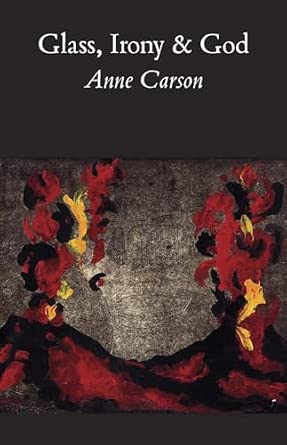 | Best for Readers Who Want Carson’s Range | Author: Anne Carson | Title: Glass, Irony and God | ISBN-10: 0811213021 | VIEW LATEST PRICE | See Our Full Breakdown |
| Bakkhai |  | Best for Greek-Tragedy Readers | Author: Anne Carson | Title: Bakkhai | ISBN-10: 0811227103 | VIEW LATEST PRICE | See Our Full Breakdown |
| The Beauty of the Husband: A Fictional Essay in 29 Tangos |  | Best for Readers of Love and Betrayal | Author: Anne Carson | Title: The Beauty of the Husband: A Fictional Essay in 29 Tangos | ISBN-10: 0375707573 | VIEW LATEST PRICE | See Our Full Breakdown |
| Decreation: Poetry, Essays, Opera |  | Best for Readers Who Like Genre-Mixing | Author: Anne Carson | Title: Decreation: Poetry, Essays, Opera | ISBN-10: 1400078903 | VIEW LATEST PRICE | See Our Full Breakdown |
| Wrong Norma |  | Best for Readers Ready for Carson’s Later Experiments | Author: Anne Carson | Title: Wrong Norma | ISBN-10: 0811230341 | VIEW LATEST PRICE | See Our Full Breakdown |
| Anne Carson book | Title | Author | Format | Edition |
|---|---|---|---|---|
| Red Doc> | Red Doc> | Anne Carson | Not specified in the supplied product data | — |
| Eros the Bittersweet: An Essay | Eros the Bittersweet: An Essay | Anne Carson | — | Princeton Classics |
| Men in the Off Hours | Men in the Off Hours | Anne Carson | Not specified in the supplied product data | — |
| Autobiography of Red | Autobiography of Red | Anne Carson | Not specified in the supplied product data | — |
| If Not | If Not, Winter: Fragments of Sappho | — | — | — |
| Glass | Glass, Irony and God | Anne Carson | Not specified | Not specified |
| Bakkhai | Bakkhai | Anne Carson | Not specified | Not specified |
| The Beauty of the Husband: A F | The Beauty of the Husband: A Fictional Essay in 29 Tangos | Anne Carson | Not specified | Not specified |
| Decreation: Poetry | Decreation: Poetry, Essays, Opera | Anne Carson | Not specified | Not specified |
| Wrong Norma | Wrong Norma | Anne Carson | Not specified | Not specified |
More Details on Our Top Picks
Red Doc>
Red Doc> revisits the mythic figures of Geryon and Herakles from Autobiography of Red, but it is not simply a repeat of that novel’s coming-of-age narrative. Carson shifts into a more fractured, compressed form, making this the better fit for readers who enjoy gaps, abrupt turns, and poetry that resists a conventional plot. Compared with Autobiography of Red, it offers less narrative handholding and assumes more familiarity with Carson’s earlier work. That freedom is also its main tradeoff: readers looking for a self-contained, clearly paced story may find its allusions and discontinuities difficult to follow. I’d choose it after Autobiography of Red, not as a first introduction to Carson.
Pros:- Revisits characters from Autobiography of Red in a distinctly altered form
- Compressed, experimental writing rewards readers who enjoy formal risk
- Offers a useful point of comparison with Carson’s earlier myth-based work
Cons:- Fragmented structure can make the narrative difficult to follow
- Less welcoming as a first Carson book than Autobiography of Red
- The available product information provides no edition or format details
Best for: Readers who already know Autobiography of Red and want a more fragmented, formally adventurous return to its mythic characters.
Not ideal for: Readers seeking a straightforward plot or a first Anne Carson book with a clear entry point.
- Title:Red Doc>
- Author:Anne Carson
- ASIN:0307950670
- Work type:Book
- Subject connection:Revisits figures from Autobiography of Red
- Format:Not specified in the supplied product data
Our verdict“Choose Red Doc> if you already enjoy Carson’s mythic storytelling and want a more fractured sequel-like reading experience.”
Eros the Bittersweet: An Essay
Eros the Bittersweet is the most direct choice here for readers who want Carson’s thinking about desire rather than a story-driven introduction to her writing. Framed as an essay on eros and the bittersweet nature of longing, it connects classical literature with an idea that remains recognizable beyond its ancient sources. The Princeton Classics edition gives this selection a clear identity within the lineup, while If Not, Winter offers a closer encounter with Sappho through translation and facing Greek text. The tradeoff is that this is an essay, not a novel or a collection of poetic fragments; readers seeking the narrative pull of Autobiography of Red may find its analytical focus less inviting.
Pros:- Centers on a focused subject: eros and the bittersweet quality of desire
- Connects classical sources with an enduring emotional theme
- Princeton Classics edition is identified in the supplied product data
Cons:- Essay form may not suit readers who prefer Carson’s narrative works
- The supplied description gives no further information about edition contents
- Less suited to readers specifically seeking Sappho’s surviving poems
Best for: Readers drawn to classical literature who want an essay-length exploration of eros, longing, and the bittersweet.
Not ideal for: Readers looking for a plot-led novel, or for translated ancient poems presented alongside their original text.
- Title:Eros the Bittersweet: An Essay
- Author:Anne Carson
- ASIN:0691247935
- Work type:Essay
- Edition:Princeton Classics
- Subject:Eros and the bittersweet nature of desire
Our verdict“Pick Eros the Bittersweet if you want Carson’s sustained critical approach to desire rather than a novel or translation.”
Men in the Off Hours
Men in the Off Hours suits readers who want Carson working across subjects and forms rather than concentrating on a single myth or source. Its place in the Vintage Contemporaries series is the only edition detail supplied, so I would not choose it for a specific feature or format without checking the listing. As a contrast, Eros the Bittersweet has a clearly stated focus on eros, while If Not, Winter centers on Sappho’s surviving fragments; this title is the better pick for someone seeking a less narrowly defined Carson reading experience. That breadth can also make it a less tidy starting point: readers who want one continuous story or a clearly described subject may prefer Autobiography of Red.
Pros:- Offers an alternative to Carson’s more single-focus works
- Vintage Contemporaries series information identifies the supplied edition
- Can suit readers interested in seeing Carson across varied material
Cons:- The supplied product description gives no contents or format details
- May feel less cohesive than the focused essay Eros the Bittersweet
- Not the clearest choice for readers seeking an accessible, continuous narrative
Best for: Readers familiar with Carson who prefer a collection moving across subjects and literary modes over one sustained narrative.
Not ideal for: Readers who want a clearly specified theme, a continuous plot, or detailed edition information before choosing.
- Title:Men in the Off Hours
- Author:Anne Carson
- ASIN:0375707565
- Series:Vintage Contemporaries
- Work type:Book
- Format:Not specified in the supplied product data
Our verdict“Choose Men in the Off Hours if you want a broad Carson collection and are comfortable with limited edition details.”
Autobiography of Red
Autobiography of Red is my strongest starting recommendation in this group because its novel-like frame gives readers a more sustained narrative route into Carson’s inventive use of myth. It retells the story of Geryon, bringing an ancient figure into a modern coming-of-age context. That makes it easier to approach than the fractured Red Doc>, which returns to related characters but offers less conventional narrative guidance. Readers who prefer Carson’s direct engagement with classical texts may find If Not, Winter a better match, but its fragmentary source material creates a very different reading experience. The tradeoff here is that this is not a conventional novel: its mythic premise and poetic approach may feel unexpected to readers who want realistic fiction with a straightforward style.
Pros:- Provides a sustained narrative entry point into Carson’s work
- Recasts a classical myth in a modern coming-of-age frame
- Offers useful context for readers considering the related Red Doc>
Cons:- Its poetic, myth-based approach differs from conventional realistic fiction
- Readers seeking Carson’s translation work may prefer If Not, Winter
- The supplied product data does not identify an edition or format
Best for: Readers new to Anne Carson who want a sustained, story-centered introduction to her mythic and poetic approach.
Not ideal for: Readers who prefer conventional realistic novels or want Carson primarily as a translator of ancient poetry.
- Title:Autobiography of Red
- Author:Anne Carson
- ASIN:037570129X
- Work type:Book
- Narrative basis:Retelling of the story of Geryon
- Format:Not specified in the supplied product data
Our verdict“Start with Autobiography of Red if you want the most story-led introduction to Carson among these five books.”
If Not, Winter: Fragments of Sappho
If Not, Winter is the clearest choice for readers who want to encounter Sappho through Carson’s translation rather than through a modern story inspired by ancient myth. The fragments appear alongside the original Greek text, letting readers see the surviving words and the translation together. That makes this a different kind of reading from Autobiography of Red, which builds a modern narrative from myth, or Eros the Bittersweet, which takes an essay form. The central tradeoff comes from the source itself: these are surviving fragments, not a continuous collection of complete poems, so gaps and broken lines are part of the experience. Readers seeking a smooth narrative arc should choose elsewhere in this lineup.
Pros:- Presents Sappho’s surviving fragments in Carson’s translation
- Places the original Greek alongside the translated text
- Offers a direct alternative to Carson’s myth-based fiction and critical essays
Cons:- Fragmentary source texts do not provide a continuous narrative
- The Greek text may be less useful to readers who want translation alone
- The supplied product data does not specify an edition or format
Best for: Readers of classical poetry, translation, and Greek literature who value seeing original text beside Carson’s rendering.
Not ideal for: Readers who want complete, continuous poems or a plot-driven introduction to Anne Carson.
- Title:If Not, Winter: Fragments of Sappho
- Translator:Anne Carson
- ASIN:0375724516
- Source author:Sappho
- Work type:Translation of surviving poetic fragments
- Text presentation:Fragments alongside the original Greek text
Our verdict“Choose If Not, Winter if you want Carson translating Sappho with the original Greek visible beside the fragments.”
Glass, Irony and God
Glass, Irony and God is a strong choice for readers who want to see Anne Carson move among poetry, myth, and reflective prose rather than follow one continuous story. Its variety makes it a broader entry point than Eros the Bittersweet, which centers on a sustained argument about desire, and less narratively anchored than Autobiography of Red. That range is also the main tradeoff: shifts in form and subject can make the collection feel less cohesive than a single long work. I’d choose it for sampling Carson’s intellectual and poetic modes in one volume, not for a straightforward plot or an easy introduction to every side of her work. Readers who prefer a clear narrative arc may find the changes in approach demanding.
Pros:- Brings poetry and reflective writing together in one collection
- Shows a wider range of Carson’s interests than a single-subject work
- Offers a different reading experience from the narrative focus of Autobiography of Red
Cons:- Shifts in form and subject may make the collection feel less unified
- Its variety can be a less direct starting point than a more focused book
Best for: Readers who want a varied introduction to Carson’s poetry and prose and are comfortable moving between forms.
Not ideal for: Readers seeking a linear story or a single, sustained subject; this collection’s variety can feel fragmented.
- Author:Anne Carson
- Title:Glass, Irony and God
- ISBN-10:0811213021
- Format:Not specified
- Edition:Not specified
- Publication date:Not specified
Our verdict“Choose Glass, Irony and God if you want Carson’s range more than a continuous narrative.”
Bakkhai
Bakkhai is the most direct pick here for readers who want Carson working with a Greek tragedy rather than building a contemporary narrative or essay-like argument. Its dramatic source gives the book a clear structural frame, making it a more focused choice than the mixed forms of Decreation or Glass, Irony and God. That focus suits readers interested in how an ancient play can speak through a modern literary voice. The tradeoff is that a tragedy’s characters, conflict, and inherited context shape the reading experience; this is not the best choice for someone seeking Carson’s most personal-feeling lyric collection or a conventional novel. Readers unfamiliar with Greek drama may also want to bring some patience for its theatrical and mythic framework.
Pros:- Offers a focused dramatic reading experience
- Connects Carson’s writing with the tradition of Greek tragedy
- Provides a clear contrast to the mixed genres of Decreation
Cons:- Its tragic and mythic framework may be less accessible without interest in classical drama
- Readers seeking a conventional novel may not connect with its theatrical form
Best for: Readers of Greek tragedy who want Carson’s literary voice applied to a classical dramatic work.
Not ideal for: Readers looking for a contemporary, plot-driven novel or a collection of unrelated lyrics.
- Author:Anne Carson
- Title:Bakkhai
- ISBN-10:0811227103
- Format:Not specified
- Edition:Not specified
- Publication date:Not specified
Our verdict“Choose Bakkhai for Carson’s engagement with Greek tragedy, not for a conventional novel or poetry collection.”
The Beauty of the Husband: A Fictional Essay in 29 Tangos
The Beauty of the Husband gives readers a sustained exploration of marriage, desire, and betrayal through the unusual frame of 29 tangos. That recurring structure makes it more tightly shaped than Glass, Irony and God, whose appeal is its wider range, while its relationship-centered subject offers a different route into Carson than the classical focus of Bakkhai. The book’s hybrid label—a fictional essay—signals that readers should expect neither a conventional novel nor a straightforward critical essay. The formal pattern can lend the work momentum, but readers who want an uncomplicated romance or a fully realistic narrative may find its shifts in mode and its fractured treatment of love less satisfying.
Pros:- Uses 29 tangos as a distinctive organizing structure
- Keeps its attention on a sustained emotional subject
- Offers a more concentrated focus than the varied pieces in Glass, Irony and God
Cons:- The fictional-essay form may frustrate readers who want a clear genre
- Its fractured treatment of relationships is not a conventional romance
Best for: Readers drawn to formally inventive writing about marriage, desire, and betrayal.
Not ideal for: Readers who want a conventional love story, a realistic novel, or a clearly defined essay collection.
- Author:Anne Carson
- Title:The Beauty of the Husband: A Fictional Essay in 29 Tangos
- ISBN-10:0375707573
- Form:Fictional essay
- Structure:29 tangos
- Format:Not specified
- Edition:Not specified
Our verdict“Pick The Beauty of the Husband if you want an formally inventive, relationship-focused Carson book rather than a conventional romance.”
Decreation: Poetry, Essays, Opera
Decreation is the pick for readers who want Carson’s work to cross boundaries among poetry, essays, and opera. The explicitly mixed form makes it a broader and less plot-led experience than The Beauty of the Husband, whose 29-tango structure centers on one relationship, and less tied to classical drama than Bakkhai. That breadth is its distinctive appeal, but also its chief demand: readers need to be open to changes in genre rather than expect one continuous argument or narrative. I’d recommend it to readers who enjoy formally adventurous writing and want several modes in one volume. If you prefer Carson at her most focused, a single-subject book will offer a clearer path through her ideas.
Pros:- Combines poetry, essays, and opera
- Offers more formal variety than the focused structure of The Beauty of the Husband
- Suits readers interested in Carson’s cross-genre work
Cons:- Genre shifts may make it feel less cohesive
- Its breadth can be challenging for readers seeking a simple entry point
Best for: Readers who enjoy poetry alongside essays and dramatic or operatic forms in one book.
Not ideal for: Readers who want a single, continuous story or a collection unified by one genre.
- Author:Anne Carson
- Title:Decreation: Poetry, Essays, Opera
- ISBN-10:1400078903
- Forms:Poetry, essays, opera
- Format:Not specified
- Edition:Not specified
- Publication date:Not specified
Our verdict“Choose Decreation if you value Carson’s movement across genres more than a continuous narrative.”
Wrong Norma
Wrong Norma is the pick for readers who want a less predictable entry in Carson’s body of work, rather than a book chosen for a clearly stated narrative or genre premise. Compared with Autobiography of Red, which has a more recognizable story frame, this title is better approached with openness to shifts in form and direction. That makes it a distinct choice for readers already curious about Carson’s experiments, but a riskier first book if you need a clear account of what each piece is doing. Because the supplied product details provide no description of its contents or format, I can’t make a more specific claim about its structure. Buyers who want a dependable introduction may prefer a work with a clearer stated premise.
Pros:- Offers an alternative to the story-led approach of Autobiography of Red
- May suit readers seeking a less conventional Carson selection
- Provides a distinct option for readers already exploring her work
Cons:- Available product details do not specify its contents or form
- Its unclear premise makes it a less dependable starting point for new readers
Best for: Readers already interested in Carson who are willing to choose a book without a clearly stated genre or content description.
Not ideal for: First-time readers who want a defined subject, a clear plot, or detailed information about the book’s contents before choosing.
- Author:Anne Carson
- Title:Wrong Norma
- ISBN-10:0811230341
- Format:Not specified
- Edition:Not specified
- Publication date:Not specified
- Description provided:None
Our verdict“Choose Wrong Norma if you are already curious about Carson and comfortable selecting a book with limited description.”

How We Picked
I ranked these books by how well each serves a distinct reading goal: an accessible first encounter, a sustained story, a classical translation, a play, or a more formally varied collection. I also weighed how much context a reader may need, how clearly a book’s structure signals its approach, and whether its mix of poetry, criticism, and other forms is likely to feel rewarding or demanding. Those criteria favor Autobiography of Red as the best overall choice, while leaving room for books that are stronger matches for specific interests.
The ranking is a guide to fit, not a claim that one form of Carson’s work is inherently better. Narrative momentum and an identifiable subject can make a book easier to enter; fragmentary, essayistic, or hybrid structures can offer a more distinctive experience but ask readers to accept uncertainty and shifts in form. I place the most versatile options higher, then distinguish the others by the kind of reading they invite. The ten titles cover different modes, so the best match for a reader of ancient Greek literature may not be the best first book for someone seeking a story.
| Anne Carson book | Work type | Format | Edition |
|---|---|---|---|
| Red Doc> | Book | Not specified in the supplied product data | — |
| Eros the Bittersweet: An Essay | Essay | — | Princeton Classics |
| Men in the Off Hours | Book | Not specified in the supplied product data | — |
| Autobiography of Red | Book | Not specified in the supplied product data | — |
| If Not | Translation of surviving poetic fragments | — | — |
| Glass | — | Not specified | Not specified |
| Bakkhai | — | Not specified | Not specified |
| The Beauty of the Husband: A F | — | Not specified | Not specified |
| Decreation: Poetry | — | Not specified | Not specified |
| Wrong Norma | — | Not specified | Not specified |
Factors to Consider When Choosing Best Anne Carson Books
Choosing among Carson’s books is less about finding a single representative work and more about matching your appetite for story, translation, argument, and formal experimentation. I’d start by deciding how much structure you want, then use subject matter and familiarity with classical sources to narrow the field.
Choose between a story and a collection of forms
A sustained narrative gives you a recurring situation to follow, even when its language and structure are unconventional. A book that moves among poems, essays, translations, or performance texts may feel more varied but less like a continuous journey. Don’t assume a book called a novel will read like conventional fiction, or that a poetry collection will keep to one mode. Ask whether you want to return to the same characters and concerns or meet a new form on each turn. If you’re unsure, a narrative frame can provide a useful foothold. If formal shifts are part of the appeal, a hybrid collection may be a better match.
Decide how much classical context you want
Carson frequently draws on ancient Greek literature, but readers don’t all need the same level of background. A translation or book built around a classical source may be especially satisfying if you enjoy comparing fragments, myths, and retellings. At the same time, a reader who expects a conventional retelling may find the gaps and reinterpretations disorienting. You don’t need to study the original texts before reading, but a willingness to follow allusions without resolving every one can help. Choose based on whether classical material is a pleasure in itself or a subject you’d rather encounter through a more contemporary narrative. A book’s form matters as much as its source.
Treat fragments and gaps as a reading style
Fragmentary writing can leave missing context, incomplete lines, or open questions; those features may be central to the book rather than flaws to be corrected. Readers who want a clear sequence of events may prefer a more sustained narrative. Readers comfortable pausing over what is absent can find that fragments sharpen attention and invite rereading. A common mistake is to judge a fragment-based work by how completely it reconstructs a story. Instead, ask whether uncertainty itself sounds appealing. If you’re choosing a gift, consider the recipient’s patience for ambiguity as much as their interest in poetry or Greek literature.
Look at the balance of poetry, criticism, and performance
Carson’s books can cross boundaries among lyric writing, literary argument, translation, drama, and performance-minded forms. That variety can make a book feel unusually alive, but it can also interrupt the reading rhythm if you want one consistent mode. Think about whether you like a poem to stand alone or want it placed beside commentary and other kinds of writing. Readers who enjoy ideas embedded in literary form may welcome those shifts; readers seeking an uninterrupted verse collection may not. Check the book’s subtitle and description for clues about its range, then choose by the reading experience you want rather than by a broad label such as poetry or essay.
Choose an entry point that leaves room to branch out
Your first Carson book doesn’t need to explain every feature of her work. A narrative can introduce her imaginative approach, while an essay or translation can show how she thinks through language and source texts. Trying to begin with the most challenging or most representative-sounding title can backfire if its structure isn’t what you enjoy. Start with the form that already appeals to you, then branch into contrasting work. If you like a book’s story, follow it with a collection that shifts the focus; if you prefer its literary argument, try a book with a more open structure. This approach makes a reading path more useful than searching for a single definitive entry point.
Frequently Asked Questions
Which Anne Carson book should I read first if I’m new to her work?
I’d start with Autobiography of Red if you want a continuing narrative to guide you through Carson’s unusual forms. It gives a first-time reader a clearer story thread than the more fragmentary or mixed-form options in this roundup. If you’d rather begin with literary ideas than a narrative, Eros the Bittersweet is a better fit. Neither choice is a complete map of her work, so treat the first book as a way to discover which of her modes you want more of. From there, branch toward translation, drama, or hybrid collections.
Do I need to know Greek mythology or classical literature before reading these books?
No prior study is required, but your enjoyment may depend on how comfortable you are with references that are not fully explained. Carson’s use of classical sources can reward readers who recognize the material, while many readers can still follow the writing through its imagery, structure, and emotional concerns. If you want a story with a more immediate narrative foothold, begin with Autobiography of Red rather than treating a source-heavy work as a test of prior knowledge. For a translation-centered reading, If Not, Winter makes the condition of the surviving fragments part of the encounter. A brief reference lookup can add context, but it is not a prerequisite.
Should I read Autobiography of Red before Red Doc>?
I’d read Autobiography of Red first if you plan to read both, since Red Doc> returns to its world and is more meaningful as a follow-up. The earlier book also makes a stronger general starting point for readers who want a continuous story. That said, Red Doc> is a separate reading choice for anyone more interested in a later, differently shaped work than in following a sequence. If you only want one book, choose by the kind of reading you want rather than feeling obliged to complete a pair. Reading order matters most when you want the connection between them.
Which book is the better choice for someone who wants translation rather than original poetry?
If Not, Winter: Fragments of Sappho is the most direct choice here for a reader seeking translation. Its appeal lies partly in the surviving poems’ fragmentary state, so it offers a different experience from reading a complete, continuous work in translation. If you want Carson’s own poems and ideas instead of a translator’s engagement with an ancient poet, choose another title in the lineup. It can help to approach the book as an encounter with what survives, not as a reconstruction of everything Sappho wrote. That distinction clarifies whether the fragments are likely to interest you.
Is a poetry collection or a hybrid book a safer gift for a reader new to Anne Carson?
For someone new to Carson, I’d choose by the reader’s habits rather than by the broad label on the book. A reader who likes stories may find Autobiography of Red easier to settle into than a book that moves among poems, essays, and other forms. A reader who enjoys experiments in structure may prefer a hybrid work, even without prior familiarity with Carson. If you don’t know their tastes, avoid assuming that the most unusual format will be the most welcoming. A title connected to a subject they already enjoy, such as classical literature or literary criticism, can make the choice more personal.
Conclusion
Best overall: I recommend Autobiography of Red for its balance of narrative momentum and formal invention. Best value in reading range: choose Men in the Off Hours if you want to encounter Carson’s varied poetic and essayistic modes in one book. Best premium pick for classical-literature readers: If Not, Winter is the one to choose when Sappho and fragmentary translation are the main draw. Best for beginners: start with Autobiography of Red; readers who prefer ideas to story can start instead with Eros the Bittersweet. For a specific need, choose Bakkhai for drama, Red Doc> as a follow-up to Autobiography of Red, or Decreation for a more mixed-form reading experience. The right choice is the one whose form you want to spend time with, not simply the title that seems most representative.
Halloween Picks
halloween
As an affiliate, we earn on qualifying purchases.