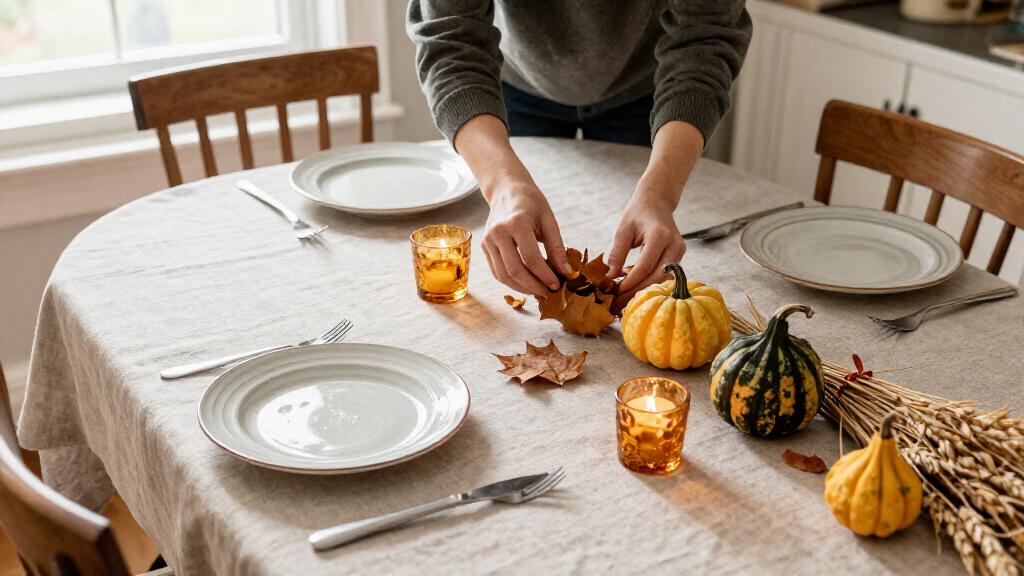

Choosing Thanksgiving table decor is less about finding the one right style and more about deciding where to spend your limited hosting resources: time, money, or creative effort. DIY decor gives you control over colors, materials, and personal touches, and it can be inexpensive when you already have supplies. Store-bought pieces make setup more predictable and can produce a coordinated table without hours of crafting.

Get art and craft supplies delivered free with Prime
- Fast, free delivery on millions of items
- Prime Video, Amazon Music and more included
- Member-only deals all year

OHOME 9-Piece 3D Honeycomb Thanksgiving Table Centerpieces
- ✔ Brand: OHOME
- ✔ Quantity: 9 pieces
- ✔ Materials: Double-sided cardstock, honeycomb orbs, PET film

32-Piece Artificial Fall Pumpkin and Harvest Decor Set
- ✔ Brand: SY Super Bang
- ✔ Set size: 32 pieces
- ✔ Contents: Artificial pumpkins, gourds, maple leaves, acorns, pine cones, and berry branches

15-Piece Assorted Flocked Foam Pumpkins for Fall Decor
- ✔ Quantity: 15 pumpkins
- ✔ Material: Foam
- ✔ Texture: Flocked velvet
The tradeoff is clearest when the holiday is close. If you enjoy making place cards, arranging gathered branches, or adapting what you own, DIY can feel personal and keep costs down. If you are juggling cooking, guests, and cleanup, ready-made decor may be worth paying for. The comparison below focuses on cost, preparation, coordination, customization, reuse, durability, and hosting practicality so you can choose a route that fits your table and your schedule.
At a Glance
| Criteria | DIY Thanksgiving Table Decor | Store-Bought Thanksgiving Table Decor | Winner |
|---|---|---|---|
| Upfront cost | Often low if you use household or natural materials; craft supplies can add up. | Ranges from inexpensive accents to costly coordinated sets. | Depends |
| Preparation time | Usually higher because sourcing, making, and arranging take time. | Low: purchase, unpack, and arrange. | B |
| Style coordination | Flexible, but a consistent look takes planning. | Usually easier to coordinate when buying from one collection or palette. | B |
| Customization | High: colors, names, sizes, and details can be tailored. | Limited to available designs, though pieces can be mixed. | A |
| Reuse and storage | Depends on materials; reusable pieces can be stored, while natural items may be seasonal. | Often straightforward for durable items, but bulky seasonal pieces need storage. | Depends |
| Durability | Varies by technique and materials; handmade pieces may need careful handling. | Predictable when materials and construction are clearly described. | B |
| Hosting practicality | Can be adapted to the table, but projects may compete with cooking and setup. | Convenient for hosts who need a reliable setup with little prep. | B |
OHOME 9-Piece 3D Honeycomb Thanksgiving Table Centerpieces
For shoppers who want the table to read as Thanksgiving at a glance, OHOME’s nine-piece set is our best overall choice. Turkeys, pumpkins, and “Give Thanks” designs make the theme explicit, while honeycomb elements give the cardstock decorations dimension rather than the flat look of ordinary paper cutouts. Compared with the flocked pumpkins, this set supplies more visual variety without requiring us to combine separate colors and shapes into a theme ourselves.Setup is part of the appeal: the pieces unfold and use glue dots, so we can create a coordinated display without tools or complicated construction. The double-sided cardstock and PET-film lamination are described as tear-resistant and waterproof, which gives them a more practical edge over unlaminated paper decorations for occasional reuse. The stated indoor and outdoor suitability also offers flexibility, although these remain lightweight paper-based pieces rather than heavy, weatherproof table ornaments.The main limitation is scale. Individual pieces are listed at 9.3 by 5.9 by 0.1 inches, and a set of nine may still look modest on a long dining table or a broad buffet. We may need to group several together or combine them with foliage, candles, or other low decor. Compared with the 32-piece harvest set, OHOME is more coordinated and faster to place, but it offers less organic variety for building a loose, layered centerpiece. It is also the pick to skip if we prefer subtle decor that blends into a neutral tablescape rather than announcing the holiday.
Pros:
- Nine pieces use recognizable turkey, pumpkin, and gratitude motifs for a coherent holiday look.
- Honeycomb details create a dimensional display rather than a flat paper arrangement.
- Unfolding and glue-dot assembly avoid tools and lengthy setup.
- PET-film-laminated cardstock is described as tear-resistant and waterproof for more flexible reuse.
Cons:
- The listed piece dimensions may feel small across a long dining table or large buffet.
- Cardstock can crease or become damaged if stored loosely between seasons.
- The bold, themed designs may not suit a restrained or purely natural tablescape.
Best for: Hosts who want a coordinated, unmistakably Thanksgiving display that is quick to assemble and easy to distribute around a table.
Not ideal for: Shoppers seeking understated natural materials, a large single centerpiece, or decorations that can be stored without protecting paper components.
Bottom line: We recommend OHOME when fast setup and coordinated Thanksgiving imagery matter more than a naturalistic or oversized centerpiece.
“We recommend OHOME when fast setup and coordinated Thanksgiving imagery matter more than a naturalistic or oversized centerpiece.”
32-Piece Artificial Fall Pumpkin and Harvest Decor Set
When we want to build the centerpiece ourselves instead of setting out a predesigned decoration, the 32-piece harvest assortment gives us the most ingredients. Artificial pumpkins and gourds are joined by maple leaves, acorns, pine cones, and berry branches in green, beige, and dark brown. That mix can create a fuller, more layered fall arrangement than the pumpkin-only flocked set, and it is less overtly graphic than OHOME’s printed turkey and “Give Thanks” pieces.The assortment is useful beyond the center of the table. We can scatter a few leaves and acorns around a serving tray, arrange the pumpkins in a bowl, or save some pieces for a wreath or basket. Its lightweight foam and plastic construction means the components are easy to move and do not require daily care. That flexibility makes this the strongest option for hosts who like to change the layout from one gathering to another or use the same fall decor in different rooms.There is an important uncertainty: the listing gives dimensions as 1 x 1 x 1 inch without explaining whether that applies to the whole set or each item. We should not assume every piece is large enough to anchor a table, and the assortment may work best as scattered accents or as part of a larger centerpiece. Unlike OHOME, it has no ready-made upright composition, so achieving a polished look takes more arranging. The pieces are decorative, not functional produce, and material details vary by item. Choose it for variety and creative control; skip it if we need a predictable centerpiece with clearly stated individual dimensions.
Pros:
- Includes a broad mix of pumpkins, gourds, leaves, acorns, pine cones, and berry branches.
- Multiple earth-toned colors make it easier to create a layered fall palette.
- Pieces can be arranged on a table or repurposed in baskets and wreath projects.
- Lightweight decor requires no daily maintenance and can be reused seasonally.
Cons:
- The listed 1 x 1 x 1-inch dimension does not explain the size of individual pieces.
- Loose components require styling and may not form a centerpiece on their own.
- Foam and plastic are decorative materials, not substitutes for real produce or natural foliage.
Best for: Hosts who enjoy styling their own harvest display and want decor that can move between a table, basket, tray, or DIY project.
Not ideal for: Buyers who want a ready-to-use centerpiece, need precise piece dimensions, or prefer substantial natural materials.
Bottom line: We would choose this assortment for the broadest styling flexibility, provided we are comfortable arranging small decorative elements ourselves.
“We would choose this assortment for the broadest styling flexibility, provided we are comfortable arranging small decorative elements ourselves.”
15-Piece Assorted Flocked Foam Pumpkins for Fall Decor
The flocked pumpkin set is the most focused option here: 15 small pumpkins in five autumn colors, with a velvet-like surface that softens the look of foam. At about 2.75 inches each, they suit a bowl, narrow tray, or compact table arrangement where we want a little color without adding tall decorations. Compared with OHOME’s themed honeycomb shapes, these pumpkins are quieter and easier to mix into decor that continues beyond Thanksgiving.Color variation gives us some room to style the display. Coffee, gold, beige, orange, and brown can be grouped for a warm arrangement or distributed among place settings. Because each item shares the same basic form, the result is more restrained than the 32-piece harvest set, which combines leaves, berries, and other shapes. That consistency is an advantage for a tidy bowl display, but it also means we will not get the same visual variety from this set alone.These are accents, not oversized centerpiece pumpkins. Their small size can disappear on a long dining table, especially if they are spaced too far apart or placed among large serving dishes. Foam keeps them lightweight but is less substantial than solid decor, and the flocked finish may need gentle handling to stay presentable. The indoor and outdoor use description adds flexibility, but it does not make foam equivalent to durable outdoor ornamentation. Choose this set when compact, reusable pumpkin color is the goal; if we want a complete harvest scene or explicit Thanksgiving motifs, the other two picks make a stronger starting point.
Pros:
- Fifteen pumpkins come in five colors for flexible grouping and placement.
- Flocked velvet texture adds visual softness compared with plain foam pieces.
- The approximately 2.75-inch size works for bowls, trays, wreaths, and compact displays.
- Can be used in indoor or outdoor seasonal arrangements, according to the product description.
Cons:
- Small pumpkins may lack presence on a long table or in a large centerpiece.
- Foam construction is less substantial than solid or natural decor.
- A pumpkin-only assortment offers less shape variety than the 32-piece harvest set.
Best for: Hosts styling a small table, bowl, or tray who want assorted fall colors and a soft-textured pumpkin accent.
Not ideal for: Anyone who needs a large, varied centerpiece, prefers sturdy materials, or wants turkey and harvest motifs beyond pumpkins.
Bottom line: We recommend these pumpkins for compact, low-effort fall accents, not as the sole focal point of a large Thanksgiving table.
“We recommend these pumpkins for compact, low-effort fall accents, not as the sole focal point of a large Thanksgiving table.”
As an Amazon Associate we earn from qualifying purchases.
Key Differences
The most practical difference is who does the work. DIY shifts effort from shopping to planning and making; store-bought decor shifts more of that work to the seller, leaving you to choose and arrange. That makes ready-made pieces the safer choice for a busy host or a firm deadline. DIY has a stronger payoff when the process itself is enjoyable, the design is specific, or supplies are already on hand.
Cost is not automatically a win for either route. A simple arrangement made from a vase you own, a few branches, and handwritten place cards can be very affordable. Buying tools, specialty materials, and enough supplies for a large table can erase that advantage. Conversely, a restrained set of purchased accents can be reused for years; elaborate disposable purchases are harder to justify. The best value depends on total cost, time, and whether the pieces will serve beyond one dinner.
For most hosts who want a polished table with minimal effort, store-bought decor is the more dependable choice. DIY is better for people who value individual details and have time to make them. A hybrid often works best: use one or two purchased anchors, such as a table runner or candleholders, then add handmade place cards or a simple natural centerpiece.
Detailed Comparison
Upfront cost (moderate difference)
DIY wins when materials are already available. Reusing jars, fabric, foliage, or leftover craft supplies can keep spending low, and handmade details let you make only what the table needs. The gap is moderate, not guaranteed: buying specialty tools, seasonal supplies, or materials for a large group can make DIY surprisingly expensive. Store-bought decor ranges from budget accents to premium coordinated sets, so it can be cheaper when you need only a few items. Compare the full basket of supplies with the price of finished pieces, rather than assuming handmade means free.
Preparation time (Store-Bought Thanksgiving Table Decor wins — major)
Store-bought decor wins by a major margin. It still takes time to shop, unpack, and arrange, but the pieces are ready to use. DIY can require gathering materials, testing a design, making multiples, and tidying up the work area. That extra effort matters most in the week of Thanksgiving, when cooking and guest logistics already compete for attention. Choose DIY when crafting is part of the pleasure or work can be completed well ahead; choose ready-made when a predictable setup matters more than the making process.
Style coordination (Store-Bought Thanksgiving Table Decor wins — moderate)
Store-bought decor has a moderate advantage in coordination. Pieces sold in the same collection or chosen from a planned palette are more likely to share colors, finishes, and scale. DIY can look just as coherent, but it takes deliberate choices: decide on a small color range, repeat materials, and avoid adding every appealing project to the table. For a host who wants a finished look without design experimentation, ready-made sets reduce guesswork. For someone with a clear vision, DIY offers enough control to match existing dishes and linens precisely.
Customization (DIY Thanksgiving Table Decor wins — major)
DIY wins by a major margin. Handmade decor can fit an unusual table shape, a particular color scheme, family traditions, dietary labels, or each guest’s name. Store-bought options offer a narrower range of designs and dimensions, although mixing items can add some individuality. This difference is useful when standard decor clashes with your home or when personal details matter to your gathering. It matters less if you want a familiar autumn palette and are content with a broadly available style.
Reuse and storage (minor difference)
Neither option wins in every case. Purchased fabric runners, sturdy candleholders, and durable serving accents are easy to bring back each year, but large seasonal pieces can take up valuable storage space. DIY decor can also be reusable if it is made from sturdy materials and stored carefully; natural foliage, paper details, and fragile projects may be intended for one season. The practical winner is the route that produces pieces you will genuinely reuse. Before buying or making, ask where the items will live after dinner and whether they suit other meals or holidays.
Durability (Store-Bought Thanksgiving Table Decor wins — moderate)
Store-bought decor has a moderate edge in predictability. Finished products usually provide clearer expectations about material, construction, and care, though quality still varies. DIY durability depends on the materials and skill involved: a well-sewn runner may last for years, while a rushed paper centerpiece may not survive the evening. If the decor will sit near food, children, pets, or warm serving dishes, sturdy and easy-to-clean pieces are more useful than delicate details. Inspect purchased materials too; a low-cost item is not good value if it quickly breaks or sheds.
Hosting practicality (Store-Bought Thanksgiving Table Decor wins — moderate)
Store-bought decor wins moderately for hosts with a tight schedule. Ready-made accents are easier to plan around and can be arranged close to the meal. DIY can be more practical when it uses what is already at home, suits the table exactly, or avoids unnecessary shopping. Either way, the design should leave room for serving dishes and conversation. Tall arrangements can block sightlines, loose materials can make cleanup harder, and open flames require safe placement. Choose pieces that support dinner rather than compete with it.
DIY Thanksgiving Table Decor: Pros and Cons
Pros:
- Offers strong control over colors, sizes, and personal details.
- Can cost less when you reuse household or gathered materials.
- Creates opportunities for family participation and meaningful traditions.
- Can be tailored to an unusual table or existing dishes.
Cons:
- Requires time for planning, making, and cleanup.
- The total cost can rise when projects need specialty supplies.
- A coordinated, polished result takes design choices and practice.
- Fragile or seasonal materials may not store or reuse well.
Store-Bought Thanksgiving Table Decor: Pros and Cons
Pros:
- Quick to set up and easier to plan around a busy holiday schedule.
- Coordinated pieces reduce guesswork about color and finish.
- Finished construction offers more predictable use and care.
- Durable accents can be reused across multiple Thanksgiving dinners.
Cons:
- Less control over exact colors, dimensions, and personal details.
- A full set can cost more than using supplies already at home.
- Seasonal designs may feel generic or match the table poorly.
- Bulky decor can take up storage space between holidays.
Who Should Choose What
Choose DIY Thanksgiving Table Decor if:
- You enjoy crafting and can finish projects before hosting week.
- You already own useful supplies or want to reuse materials.
- Your table needs unusual sizes, specific colors, or personalized place settings.
- You want decor tied to family traditions rather than a standard seasonal collection.
Choose Store-Bought Thanksgiving Table Decor if:
- Your schedule is crowded and you want a quick, predictable setup.
- You want a coordinated look without planning every detail yourself.
- You need sturdy pieces you can use again and store easily.
- You are buying only a few accents and can avoid paying for a complete set.
Skip both if: Skip a large decor purchase or an elaborate craft project if the table is already crowded or the budget is tight. A clean table, existing linens, simple place settings, and one low centerpiece can feel festive without adding clutter or work.
Value for Money
Paying more for store-bought decor is worth it when the purchase saves hours you would rather spend cooking, resting, or welcoming guests. It is especially good value if you choose durable pieces that can return to the table each year, or use the items for other dinners. Paying a premium for a single-use set is harder to justify unless that exact look matters to you.
DIY offers better value when you have materials at home, enjoy the activity, and can reuse the finished pieces. Do not count only the sticker price: include supplies, the time required, and any storage or cleanup burden. For many households, a modest hybrid gives the best return: buy a durable base such as a runner or candleholders, then add low-cost handmade details. That limits spending while preserving personal character.
Final Verdict
Choose store-bought Thanksgiving table decor if convenience, a coordinated look, and a reliable deadline matter most. For the average busy host, it is the safer choice, particularly when you buy a few reusable pieces rather than a disposable full-table set. Choose DIY if you have time, enjoy making things, or need details that standard products cannot provide. The biggest deciding factor is not whether handmade or purchased decor looks better in theory; it is whether you would rather spend your holiday preparation time making the table or setting it up. If both cost and time matter, buy durable anchor pieces and make only the personal accents.
Frequently Asked Questions
Is DIY Thanksgiving table decor always cheaper?
No. DIY is usually cheaper when you already own the materials or can use inexpensive items from home. Costs can climb when a project needs specialty tools, fabric, paint, or enough supplies for many guests. Compare the complete materials list with the price of finished decor before deciding.
How can store-bought decor feel less generic?
Choose a small number of pieces that match your existing dishes and linens, then add one personal detail, such as handwritten place cards or a family recipe card at each setting. A restrained combination looks more intentional than filling the table with unrelated seasonal items.
What is the best option for a last-minute host?
Store-bought decor is usually the better fit because it requires less preparation and gives you a more predictable setup. A simple hybrid can be even faster: use a runner or candleholders you already own, add a ready-made centerpiece, and skip projects that need assembly.
Can DIY and store-bought decor work together?
Yes. Use store-bought pieces for the larger visual elements, where coordination and durability matter, and DIY small details such as place cards or napkin ties. This approach controls cost and workload while keeping the table personal. Keep the palette limited so both types of decor feel connected.