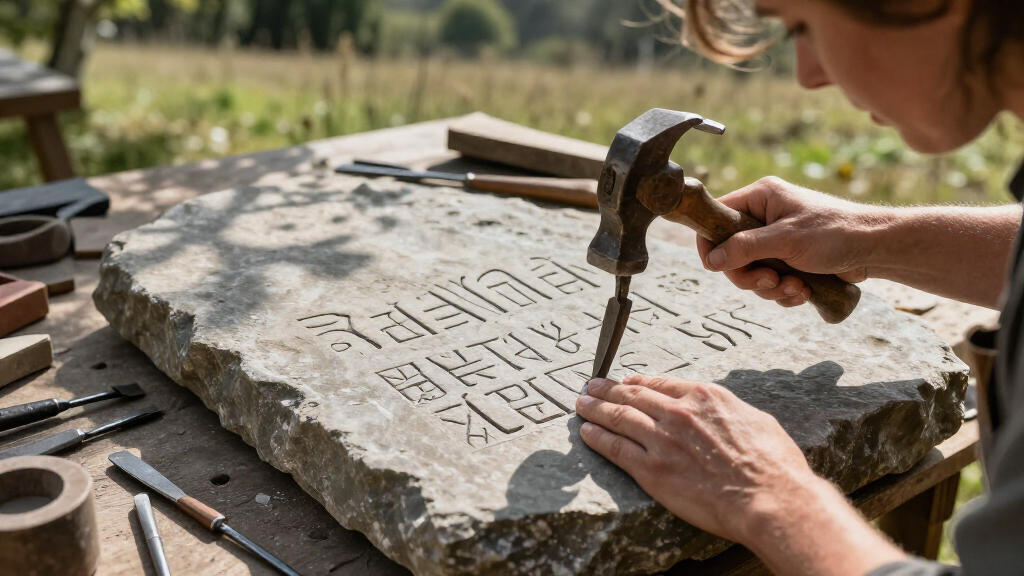

🔍 Read the full analysis: SVG Carving Animation: A Look Inside “The Runestone Field — Carve Words Into Winter” (FABLE/175) on ThorstenMeyerAI.com

Get art and craft supplies delivered free with Prime
- Fast, free delivery on millions of items
- Prime Video, Amazon Music and more included
- Member-only deals all year
TL;DR
‘The Runestone Field — Carve Words Into Winter’ is an innovative project using SVG carving animation to transform static runic carvings into dynamic, immersive narratives. It showcases how automation and craftsmanship merge in digital storytelling.
‘The Runestone Field — Carve Words Into Winter’ is a digital art project that uses SVG carving animation to bring ancient runic carvings to life. Developed as an immersive storytelling experience, it combines traditional symbolism with cutting-edge technology, allowing viewers to explore the intricate details of the carvings as if they are being dynamically inscribed in real time. This project exemplifies how automation can elevate visual storytelling, making history accessible and engaging for modern audiences. Learn more about similar innovations in the original article.
The project was created by a team leveraging SVG (Scalable Vector Graphics) techniques to animate the carving process on digital runestones. By integrating precise SVG paths with fluid animation sequences, the team simulated the act of carving into stone, revealing the runes gradually and with visual depth. The experience is designed to evoke the tactile feel of ancient stone inscriptions while offering a contemporary digital interface. According to Thorsten Meyer, the project aims to blend craftsmanship with automation, creating an interactive narrative that invites viewers to explore every detail of the carvings, almost as if the stones are speaking again. For more details, see the original analysis of the project here.
Developers faced challenges in achieving realistic carving effects and fluid motion, but breakthroughs in SVG animation techniques allowed for highly detailed and customizable visualizations. The project’s case study details the step-by-step process, from initial design sketches inspired by historical runic art to the technical implementation of SVG paths and animation timing. The final result is a seamless experience that combines historical accuracy with modern visual storytelling, providing an engaging way to explore ancient symbols and their meanings.
SVG Carving Animation: Inside “The Runestone Field — Carve Words Into Winter”
A digital art project that transforms static runic carvings into dynamic, immersive narratives — using SVG paths and fluid animation sequences to simulate the act of carving into stone, revealing runes gradually and in real time.
An Innovative Fusion of Ancient Art & Digital Animation
Heritage, Reimagined
Digital tools preserve and reinterpret ancient cultural artifacts, making runic symbolism accessible to a far broader audience than static museum displays ever could.
Automation as Craft
SVG carving animation demonstrates how automation enhances storytelling — dynamic, interactive narratives that were previously impossible with static images.
Who Benefits
Educators, historians, and digital artists gain new avenues for engaging audiences — while the project raises questions about the future of digital preservation.
The Development: From Sketch to Speaking Stones
Design Sketches
Initial drafts inspired by historical runic art and traditional stone inscription techniques.
SVG Path Mapping
Precise vector paths trace each rune, defining the geometry of every simulated chisel stroke.
Animation Timing
Fluid animation sequences reveal the runes gradually, with visual depth that evokes real carving.
Immersive Release
A seamless live experience where the stones appear to speak again — history in real time.
Challenges & Breakthroughs in SVG Technique
ESTIMATED MATURITY OF KEY TECHNICAL DIMENSIONS
“The project aims to blend craftsmanship with automation, creating an interactive narrative that invites viewers to explore every detail of the carvings — almost as if the stones are speaking again.”
— Thorsten MeyerStatic Carvings vs. SVG Carving Animation
| Dimension | SVG Carving Animation | Traditional Static Carvings |
|---|---|---|
| Reveals inscription process | ✓ Simulated in real time | ✗ Only final state visible |
| Scalability of detail | ✓ Lossless at any size | ~ Depends on scan quality |
| Audience interactivity | ✓ Interactive narrative | ✗ Passive viewing |
| Historical authenticity | ~ Digital reinterpretation | ✓ Original artifact |
| Adaptability to other art forms | ~ Under development | ✗ Not applicable |
| Deployment in education | ~ Planned long-term | ~ Limited to physical visits |
From Ancient Symbol to Digital Experience
Key Questions
How does SVG carving animation work?
Scalable vector graphics paths combined with animation sequences simulate the act of carving into stone, creating the illusion of dynamic inscription in real time.
What inspired the “Runestone Field” project?
A desire to preserve and reinterpret ancient runic carvings through modern digital techniques — blending history with innovation.
Can it be used for other historical art?
While currently focused on runic carvings, the underlying SVG techniques could animate other historical inscriptions, pending further development.
Is it available for public viewing?
Yes — the experience can be viewed live, with ongoing updates planned for broader accessibility and interaction options.
Innovative Fusion of Ancient Art and Digital Animation
This project highlights how digital tools can preserve and reinterpret ancient cultural artifacts, making them accessible to a broader audience. The use of SVG carving animation demonstrates the potential for automation to enhance storytelling, allowing creators to produce dynamic, interactive narratives that were previously impossible with static images. For educators, historians, and digital artists, this approach offers new avenues for engaging audiences and exploring heritage through technology. It also raises questions about the future of digital preservation and the ways automation can complement traditional craftsmanship in cultural storytelling.
As an affiliate, we earn on qualifying purchases.
Bridging History and Modern Technology in Visual Storytelling
Traditional runic carvings have long served as symbols of cultural identity and storytelling in ancient societies. Recent efforts in digital art seek to preserve and reinterpret these symbols through innovative means. The use of SVG (Scalable Vector Graphics) for animation is part of a broader trend where digital artisans use automation to simulate craftsmanship, creating immersive experiences that honor historical techniques while leveraging modern technology. This project builds on prior experiments in digital storytelling and visual animation, pushing the boundaries of how historical art forms can be experienced today. The technique was refined through a series of prototypes, focusing on achieving realistic carving motions and visual depth, culminating in the current immersive experience.
As an affiliate, we earn on qualifying purchases.
Unresolved Technical Challenges and Future Enhancements
While the project successfully demonstrates realistic SVG carving animations, details remain unclear regarding how scalable or adaptable the technique is for other forms of historical art. It is also not yet confirmed how viewers will interact with the experience in different settings or whether additional features, such as user-driven customization, will be introduced. The team has not publicly disclosed plans for broader deployment or integration into educational platforms, leaving some questions about its long-term application and accessibility.
As an affiliate, we earn on qualifying purchases.
Next Steps in Digital Carving Animation Development
Developers plan to refine the SVG carving techniques further, aiming for even more realistic textures and motion fluidity. Future updates may include interactive features allowing users to customize carvings or explore different historical narratives. Additionally, the team intends to showcase the project at upcoming digital art and heritage conferences to gather feedback and explore potential collaborations. Long-term, there is interest in integrating this technology into educational tools and virtual museums, broadening its reach and impact.
As an affiliate, we earn on qualifying purchases.
Key Questions
How does SVG carving animation work?
SVG carving animation uses scalable vector graphics paths combined with animation sequences to simulate the act of carving into stone, creating the illusion of dynamic inscription in real time.
What inspired the ‘Runestone Field’ project?
The project was inspired by a desire to preserve and reinterpret ancient runic carvings through modern digital techniques, blending history with innovation.
Can this technology be used for other types of historical art?
While currently focused on runic carvings, the underlying SVG techniques could be adapted to animate other forms of historical inscriptions or artwork, pending further development.
Is the project available for public viewing?
Yes, the ‘Runestone Field’ experience can be viewed live, with ongoing updates planned for broader accessibility and interaction options.
What are the main challenges faced in this project?
Key challenges include achieving realistic carving textures and motion, as well as ensuring the animation remains scalable and adaptable for various historical styles.
Source: ThorstenMeyerAI.com
Halloween Picks
halloween
As an affiliate, we earn on qualifying purchases.