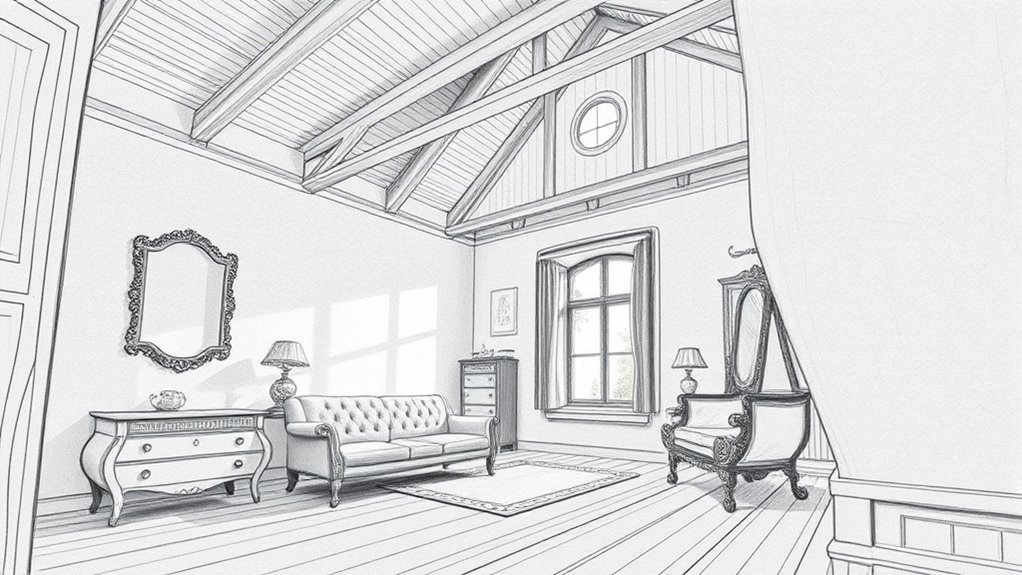

To draw realistic space and form, focus on understanding perspective, which guides how objects shrink or grow with distance. Use overlapping shapes and accurate shading to model volume and depth. Observe how light interacts with surfaces to create shadows and highlights that enhance three-dimensionality. Practice applying perspective lines and considering environmental context to position objects correctly. Keep exploring these techniques, and you’ll develop a stronger sense of space and form in your artwork.
Key Takeaways
- Use perspective lines to accurately position and size objects relative to their distance from the viewer.
- Overlap objects strategically to reinforce spatial relationships and create a sense of depth.
- Apply volumetric shading to convey form, using light and shadow to suggest three-dimensionality.
- Observe how light interacts with objects to place shadows and highlights accurately, enhancing realism.
- Practice sketching simple scenes, focusing on perspective, shading, and environmental context for improved spatial understanding.

Mastering realistic space and form in drawing begins with understanding how objects occupy and relate to their environment. When you focus on depth perception, you start to see how different elements interact in a three-dimensional space on a two-dimensional surface. Depth isn’t just about placing objects in front or behind each other; it involves creating convincing illusions that make your drawings feel alive and tangible. One of the key tools to achieve this is volumetric shading, which helps convey the form and solidity of your subjects. By carefully applying shading that reflects how light interacts with surfaces, you can suggest volume and weight, making flat sketches appear three-dimensional.
Understanding object placement and volumetric shading enhances depth and realism in your drawings.
To improve your depth perception, practice observing how light hits objects and how shadows fall. Notice the way shadows change as objects rotate or as the light source moves. This awareness allows you to place shadows and highlights accurately, enhancing the sense of space and volume. When you shade, don’t just darken areas randomly; think about the form’s orientation and the direction of the light. Use gradual transitions and subtle tonal variations to indicate curved surfaces, edges, and recesses. This technique, volumetric shading, is essential for translating flat shapes into believable three-dimensional forms.
In your drawing process, always consider the environment around your subject. Overlapping objects can create a sense of depth, but only if you handle their placement thoughtfully. Use perspective lines as guides to position objects correctly in space, ensuring that they shrink or grow in size relative to their distance from the viewer. Combining perspective with volumetric shading strengthens the illusion of space. For instance, a sphere in the foreground will have more defined shading, with sharp highlights and shadows, while a background object might have softer, less detailed shading to suggest distance.
Keep practicing these concepts by sketching simple objects and focusing on their placement and shading. Experiment with different light sources to see how shadows and highlights shift. Additionally, paying attention to materials and textures can help you understand how different surfaces reflect light, which is crucial for realistic shading. Over time, your ability to perceive depth accurately and render volumetric shading convincingly will improve, making your drawings more realistic. Remember, mastering space and form isn’t just about technical skills; it’s about training your eye to see the subtle cues that convey three-dimensionality. With patience and attentive observation, you’ll develop a more intuitive understanding of how to create depth and volume, bringing your drawings to life with authentic realism.
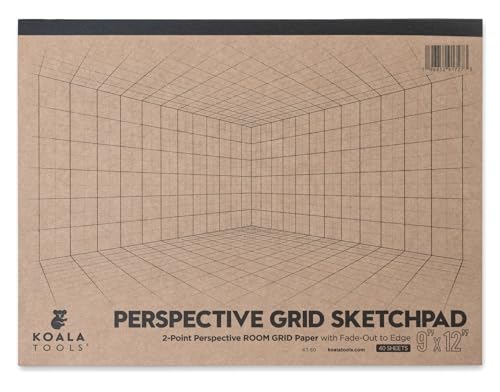
Koala Tools – 40-Page Drawing Pad for 2-Point Perspective, Room Grid Sketch Pad with 3D Virtual Walls Design, Gridded Graph Paper for Interior Room Design, Industrial, Architectural 9 x 12 inches
VIRTUAL WALL SKETCH PAD: 2-point perspective grid design allows for drawing realistic room interiors and layouts, as well…
As an affiliate, we earn on qualifying purchases.
As an affiliate, we earn on qualifying purchases.
Frequently Asked Questions
How Do I Choose the Right Perspective for Complex Scenes?
To choose the right perspective for complex scenes, focus on depth cues like overlapping objects, size variation, and atmospheric perspective. Use multiple vanishing points to accurately depict different angles and planes, creating a realistic sense of space. Think about where your viewer’s eye should be drawn and adjust your perspective accordingly. Experiment with different vanishing points and depth cues to find the most convincing, dynamic composition for your scene.
What Are Common Mistakes Beginners Make With Perspective?
You often fall into the trap of ignoring depth illusions and foreshortening techniques, making your scenes look flat or distorted. It’s a common mistake to overlook how perspective lines converge or to underestimate the importance of accurate scale. To improve, practice deepening your understanding of these techniques, always double-check your vanishing points, and remember that correct perspective creates convincing space and form.
How Can I Improve My Sense of Depth in Drawings?
To improve your sense of depth, focus on mastering foreshortening techniques and understanding spatial relationships. Practice changing the scale and angle of objects to create realistic perspective, making closer objects larger and distant ones smaller. Study how objects overlap and position themselves in space, and use shading to enhance depth. Regularly sketch from life or photos, and review your work critically to refine your sense of three-dimensionality.
What Tools Best Assist in Mastering Perspective Drawing?
You might think mastering perspective is complicated, but tools like perspective grids and vanishing points simplify the process. Using perspective grids helps you organize your drawing space accurately, while vanishing points guide your lines to create realistic depth. Practice regularly with these tools, and you’ll find your understanding of perspective improves rapidly, making your drawings more convincing and three-dimensional without frustration.
How Does Lighting Affect the Perception of Space and Form?
Lighting dramatically influences how you perceive space and form by creating shadow depth and highlight placement. When you position a light source, shadows become more defined, emphasizing the three-dimensionality of objects. Bright highlights draw attention to surfaces, making objects appear closer or more prominent. By carefully controlling shadow depth and highlight placement, you guide viewers’ eyes and enhance the realism of your drawing, making forms feel tangible and spatially accurate.
MARKART Professional Drawing Sketching Pencil Set – 14 Pieces,Graphite,(12B – 4H), Ideal for Drawing Art, Sketching, Shading, Artist Pencils for Beginners & Pro Artists
PREMIUM DRAWING SKETCH PENCIL SET – A wide variety of hardness for all your artwork needs. Includes 14…
As an affiliate, we earn on qualifying purchases.
As an affiliate, we earn on qualifying purchases.
Conclusion
Mastering perspective is like opening a secret door to a world of endless possibilities. When you understand how to draw space and form accurately, your art transforms from flat sketches to vibrant realities that breathe and stretch. Keep practicing, and you’ll find yourself painting with the confidence of an explorer charting new territory. Remember, every line you draw is a step closer to making your artwork a gateway to a universe full of depth and wonder.

N NOROCME 12 PCS Blending Stumps and Tortillions Paper Art Blenders with Sandpaper Pencil Sharpener Pointer for Student Artist Charcoal Sketch Drawing Tools
13 Pcs in Total: 6 pcs blending stumps(#1, #2, #3, #4, #5, #6); 6 pcs tortillions(#1, #2, #3),two…
As an affiliate, we earn on qualifying purchases.
As an affiliate, we earn on qualifying purchases.

Light, Shade and Shadow (Dover Art Instruction)
As an affiliate, we earn on qualifying purchases.
As an affiliate, we earn on qualifying purchases.