
TL;DR
A team of researchers has uncovered new mathematical patterns in Gaudí’s Sagrada Familia, providing insights into its intricate geometry. This discovery enhances understanding of the basilica’s design and ongoing building process.
Researchers have uncovered new mathematical principles underlying the design of Barcelona’s Sagrada Familia, providing fresh insights into the basilica’s complex geometric structure. This discovery offers a deeper understanding of Antoni Gaudí’s architectural innovation and has implications for its ongoing construction.
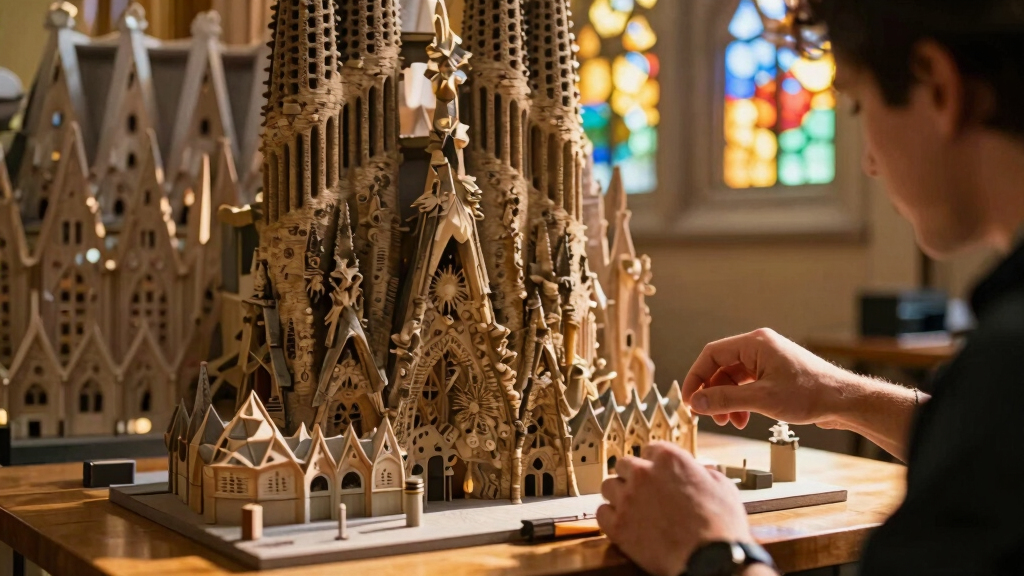
The research, conducted by a team of mathematicians and architects, identified specific geometric patterns and ratios that Gaudí used in the basilica’s design, which had previously remained largely unexplored. The team analyzed detailed architectural plans and 3D models, revealing the use of advanced mathematical concepts, including fractal-like patterns and the application of the Fibonacci sequence in the basilica’s proportions.
According to Dr. Maria López, lead researcher from the University of Barcelona, ‘Our findings suggest that Gaudí employed a sophisticated mathematical framework to ensure structural stability and aesthetic harmony. These patterns are embedded in the very fabric of the basilica’s design and are integral to its ongoing construction.’ The discovery could influence future restoration and building techniques, as well as inspire new architectural approaches.
Implications for Architectural Understanding and Construction
This discovery matters because it uncovers the mathematical foundation of one of the world’s most iconic architectural masterpieces. Understanding the geometric principles Gaudí used can improve preservation efforts, guide future construction, and deepen appreciation for his innovative approach. It also highlights the intersection of art and science in architectural design, emphasizing Gaudí’s role as both an artist and mathematician.
As an affiliate, we earn on qualifying purchases.
Historical and Architectural Context of Gaudí’s Work
Antoni Gaudí began work on the Sagrada Familia in 1882, and it remains unfinished despite over a century of construction. Known for his pioneering use of organic shapes and complex geometries, Gaudí integrated mathematical concepts into his designs to achieve structural stability and aesthetic harmony. Previous studies have recognized some of these patterns, but recent research reveals even more intricate mathematical frameworks that underpin the basilica’s design.
“Gaudí’s work was not only artistic but deeply mathematical. Our research uncovers the hidden geometric language embedded in the basilica’s structure.”
— Dr. Maria López
As an affiliate, we earn on qualifying purchases.
Unexplored Aspects of Gaudí’s Mathematical Framework
While the research has identified key geometric patterns, it is still unclear how extensively Gaudí applied these principles throughout the entire basilica. The full scope of his mathematical approach remains to be mapped, and some aspects of the design are still under analysis. Additionally, the practical application of these findings to ongoing construction is in early stages and requires further validation.
As an affiliate, we earn on qualifying purchases.
Future Research and Preservation Efforts Based on Findings
Researchers plan to publish detailed analyses of the mathematical patterns and collaborate with architects involved in the basilica’s construction and restoration. The team aims to develop new tools for preserving Gaudí’s design and potentially apply these principles to other architectural projects. Further studies will seek to map the full extent of Gaudí’s mathematical framework and its influence on structural stability.
As an affiliate, we earn on qualifying purchases.
Key Questions
How do these mathematical discoveries affect the ongoing construction of Sagrada Familia?
The findings could inform construction techniques, ensuring that new additions align with Gaudí’s original geometric principles, potentially improving structural stability and aesthetic fidelity.
Were these mathematical patterns known before this research?
Some patterns, such as the use of the Fibonacci sequence, were previously recognized, but the recent research uncovers a much more complex and systematic mathematical framework embedded in Gaudí’s design.
Will this discovery influence restoration efforts?
Yes, understanding Gaudí’s mathematical principles can guide more accurate restoration, helping preserve the basilica’s original geometric harmony.
Are these mathematical principles unique to Sagrada Familia?
While Gaudí’s application of mathematics was especially intricate in Sagrada Familia, similar principles may be present in his other works, and ongoing research may reveal more such patterns.
Source: hn