
Post-Impressionism builds on Impressionism by emphasizing emotional depth, symbolism, and new techniques. Artists like Van Gogh use bold colors and textured brushwork to express turmoil and spirituality, while Cézanne focuses on structure and underlying forms to reveal deeper truths. They move beyond capturing fleeting light to explore personal visions and psychological states. If you explore further, you’ll discover how their innovations laid the foundation for modern art’s focus on individual expression and meaning.
Key Takeaways
- Post-Impressionism emerged as a response to Impressionism, emphasizing personal expression, symbolism, and psychological depth.
- Artists like Van Gogh and Cézanne used bold colors, textured brushwork, and structural techniques to convey emotion and underlying truths.
- Van Gogh’s vibrant, swirling compositions evoke mood and turmoil, while Cézanne focused on form, structure, and underlying architecture.
- The movement prioritized symbolism and innovative techniques, laying the groundwork for modern art’s focus on individual vision.
- Post-Impressionism shifted art toward deeper meaning, emotional resonance, and experimental use of materials and color.
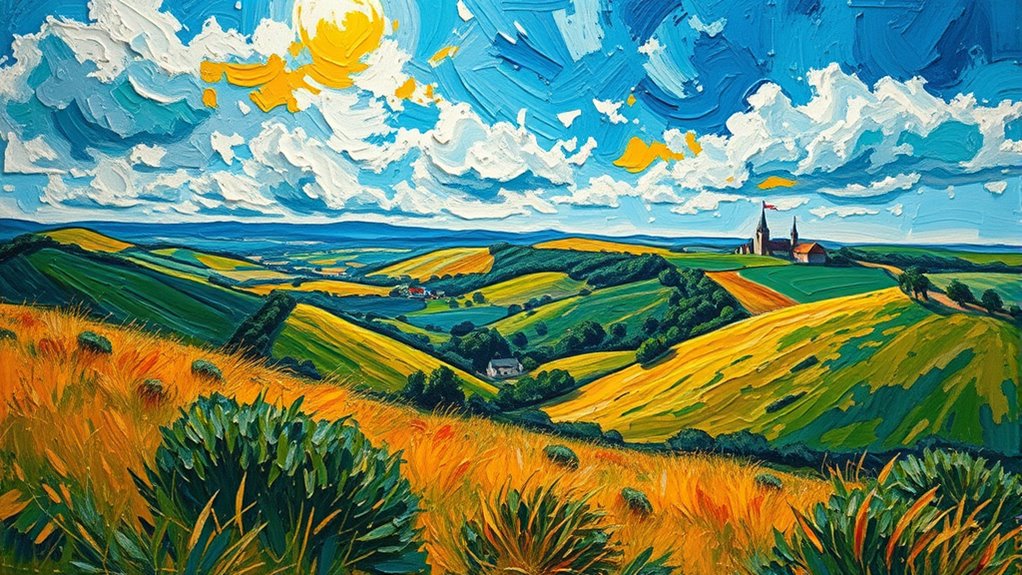
Emerging as a response to Impressionism, Post-Impressionism is an art movement that pushed artists beyond the limits of naturalistic depiction. You’ll notice that artists like Van Gogh, Cézanne, and Gauguin sought to infuse their works with deeper meaning and personal expression, moving away from the fleeting effects of light and color that defined Impressionism. Instead, they explored symbolism, delving into emotional, spiritual, and psychological themes. This exploration of symbolism allows you to see beyond the surface, as each brushstroke and color choice often carries layered significance. For instance, Van Gogh’s swirling skies and vibrant yellows aren’t just visual choices—they evoke intense emotion and inner turmoil. Similarly, Cézanne’s approach to form and structure reveals a desire to uncover underlying truths, making his work a bridge between the natural world and abstract interpretation.
Color theory analysis plays a vital role in Post-Impressionism, enabling you to understand how artists manipulated hues to evoke specific moods and psychological states. Van Gogh, for example, used bold, contrasting colors to create vibrancy and emotional intensity, often applying thick, textured paint that invites you to feel the energy radiating from his canvases. Cézanne, on the other hand, approached color with a more analytical mindset. He used subtle shifts in hue and carefully layered tones to build form and depth, emphasizing the structural qualities of his subjects. You’ll find that this focus on color as a tool for structure rather than mere decoration marks a significant departure from Impressionism’s emphasis on capturing natural light. Instead, Post-Impressionists used color to communicate mood, symbolism, and a deeper understanding of their subjects.
Furthermore, the innovative techniques employed by Post-Impressionists often incorporated materials and textures, which enhanced the expressiveness of their work and set the stage for modern artistic explorations. As you study their works, you’ll notice that these artists experimented with different techniques to express their visions. Van Gogh’s expressive brushwork and intense colors create a sense of movement and emotional depth, while Cézanne’s methodical layering and geometric simplification aim to reveal the underlying architecture of reality. Their innovations in symbolism exploration and color theory analysis show a deliberate effort to go beyond mere representation, inviting you to interpret their paintings on a psychological and conceptual level. These techniques collectively mark a pivotal shift in art, emphasizing personal vision and emotional resonance over straightforward realism. By engaging with their work, you gain insight into how Post-Impressionism laid the groundwork for modern art’s focus on individual expression and subjective experience.
Frequently Asked Questions
How Did Post‑Impressionism Influence Modern Abstract Art?
Post-Impressionism influences modern abstract art by emphasizing emotional expression through bold colors and innovative techniques. You see artists exploring color theory to evoke mood and deepen emotional impact, moving beyond realistic representation. This approach encourages you to focus on personal expression and subjective experience, shaping abstract art’s emphasis on form, color, and emotion. As a result, Post-Impressionists inspire artists to break traditional boundaries and prioritize individual perception and feeling.
What Were the Key Technological Advances During the Post‑Impressionist Era?
During the post-impressionist era, you encounter key technological advances like digital techniques and innovative applications of color theory. These breakthroughs allow you to experiment with new forms, deepen your understanding of color, and push artistic boundaries. You embrace these tools to create more expressive, personal works, revolutionizing your approach to art. As you explore these advances, you shape a foundation for modern artistic innovation and visual communication.
Which Lesser-Known Artists Contributed to Post‑Impressionism’s Development?
You’ll find hidden innovators like Paul Sérusier and Georges Seurat, whose regional influences shaped post-impressionism. Sérusier’s bold, symbolic style and Seurat’s pointillism expanded artistic boundaries. These lesser-known artists challenged traditional techniques and brought fresh perspectives, contributing profoundly to the movement’s development. By exploring regional influences, they pushed post-impressionism beyond its core, fostering experimentation and laying groundwork for future modernist artists.
How Did Cultural and Political Contexts Shape Post‑Impressionist Artworks?
You see political upheavals and cultural identity explode onto post-impressionist canvases like wild fireworks, transforming the art world. These upheavals push artists to challenge tradition, infuse bold colors, and experiment with form. Your work reflects a desire to express national pride or turmoil, making each brushstroke a vivid statement of cultural identity amid chaos. The era’s turbulent politics ignite creativity, shaping artworks that scream with emotion and defy convention.
What Is the Legacy of Post‑Impressionism in Contemporary Art?
You see the legacy of post-impressionism in contemporary art through its focus on symbolic expression and urban aesthetics. Artists today experiment with bold colors and emotional depth, echoing Van Gogh’s brushwork and Cézanne’s structure. You might notice how modern works capture city life’s vibrancy or use symbolism to convey complex themes. This movement’s emphasis on personal vision continues to inspire innovative, expressive art forms today.
Conclusion
As you explore Post-Impressionism, you realize it gently nudges art beyond the familiar, hinting at new possibilities beneath the surface. Van Gogh’s vibrant emotions and Cézanne’s structured visions remind you that progress often whispers rather than shouts. Embrace these subtle shifts, for they invite you to see the world through a softer lens—where change isn’t loud, but quietly profound, shaping the future of art in ways you might not immediately notice.