
Mannerism in 16th-century art emphasizes elegance through deliberate distortion and exaggerated forms. You’ll notice elongated figures, twisted poses, and unusual perspectives that evoke emotional tension and symbolic meaning. Artists challenge traditional harmony by creating complex, asymmetrical compositions filled with intricate details and unusual colors. These choices deepen the viewer’s engagement and suggest deeper emotions or ideas. If you explore further, you’ll discover how this movement transformed artistic expression beyond classical norms.
Key Takeaways
- Mannerism emerged in the 16th century as a reaction to High Renaissance harmony, emphasizing exaggeration and complexity.
- Artists manipulated proportions and poses to evoke symbolic meanings and emotional tension.
- Features include elongated figures, twisted compositions, and unusual color palettes, creating a sense of elegance and artificiality.
- Mannerism challenged traditional notions of beauty, prioritizing emotional depth, mystery, and conceptual complexity.
- Its innovative style influenced later art movements and remains notable for its sophisticated, thought-provoking visual language.

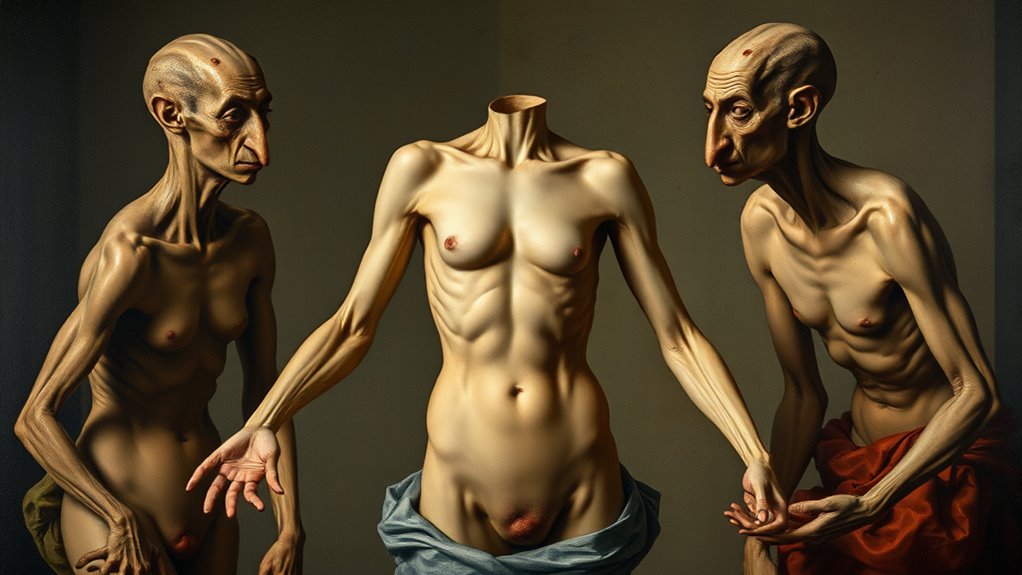
Mannerism emerged in the 16th century as a reaction against the harmonious ideals of the High Renaissance, characterized by its focus on exaggerated proportions, complex compositions, and unusual perspectives. As you explore this artistic movement, you’ll notice how artists deliberately manipulate forms to evoke specific symbolic meanings. Instead of endeavoring for ideal beauty and balance, Mannerists often emphasized emotional tension, ambiguity, and sophistication. They used elongated figures, twisted poses, and disproportionate features to communicate complex ideas or to evoke a sense of mystery and elegance. These stylistic choices are not random; they serve to deepen the viewer’s engagement with the artwork, inviting interpretations rooted in symbolism. For example, the elongated limbs might symbolize spiritual aspiration or divine grace, while distorted facial expressions can convey inner turmoil or transcendent experiences. This layered use of symbolism adds depth and nuance to Mannerist works, setting them apart from the more harmonious compositions of the High Renaissance. Additionally, the deliberate distortion of natural proportions often reflects the artists’ desire to express symbolic complexity, emphasizing emotional and conceptual over realistic depiction.
Stylistic influences from earlier periods are evident in Mannerism, yet artists pushed these ideas to new extremes. You’ll see how they borrow from the naturalism of the Renaissance but distort it intentionally to create a sense of artificiality and elegance. The complex compositions often involve crowded, asymmetrical arrangements, guiding the eye around the canvas in unconventional ways. Artists like Parmigianino and Pontormo, for instance, don’t shy away from bizarre poses or elongated figures that challenge traditional notions of beauty. These stylistic influences serve a dual purpose: they demonstrate technical mastery while also emphasizing the symbolic and emotional content of their work. Mannerists sought to evoke a sense of wonder, unease, or introspection, and their stylistic choices reflect that. They often used unusual color palettes and intricate details to heighten the sense of sophistication and to create a visual language that was both elegant and unsettling.
In essence, Mannerism’s unique style invites you to look beyond surface beauty and consider the underlying symbolic meanings. Its exaggerated proportions and complex compositions are carefully crafted to express the nuanced emotions and ideas that the High Renaissance’s strict harmony couldn’t accommodate. By understanding these stylistic influences and the symbolic significance behind them, you gain a richer appreciation for how Mannerist artists challenged conventions and pushed the boundaries of artistic expression, creating a movement that remains striking and thought-provoking even centuries later.
Frequently Asked Questions
How Did Mannerism Influence Later Art Movements?
You see that mannerism influences later art movements by inspiring avant-garde experiments and pushing stylistic evolution. Artists appreciated its focus on distortion, elegance, and emotional expression, which challenged classical norms. This encouraged modern artists to explore individuality and innovation, leading to diverse styles like Baroque and Expressionism. Mannerism’s emphasis on personal vision and experimental techniques remains a foundation for artistic freedom and creative exploration today.
What Are Key Visual Features Distinguishing Mannerist Art?
You’ll notice that mannerist art often features elongated figures, sometimes stretching up to twice their normal height, creating a sense of elegance and distortion. Unusual color schemes, like vivid reds and unnatural greens, also stand out, heightening the dreamlike quality. These visual features give mannerism its distinctive style, emphasizing artificiality over naturalism, and making the artwork feel both elegant and unsettling.
Who Were the Leading Artists of Mannerism?
You should look at artists like Parmigianino, Pontormo, and Bronzino, who led Mannerist portraiture with elongated figures and unusual poses. In sculpture, you’ll find artists like Cellini, known for his Mannerist sculpture’s elegance and exaggerated forms. These artists pushed traditional boundaries, emphasizing distortion and sophistication, which defined the Mannerist style and influenced many subsequent generations.
How Was Mannerism Received by Contemporary Audiences?
Your eyes might have struggled to grasp the swirling, unconventional forms, as the public reception was mixed; many found mannerism’s elegance and distortion alluring, yet others saw stylistic controversies as unsettling. Some appreciated its inventive flair, while others criticized it for abandoning classical harmony. The era’s daring approach sparked debate, making mannerism a provocative art form that challenged viewers’ expectations and stirred enduring conversations about beauty and expression.
What Cultural Factors Prompted Mannerist Style Development?
You see that cultural shifts during the Renaissance sparked artistic innovation, prompting the development of the Mannerist style. As society experienced political upheaval, religious conflicts, and a fascination with individualism, artists responded by exaggerating proportions, twisting forms, and emphasizing elegance. These changes reflected a desire to challenge classical ideals, leading to a style that conveyed emotion, complexity, and sophistication, shaping the unique aesthetic of the 16th century.
Conclusion
As you step back from the swirling, elongated forms of Mannerism, you realize it’s like gazing into a distorted mirror that reflects both beauty and chaos. This art style dances on the edge of perfection, teasing your senses with its elegance while twisting reality into unexpected shapes. Mannerism invites you to see beyond the surface, where distortion becomes a vessel for emotion and innovation, forever transforming the canvas into a mesmerizing playground of imagination.