TL;DR

Get art and craft supplies delivered free — and shop member deals
- Fast, free delivery on millions of items
- Access to Prime Big Deal Days deals on October 6–7
- Prime Video, Amazon Music and more included
A Colossal report published in October 2026 profiles London-based artist Hannah Lim’s sculptural snuff bottles, which reinterpret a small historical Chinese vessel at a much larger scale. Lim connects the works to her British-Singaporean heritage, research into Chinoiserie and creatures from classical Chinese literature. Her solo exhibition Reimaginings is on view at the Museum of East Asian Art in Bath through November 14.
London-based artist Hannah Lim is presenting oversized, sculptural interpretations of Chinese snuff bottles that draw on her British-Singaporean heritage, historical ceramics and classical Chinese literature, according to a report published by Colossal in October 2026. The development brings attention to a body of work that reconsiders how Asian visual traditions have been adapted for Western audiences, while Lim’s solo exhibition Reimaginings is on view at the Museum of East Asian Art in Bath through November 14.
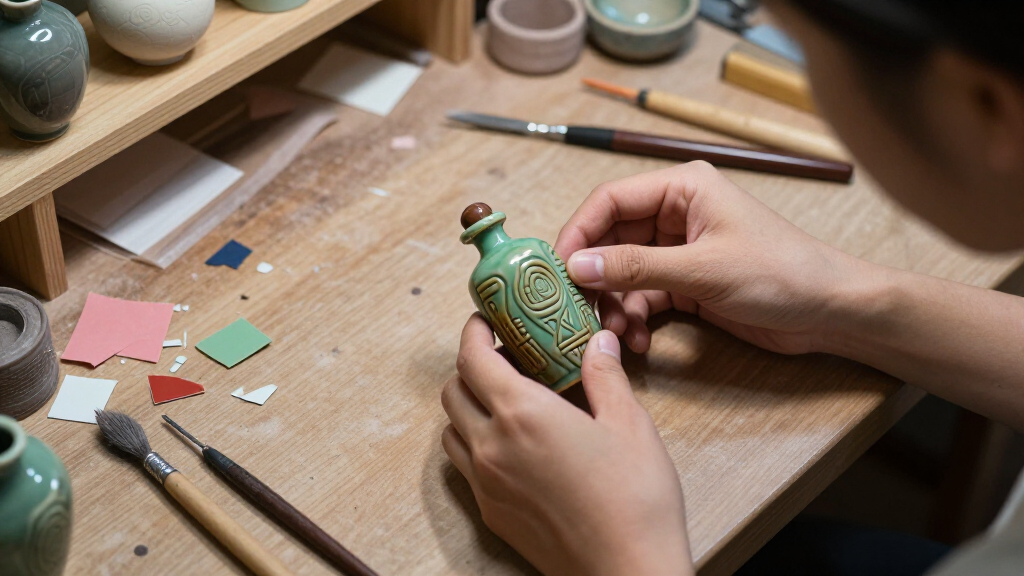
Lim’s bottles take their form from small, portable vessels used to carry snuff, a powdered, scented tobacco inhaled through the nose. Traditional examples were typically only a few inches in size. Lim instead makes sculptures several inches tall that generally require both hands to hold, shifting the object from a discreet container toward an artwork whose decoration and scale command attention.
According to Colossal, Lim first became interested in the bottles after seeing examples in museum collections around the United Kingdom. Their varied, ornate designs led her to experiment with related motifs. She uses polymer clay and Jesmonite, a casting material made from mineral powder and liquid acrylic polymer, then finishes the pieces with chalk, acrylic paint and gloss. Some include painted or raised portraits of animals and imaginary beings.
The works also carry a small structural reference to their historical models: Lim hides a hanging charm inside each lid, recalling the tiny spoon attached to the lid of a traditional snuff bottle. The report names works including “Phoenix Spirit House Snuff Bottle,” “Sleeping Tiger Snuff Bottle,” “Midnight Crane Snuff Bottle 1” and “Double Fish Snuff Bottle.”
Reworking Chinoiserie Through Sculpture
Lim’s work addresses Chinoiserie, the 17th- and 18th-century European design fashion for imitating Chinese and other Asian motifs for Western consumers. That history matters because decorative forms can carry traces of unequal cultural exchange as well as artistic influence. Lim says she aims to revisit the practice more conscientiously, using research and personal heritage rather than simply repeating its visual conventions.
The enlarged format makes that reconsideration visible. Traditional bottles were designed to be carried and put away; Lim’s versions are large enough to be held in both hands and viewed as sculptural objects. Their combination of recognizable bottle forms, invented creatures and hidden charms connects material history with contemporary interpretation. The report describes the artist’s approach and intentions, but does not present an independent assessment of how audiences or scholars have received the work.
large sculptural snuff bottle replica
As an affiliate, we earn on qualifying purchases.
As an affiliate, we earn on qualifying purchases.
From Portable Vessel to Artwork
Snuff bottles became popular in China in the 17th century, as the use of snuff spread among affluent consumers. The tobacco originated in the Americas; users took the powdered substance with a small spoon and inhaled it. The containers’ compact size and elaborate decoration suited both practical use and display. Lim’s work borrows from that object history while changing its scale, materials and function.
Her research also draws on The Classic of Mountains and Seas, an ancient Chinese text described in the source report as a fantastical account of more than 550 mountains and 300 waterways. Lim says descriptions of the creatures in the text inform recent sculptures and paintings. Her wider practice includes work with metal, laser-cut elements in the “Orchid Table,” and bespoke frames designed to extend the imagery of her paintings.
Chinese mythology animal figurines sculpture
As an affiliate, we earn on qualifying purchases.
As an affiliate, we earn on qualifying purchases.
Details Beyond the Exhibition Report
The report does not give a full exhibition checklist, attendance figures, sales information or details about the museum’s programming around Reimaginings. It also does not specify the dimensions or completion dates of each named bottle. Lim’s comments describe her intentions and research; the report does not establish how every individual sculpture relates to a particular cultural source.
Further details about the planned Paddington public artwork, including its final form, exact installation date and commissioning arrangements, are not provided. The report says Lim will unveil it later in 2026, but those details remain unconfirmed in the available material.
handmade polymer clay art sculptures
As an affiliate, we earn on qualifying purchases.
As an affiliate, we earn on qualifying purchases.
Bath Show and Planned Public Artwork
Lim’s solo exhibition Reimaginings remains on view at the Museum of East Asian Art in Bath through November 14, 2026, according to the report. Some of her works are also due to be shown later in October with Cynthia Corbett Gallery in Paris. The report does not name the specific works or give dates for that presentation.
Later in 2026, Lim is expected to unveil a new public artwork in Paddington, London. The source offers no installation schedule or further description, so those details will need to be confirmed through subsequent announcements. Lim is also continuing experiments with metal and framed paintings, extending the material and display questions present in the snuff-bottle series.
As an affiliate, we earn on qualifying purchases.
Key Questions
What is Hannah Lim’s snuff-bottle series?
It is a group of large sculptural works inspired by traditional Chinese snuff bottles, which were small containers for powdered tobacco. Lim changes their scale and decoration, using materials including polymer clay and Jesmonite.
How does Lim connect the sculptures to her heritage?
Lim has said the early works highlighted personal aspects of her British-Singaporean heritage. She describes the series as developing over time to reflect her research into historical styles and other sources.
Where can visitors see Reimaginings?
The solo exhibition is at the Museum of East Asian Art in Bath through November 14, 2026, according to the report.
What literary source informs Lim’s recent sculptures?
Lim has drawn on The Classic of Mountains and Seas, an ancient Chinese text featuring fantastical accounts of mountains, waterways and creatures.
What is known about Lim’s Paddington public artwork?
The report says Lim plans to unveil a new public artwork in Paddington, London, later in 2026. Its form, exact location and installation date were not provided.
Source: rss
Halloween Picks
halloween
As an affiliate, we earn on qualifying purchases.