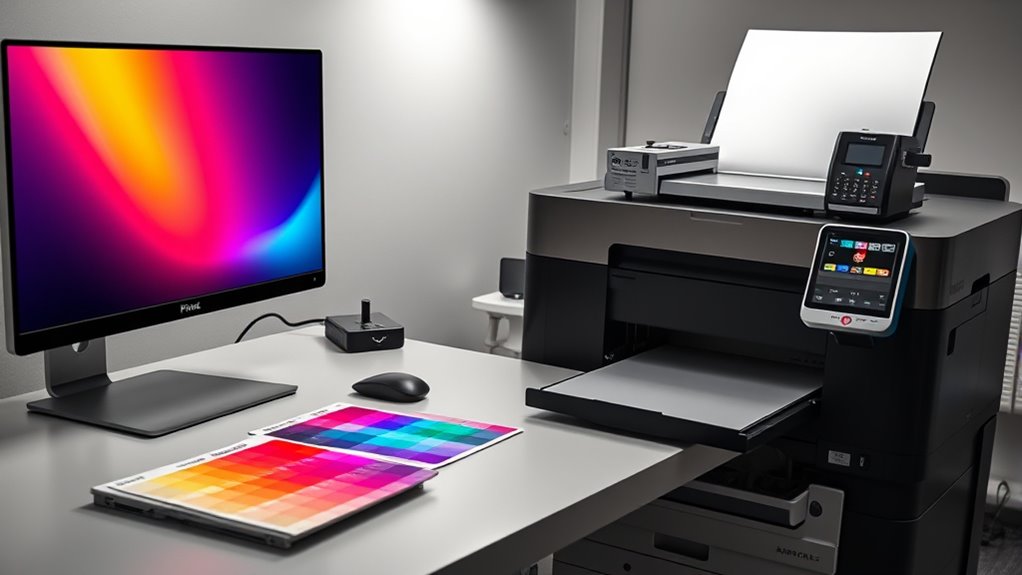

A solid color management workflow helps you maintain consistent and accurate colors across all devices and media in your print studio. Start by calibrating your monitors with colorimeters to ensure on-screen colors are true to the final print. Regularly calibrate printers with test charts and update profiles for ink and paper changes. Document all calibration steps and use software to streamline the process. Keep these practices in place, and you’ll improve color fidelity—learn more on how to optimize each stage.
Key Takeaways
- Establish a consistent color management workflow combining monitor calibration, printer profiling, and standardized procedures.
- Regularly calibrate monitors with colorimeters to ensure on-screen accuracy matching output requirements.
- Perform periodic printer calibration using test charts and spectrophotometers for precise color consistency.
- Maintain detailed documentation of calibration data, profiles, and procedures for quality control and troubleshooting.
- Integrate color management software to automate calibration processes, monitor device status, and unify color spaces.
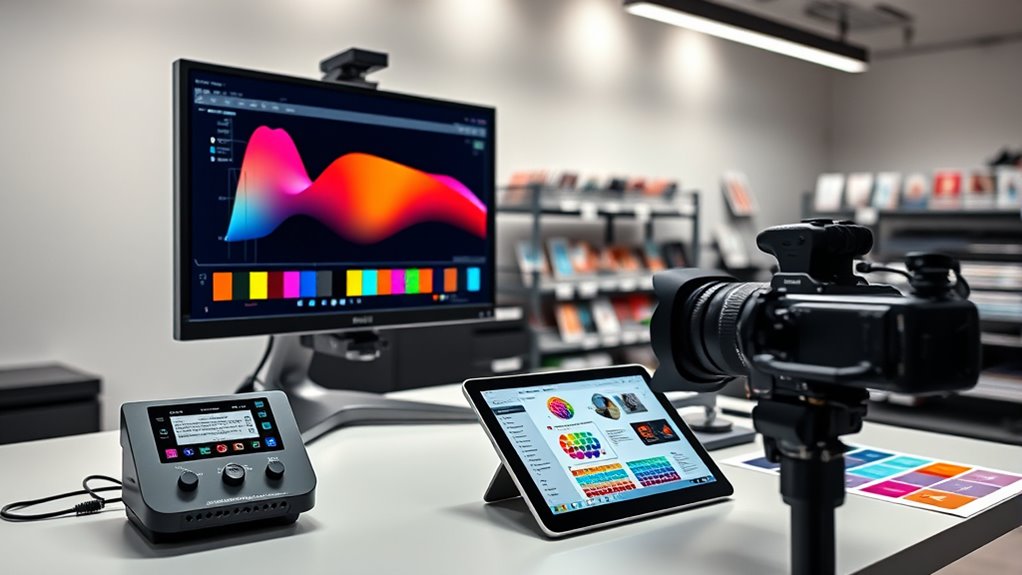
A well-structured color management workflow is indispensable for guaranteeing consistent and accurate colors across all stages of your creative process. When you establish effective calibration procedures, you lay the foundation for achieving reliable color consistency. Calibration procedures involve regularly adjusting monitors, printers, and other devices to match a standardized color profile. This step is critical because it ensures that what you see on your screen accurately represents the final printed output. Without proper calibration, colors can shift unexpectedly, leading to wasted time and materials, and potentially compromising your clients’ expectations.
In your workflow, start by calibrating your monitor using a colorimeter or spectrophotometer. This device measures your screen’s color output and helps you create a custom profile that corrects any deviations from standard color spaces like sRGB or Adobe RGB. Consistent calibration routines—performed weekly or bi-weekly—are essential for maintaining color accuracy. Once your monitor is calibrated, you can trust that the colors you see are true to the intended design, reducing guesswork when preparing files for printing.
Next, focus on calibration procedures for your printers. Printer calibration involves printing test charts and measuring the output with a spectrophotometer. This process helps you build an accurate printer profile that accounts for ink, paper, and environmental factors. Proper printer calibration ensures that the colors you design digitally translate seamlessly onto physical media, maintaining color consistency throughout your print runs. Regular calibration of your printing devices helps prevent color drift over time, which can occur due to aging inks or media changes, ultimately saving you time and resources.
Implementing a standardized workflow for color management means documenting calibration procedures and sticking to them. Keep detailed records of device profiles, calibration dates, and test results. This way, you can quickly identify when a device needs recalibration and ensure that all team members follow the same practices. Additionally, staying informed about color profiling techniques and best practices can enhance your calibration efforts and improve overall color fidelity. By doing so, you eliminate guesswork and reduce the risk of inconsistent color reproduction, which can severely impact your studio’s reputation.
Finally, integrate color management software into your workflow to streamline calibration and profile management. These tools can automate parts of the process, alert you when calibration is overdue, and help you maintain a unified color space across all devices. When you consistently follow calibration procedures and prioritize color consistency, your print studio will produce work that’s not only visually stunning but also reliably reproduces your creative vision from digital to physical media. This disciplined approach ultimately boosts client satisfaction and elevates your studio’s professionalism.

Crayola Colored Pencils (36ct), Teacher School Supplies for Kids & Adults, Preschool Classroom Must Haves, Coloring Gift, Ages 3+
- Number of Pencils: 36 colored pencils
- Ideal for Kids: Perfect for children’s art
- Educational Use: Great for school activities
As an affiliate, we earn on qualifying purchases.
Frequently Asked Questions
How Often Should Calibration Be Performed?
You should perform color calibration frequently to maintain color accuracy. The ideal calibration frequency depends on your equipment and workload, but a good rule of thumb is to follow a regular maintenance schedule—typically weekly or bi-weekly. Keep an eye on color consistency, and recalibrate whenever you notice color shifts or after major print runs. Regular calibration guarantees your prints stay true to your intended colors and reduces costly reprints.
What Are Common Color Errors in Print Studios?
Color errors in print studios are like a painter’s missteps—disappointing yet fixable. You often face issues with color matching, where tones don’t align with your vision, and ink consistency problems that cause uneven coverage. These errors can stem from calibration lapses, inconsistent ink batches, or improper lighting. Staying vigilant with regular calibration and monitoring ink quality helps you achieve accurate colors and flawless prints every time.
How Do Lighting Conditions Affect Color Accuracy?
Lighting conditions critically impact color accuracy because lighting consistency affects how colors appear. Variations in ambient influence, such as different light sources or intensities, can cause colors to look different from what they truly are. You should always check colors under controlled lighting environments to ensure consistency. By maintaining stable lighting, you minimize color shifts and achieve more accurate, predictable results in your prints.
Which Software Tools Are Best for Color Management?
Perfectly pinpointing potent software tools boosts your color management prowess. You’ll want solutions that streamline spectrophotometer calibration and simplify ICC profile creation, such as X-Rite’s i1Profiler or ColorThink Pro. These tools tackle technical tasks with intuitive interfaces, guaranteeing accurate color consistency. By choosing reliable software, you guarantee your colors stay true, transforming your print projects into pristine, professional products.
How to Train Staff on Color Consistency?
You should start by educating your staff on color perception and color psychology, helping them understand how colors influence mood and branding. Conduct hands-on training sessions to familiarize them with color management tools and standards, emphasizing consistency across projects. Encourage practice and feedback to improve their skills. By deepening their understanding of color perception, your team will produce more accurate, visually appealing prints that align with clients’ expectations.

Elmer's All Purpose School Glue Sticks, Acid-Free and Washable, Clear, 7 Grams, 30 Count - Craft Projects, Poster, Classroom Supplies, #1 Teacher Brand
- Versatile Bonding: Bonds paper, cardboard, foam, and more
- Safe and Washable: Non-toxic, acid-free, washable, photo safe
- Smooth Application: Applies smoothly without clumps
As an affiliate, we earn on qualifying purchases.
Conclusion
Implementing a solid color management workflow guarantees your print studio delivers consistent, high-quality results every time. Did you know that using proper calibration and profiling can reduce color discrepancies by up to 80%? By following best practices, you’ll save time, minimize reprints, and boost client satisfaction. Don’t underestimate the power of precise color control—it’s the key to elevating your print studio’s reputation and maintaining a competitive edge in the industry.

Crayola Construction Paper Bulk Pack (480 Sheets) – 10 Assorted Colors, 9x12, Teacher School Supplies & Classroom Must Haves, Card Making Craft Supplies, Art Paper
- Bulk Pack of 480 Sheets: Includes 48 pages per color, 10 colors
- Trusted Teacher Supplies: Ideal for classrooms and homeschool
- Perfect for Arts & Crafts: Suitable for school projects and crafts
As an affiliate, we earn on qualifying purchases.

Arts & Crafts Supplies Kits & Materials Set for Kids, Toddler - Carl & Kay
- All-Inclusive Craft Kit: Complete set of craft supplies for kids
- Huge Assortment of Materials: Includes pipe cleaners, sticks, buttons, and more
- Easy to Store and Carry: Neatly packed in zipper bags for portability
As an affiliate, we earn on qualifying purchases.