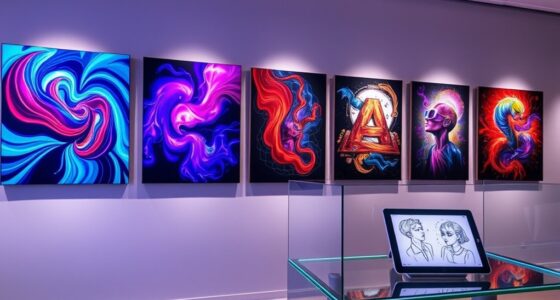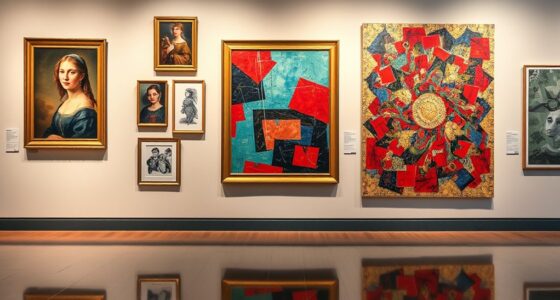

Cubism, pioneered by Picasso and Braque, transforms how you see objects by breaking them into geometric shapes and merging multiple perspectives in one image. It challenges traditional views, showing you different sides of a subject simultaneously. This style emphasizes structure over realistic detail and uses collage materials to add texture. By exploring this innovative approach, you’ll discover how Cubism reshaped modern art—keep exploring to uncover more about this influential movement.
Key Takeaways
- Picasso and Braque pioneered Cubism, transforming traditional perspective by depicting objects from multiple viewpoints simultaneously.
- Cubism breaks objects into geometric facets, emphasizing abstraction and deconstruction over realistic representation.
- Analytical Cubism focuses on dissecting forms into facets, while Synthetic Cubism incorporates collage and textured materials.
- The movement challenges conventional space perception, highlighting geometric relationships and multiple dimensions on a flat surface.
- Cubism’s fragmentation of perspective redefined modern art, emphasizing structure, abstraction, and new perceptions of reality.
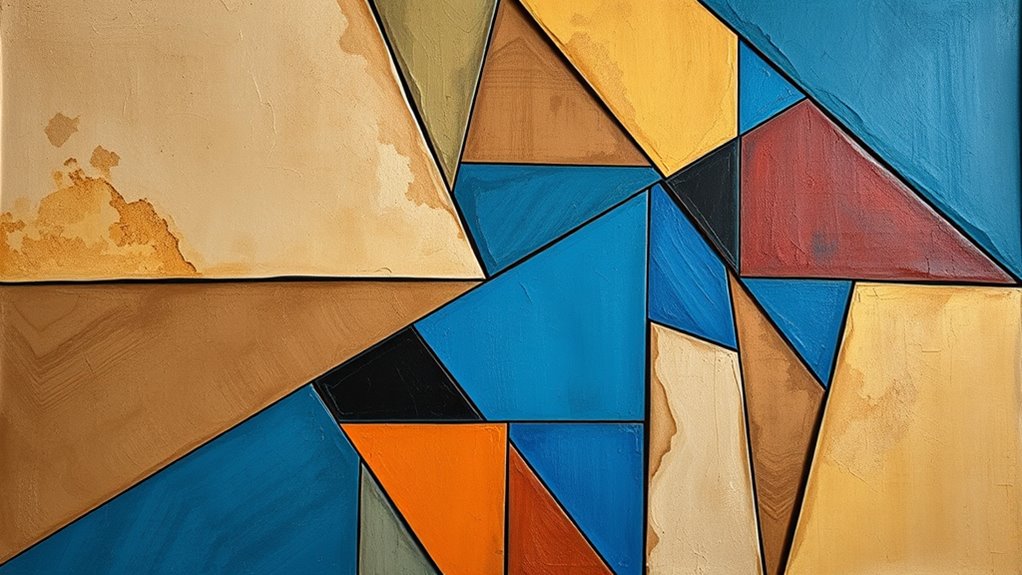
Cubism revolutionized modern art by breaking away from traditional perspectives and presenting objects from multiple viewpoints simultaneously. This innovative approach pushes you to see the subject from different angles at once, creating a fragmented yet cohesive image. Artists like Picasso and Braque pioneered this movement, transforming how you interpret space and form. As you observe a cubist piece, you notice that shapes are broken into geometric facets, emphasizing the idea of geometric abstraction—where complex forms are simplified into basic geometric shapes. This abstraction isn’t random; it’s a deliberate effort to depict multiple dimensions within a flat surface, forcing you to reconsider the conventional rules of perspective.
Synthetic cubism, a later phase of the movement, takes this exploration further. Instead of just fragmenting objects, it introduces new textures and materials—like paper, cloth, or even bits of newspaper—into the artwork. You see how artists incorporate these elements to build up the composition, enriching the visual experience and adding a tactile dimension. Synthetic cubism makes you realize that art can be more than just paint on canvas; it can be a collage of various textures and materials, blending reality with abstraction. This technique also simplifies forms compared to earlier analytical cubism, making the images more recognizable but still layered with multiple viewpoints.
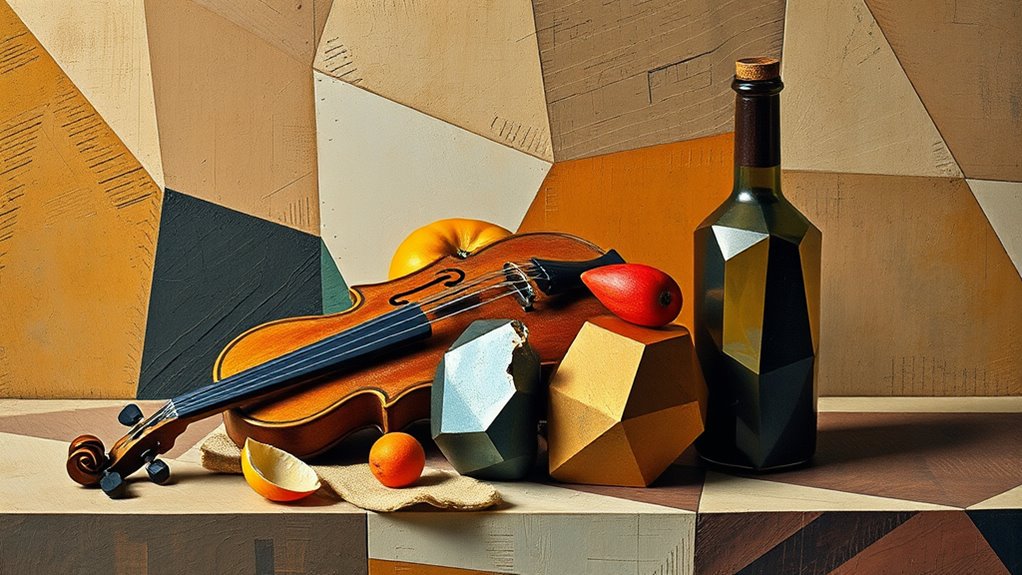
As you analyze cubist works, you notice how the emphasis on geometric abstraction helps to deconstruct the subject into fundamental shapes. This process allows artists to emphasize the essence of objects rather than their realistic details. You might see a still life where fruit, bottles, and tableware are all reduced to angular planes and overlapping facets. The movement invites you to see the world through a new lens—one that values structure and form over realistic representation. Cubism’s focus on geometric abstraction challenges your perception of space, making you aware of the underlying geometric relationships that define the objects around you.
Furthermore, the theoretical underpinning of art theory plays a crucial role in understanding how Cubism challenged traditional visual conventions and introduced new ways of perceiving reality.

Soucolor Art Supplies, 192-Pack Deluxe Art Set Drawing Painting Supplies Kit with Acrylic Pad, Watercolor Pad, Sketch Book, Canvases, Acrylic Paint, Crayons, Pencils, Gifts for Artist Adults Teen Kids
【Complete ALL-IN-ONE Deluxe Wooden Art Box】Soucolor 192-pack Deluxe Art Set includes a wide range of art supplies: 60…
As an affiliate, we earn on qualifying purchases.
As an affiliate, we earn on qualifying purchases.
Frequently Asked Questions
How Did Cubism Influence Modern Digital Art?
Cubism influences modern digital art by inspiring techniques like digital collage and pixelated abstraction. You can incorporate fragmented perspectives and geometric shapes, creating layered, multidimensional visuals. Digital artists use these concepts to challenge traditional representation, blending real and virtual worlds. This approach encourages experimentation with form and perspective, allowing you to explore new aesthetic possibilities and push boundaries in digital media, much like Cubism revolutionized early modern art.
Were There Any Major Critics Opposed to Cubism?
You might think everyone loved cubism, but art critic opposition and traditionalist resistance ran deep. Critics scoffed at its fractured perspectives, claiming it was chaos disguised as art. They saw cubism as a threat to classical beauty and mastery. Their disdain reflected a broader fear of change, proving that even revolutionary art must face the stubborn resistance of those clinging to tradition. Sometimes, progress feels like a rebellious act.
What Materials Did Cubist Artists Commonly Use?
You’ll find that cubist artists commonly used materials like newspaper clippings, labels, and various textured papers in collage techniques to add depth and complexity. They often incorporated geometric shapes and fragmented surfaces, blending different materials on canvas or board. This mix of traditional and unconventional materials helped create the layered, multi-perspective look characteristic of cubism, emphasizing abstraction and breaking away from realistic representation.
How Did Cubism Impact Sculpture and Architecture?
Imagine buildings with jagged, geometric forms and sculptures that seem to twist in space—Cubism transforms architecture and sculpture into visual puzzles. You see, it introduces spatial ambiguity, making structures appear multiple perspectives at once. This approach pushes architects and sculptors to experiment with fragmented, geometric designs, breaking traditional forms and creating innovative, dynamic works that challenge your perception of space and form.
Did Other Art Movements Emerge Directly From Cubism?
Yes, other art movements emerged directly from Cubism, focusing on abstract forms and geometric analysis. You’ll see Futurism, which emphasizes movement and modernity through dynamic shapes, and Orphism, exploring vivid colors with abstracted forms. These movements build on Cubism’s fragmentation, pushing it further into abstraction and geometric exploration, inspiring artists to experiment with non-representational art that emphasizes structure, form, and innovative perspectives.

16 Pieces Stencils for Kids Geometric Shapes Children Simple Painting Stencils Colorful Drawing Templates Art Painting for Toddlers Preschooler DIY Craft(5.9 x 5.9 Inches,Elegant Style)
What you will get: we will provide you with 16 pieces geometric shape stencils in 16 different styles,…
As an affiliate, we earn on qualifying purchases.
As an affiliate, we earn on qualifying purchases.
Conclusion
You see, cubism challenges traditional perspectives, revealing that reality isn’t fixed but fragmented. By examining Picasso and Braque’s innovations, you realize their work suggests multiple viewpoints coexist, questioning the very nature of perception. This theory of layered perspectives adds depth, prompting you to contemplate how our understanding of the world is shaped by perception itself. Ultimately, cubism invites you to see beyond surface appearances, embracing complexity and ambiguity in every fragmented image.

Cut Up This Book and Create Your Own Wonderland: 1,000 Unexpected Images for Collage Artists
As an affiliate, we earn on qualifying purchases.
As an affiliate, we earn on qualifying purchases.

Diuhofart 84 Sheets Small Textured Scrapbook Paper and 3D Embossed Collage Paper, Vintage Deckled Edge Paper Ephemera for Junk Journal Supplies, Mixed Media, Card Making, DIY Craft Art
VERSATILE TEXTURES FOR CREATIVE FREEDOM: Dive into a realm of creativity with Diuhofart's 84 sheets small Textured Scrapbook…
As an affiliate, we earn on qualifying purchases.
As an affiliate, we earn on qualifying purchases.