TL;DR

Get art and craft supplies delivered free with Prime
- Fast, free delivery on millions of items
- Prime Video, Amazon Music and more included
- Member-only deals all year
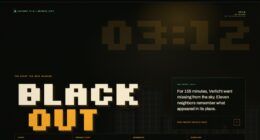
OORT is an AI-built exhibition about a fictional observatory watching the fictional comet P/2043 K1 Vesper. Its “held-light” technique gradually extends star trails while a visitor stays on the page, preserving the elapsed time locally so the same device’s sky can resume later. The comet and its vigil are part of the artwork, not a real astronomical discovery.
OORT, the original analysis of an AI-built exhibition centered on a fictional observatory and comet, uses a technique it calls “held light” to make star trails lengthen as visitors remain on the page. The interactive artwork, devoted to the imagined comet P/2043 K1 Vesper, records elapsed time locally so the same device can resume its simulated sky later.
The exhibition’s canvas draws stars in arcs around a point below the visible frame. As time passes, those trails grow according to a logarithmic curve, making early changes visible while allowing a longer visit to add to the exposure. A repeatable seed keeps the star field consistent on that device, and local storage preserves its elapsed time. The page stops its animation loop when hidden and shows a still version for visitors who have enabled reduced motion.
OORT pairs the star field with a second instrument: scrolling moves the comet through an inline SVG. The imagined ion tail points away from the sun, while the dust tail bends along the comet’s orbit. Both shapes respond to the same progress value, keeping the displayed geometry, distance and year in step. A range control changes a defocus view and its associated brightness estimate.
Another interaction lets visitors hold a control briefly to open a simulated shutter. The site records a timestamp, but it does not claim that the visitor saw or discovered the comet. In the artwork’s framing, the record marks an act of attention while Vesper remains unseen and in transit.
OORT · Room 170 of 175 · Interactive artwork
What Is the Held-Light Technique?
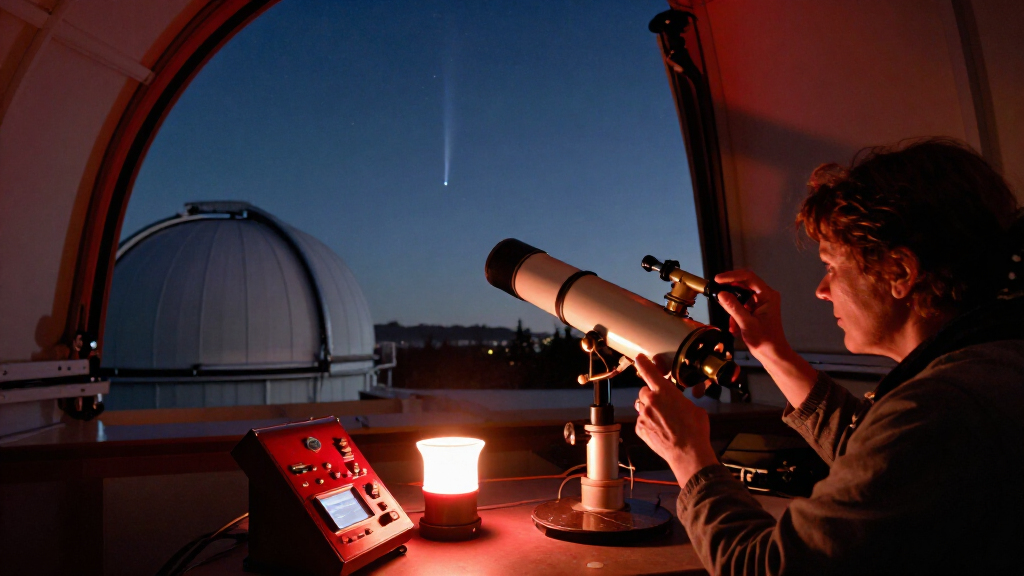
In OORT, a fictional observatory keeps watch over the imagined comet P/2043 K1 Vesper. The longer a visitor stays, the farther its simulated star trails extend—turning time on the page into part of the artwork.
“A room where waiting leaves a trace.”
OORT project description · The vigil is an artistic premise, not an astronomical report.
The subject
Fiction P/2043 K1 Vesper is imagined.The gesture
Stay Elapsed page time shapes the sky.Trail growth
LogarithmicVisible early change; longer exposure can accumulate.
Saved on
This deviceLocal elapsed time can resume on return.
Comet view
ScrollProgress moves the imagined body through an SVG.
Shutter record
TimestampAn artwork interaction, not a sighting.
01 / How it works
Waiting becomes the medium
The technique gives a visitor’s duration a visible consequence, while keeping the simulated sky tied to a single browser device.
01 · Remain
Trails lengthen
Stars draw arcs around a point below the visible frame. As time passes, the artwork gradually extends those trails.
02 · Return
Exposure persists locally
A repeatable seed keeps the star field consistent, while local storage preserves elapsed time so the same device can resume its sky.
03 · Pause
Motion respects context
The animation loop stops when the page is hidden. Visitors who enable reduced motion see a still version.
02 / The visual logic
An exposure that keeps unfolding
The project describes logarithmic growth: early changes appear readily, and a longer visit continues to add to the exposure.
What “held light” means
It is OORT’s name for star trails that lengthen while a visitor remains on the page. The accumulated time becomes a small, persistent trace of attention.
The page also offers a defocus view. A range control changes the view and its associated brightness estimate, which belongs to the interactive fiction.
Trail growth across a visit
Conceptual illustration · not a measured scale
03 / More than a star field
A second instrument follows the comet
Scrolling moves the imagined comet through an inline SVG. Both tail shapes respond to the same progress value.
04 / Fiction & evidence
A timestamp is not a discovery
OORT borrows astronomy’s language and instruments to frame an imagined community keeping watch across decades.
The boundary matters
Vesper remains fictional
The project describes the observatory and comet as fictional. Its shutter record marks attention within the artwork; it does not claim the visitor saw or discovered a comet.
05 / Key questions
A quick field guide
The supplied description explains the intended interactions, but does not report independent performance or accessibility testing.
Is P/2043 K1 Vesper real?
No. The source describes it as fictional, part of an imagined observatory and a decades-long vigil.
What does held light do?
It extends star trails over time and saves elapsed time locally so the same device can resume the simulated exposure.
Does the shutter capture a sighting?
No. It records a timestamp as part of the artwork. The project says the comet remains unseen and in transit.
What happens when visitors scroll?
The imagined comet advances through an SVG; its ion and dust tails shift with the shared progress value.
How Waiting Shapes the Artwork
The technique makes duration part of the work’s content. In a typical page, time spent reading is incidental; in OORT, remaining on the page changes the visible sky. Returning to the same device continues that accumulated exposure, giving the visit a small, persistent trace.
The interactions also draw a boundary between fiction and observation. The simulated shutter produces a timestamp, not astronomical evidence. That distinction matters because the site borrows the language and instruments of astronomy while presenting an invented comet and community. Its effect comes from sustained attention, not from a claim that Vesper is real or that a new sighting occurred.
As an affiliate, we earn on qualifying purchases.
Inside OORT’s Fictional Observatory
The project is described as room 170 of 175 in an exhibition series. Its premise is a fictional observatory whose imagined community keeps watch over P/2043 K1 Vesper across decades. The art direction calls the comet fictional and describes the vigil as an exercise in “real orbital patience.”
The visual language supports that premise: deep black evokes a dark-adapted observatory; cyan marks the ion tail and live readings; red-orange identifies instructions and actions; and pale, dust-toned text carries longer passages. Display lettering gives headings and measurements an instrument-like feel, while monospaced text frames coordinates and notes as a logbook.
The source material also describes invented amateur-vigil logs, an ephemeris table, a magnitude-estimation technique and a “last seen 1608” provenance. These details belong to the fictional setting. The available material does not establish them as records about a real comet.
““A room where waiting leaves a trace.””
— OORT project description
As an affiliate, we earn on qualifying purchases.
What the Page Does Not Establish
The source identifies both the observatory and P/2043 K1 Vesper as fictional. It does not provide evidence of a real comet observation, independent astronomical data or a scientific validation of the displayed estimates. The year, distance and brightness readings are described as elements of the interactive fiction.
The source gives no publication date, visitor statistics or technical measurements for the finished site. It describes the interaction’s intended behavior, including local persistence and reduced-motion handling, but does not provide independent performance or accessibility test results. It is also unclear how long a stored exposure persists or what happens if a visitor changes devices or clears local browser data.
As an affiliate, we earn on qualifying purchases.
The Vigil Continues on the Page
Visitors can open the live exhibition, stay on the page to watch the trails accumulate, scroll to move the imagined comet through its path and use the controls to explore the defocus view. Returning on the same device is intended to restore the local sky’s elapsed time.
The supplied description does not announce a future event or scientific milestone. The next development for a visitor is therefore another session with the interactive work; any real-world observation of a comet would require separate evidence from an attributable astronomical source.
As an affiliate, we earn on qualifying purchases.
Key Questions
What does “held light” mean in OORT?
It is the project’s name for star trails that lengthen over time as a visitor remains on the page. The site saves elapsed time locally so the same device can resume the simulated exposure later.
Is P/2043 K1 Vesper a real comet?
No. The source describes P/2043 K1 Vesper as fictional and places it in an imagined observatory and decades-long vigil.
Does the simulated shutter capture a real sighting?
No. Holding the control records a timestamp as part of the artwork. The project says the comet remains unseen and in transit; the timestamp is not evidence of an astronomical observation.
What happens when a visitor scrolls?
Scrolling advances the comet through an inline SVG. Its imagined ion tail points away from the sun, while its dust tail curves along the orbit; both respond to the same progress value.
Source: Thorsten Meyer AI
Fall Picks
fall essentials
As an affiliate, we earn on qualifying purchases.