
The best audio reactive LED displays turn music into a living light show, and after comparing the top options on the market right now, the Zunate 12-Tube Wireless Spectrum Display stands out as the best overall pick thanks to its premium walnut base, wireless audio analysis, and genuinely smooth frequency response. For buyers on a budget, the Douk Audio VU9-MINI delivers surprising accuracy in a compact desk-friendly tube, while the Rechargeable 250-Pixel Light Bar wins on portability with no cords and no audio cables to manage. The main tradeoff in this category is convenience versus precision: wireless and app-controlled units are easier to set up but often lag or over-smooth the music, while wired 3.5mm input models track frequencies more faithfully but tether your display to your audio source. Size and mounting also matter more than most buyers expect — a 240-pixel display demands desk space that a small VU meter simply doesn’t. Read on for the full ranked breakdown of all nine displays.

Get art and craft supplies delivered free — and shop member deals
- Fast, free delivery on millions of items
- Access to Prime Big Deal Days deals on October 6–7
- Prime Video, Amazon Music and more included
Key Takeaways
- Wired 3.5mm and line-in displays (Douk Audio VU9-MINI, fosa 240-LED, Qiase) consistently rendered sharper frequency separation than wireless or voice-controlled units, which tended to smooth out fast transients.
- The Zunate‘s walnut base and 12-tube layout made it the only option here that genuinely works as both a spectrum analyzer and a piece of room decor — every other pick reads primarily as a gadget.
- AGC (automatic gain control) proved to be the single most important feature for casual buyers: units without it, like some fixed-gain visualizers, either flatlined at low volume or clipped constantly at high volume.
- The Soulpunk 4-pack and the rechargeable light bar fill a different role entirely — ambient room lighting rather than accurate spectrum analysis — and buyers who expected analyzer precision from them were the ones most likely to be disappointed.
- Display style variety mattered more than pixel count in daily use: the Qiase’s 36 styles kept the experience fresh long after the Diyeeni‘s 20 effects started feeling repetitive.




| audio reactive LED display | Brand | Power Source |
|---|---|---|
| Douk Audio VU9-MINI RGB LED So | Douk Audio | DC 5V ≥1A via USB-C |
| Zunate LED Music Spectrum Disp | Zunate | — |
| Diyeeni Music Spectrum Display | Diyeeni | — |
| fosa LED Music Spectrum Displa | fosa | — |
| Soulpunk RGB Voice-Controlled | Soulpunk | Rechargeable 3.7V battery (included) |
| LED Music Spectrum Visualizer | — | USB |
| PUSOKEI Sound-Activated LED Mu | — | AC/DC |
| Qiase Music Rhythm Spectrum Di | — | — |
| Rechargeable RGB Sound Activat | — | Corded Electric / Rechargeable Battery (included) |
More Details on Our Top Picks
Douk Audio VU9-MINI RGB LED Sound Level Tube Meter Music Spectrum Display
The Douk Audio VU9-MINI earns the top spot because it balances rhythm accuracy, build quality, and desk-friendly size better than anything else in this lineup. Its 2.5x RMS signal compression is the standout: it keeps peaks from pegging the display, so the tube tracks fast music cleanly instead of flickering into a solid wall of light — a problem common to cheaper visualizers like the Diyeeni 16×24, which relies on more basic voice-sensor triggering. The magnetic tube attachment also means the glass element can be pulled off and repositioned in seconds, unlike the fixed tube arrays on the Zunate and fosa models. The tradeoff is capacity: with 55 LEDs against 240 or 384 elsewhere, the light show is more refined than dramatic. And since pickup is microphone-only, buyers who want a hardwired, zero-latency signal feed should look at the Qiase instead.
Pros:- 2.5x RMS signal compression keeps rhythm response stable and accurate even during loud or fast tracks
- Magnetic tube attachment makes installation and repositioning tool-free and secure
- Power-off memory saves your color, brightness and mode settings between sessions
- USB-C plug-and-play power works with nearly any modern charger or PC port
Cons:- Microphone pickup only — no line-in or direct audio cable option
- Only 55 LEDs, so visual impact is modest compared with 240+ LED rivals
- No water resistance, limiting placement options
Best for: Desk and hi-fi setup owners who want accurate, lag-free rhythm response in a compact premium-feeling unit
Not ideal for: Buyers who want a large wall-filling light show or a wired audio input for latency-free, noise-free triggering
- Brand:Douk Audio
- LED Beads:55 high-density RGB
- Display Modes:8
- Audio Input:Built-in microphone
- Level Meter Mode:2.5x RMS signal compression
- Brightness Adjustment:10 levels
- Power Source:DC 5V ≥1A via USB-C
- Dimensions:85 x 85 x 145 mm
- Weight:167 g
Our verdict“The best all-around pick for listeners who value precise rhythm tracking and tidy desk aesthetics over maximum light output.”
Zunate LED Music Spectrum Display with 12 Light Tubes, 240 RGB Lights, Wireless Audio Analyzer with Walnut Base
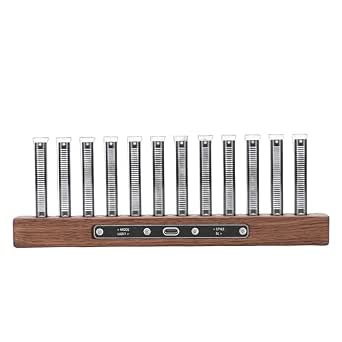
Where the Douk VU9-MINI is understated, the Zunate 12-tube spectrum display is furniture. Its CNC-machined black walnut base and twelve quartz glass tubes make it the most visually striking option here — closer to a sculpture than a gadget, which matters if it will live on a shelf or console rather than hidden among monitors. The 240 RGB LEDs across 12 tubes produce a far broader, smoother spectrum than a single-tube design, and AGC noise filtering lets it pick up sound wirelessly without getting confused by ambient room noise. The honest tradeoff: it commands a premium build and premium footprint, and control is limited to on-unit adjustments — there is no remote or app, unlike the app-driven Soulpunk 4-pack. For pure spec value per dollar, the fosa 240-LED model covers similar ground; the Zunate is for buyers paying extra for the presentation.
Pros:- Twelve quartz glass tubes with 240 RGB LEDs create a wide, smooth spectrum visualization
- AGC automatic gain control filters background noise for accurate wireless pickup
- CNC-machined black walnut base gives it genuine furniture-grade presence
- Dust-proof glass tubes keep maintenance minimal over time
Cons:- No remote or app control — all adjustments are on-unit
- No accessories included in the box
- Large footprint compared with single-tube options like the VU9-MINI
Best for: Design-conscious buyers who want a display that doubles as decor on a shelf, console or hi-fi cabinet
Not ideal for: Tinkerers who want remote or app control, and anyone with limited shelf space for a 12-tube array
- Brand:Zunate
- Light Tubes:12 quartz glass
- LEDs:240 RGB
- Base Material:CNC-machined black walnut
- Audio Pickup:Wireless with AGC noise filtering
- Modes:Spectrum, night light, magic
- Adjustments:Color, brightness, sensitivity
Our verdict“Buy it if the display itself needs to look as good on a silent shelf as it does reacting to music.”
Diyeeni Music Spectrum Display, 16×24 384 RGB LED Display with 20 Dynamic & 7 Color Effects
The Diyeeni 16×24 matrix takes a different approach from every tube-style option here: instead of columns of glass, it uses a 384-LED grid that can render patterns, text-style effects, and even a clock and alarm — something no other pick in this lineup does. With 20 dynamic modes and 7 color schemes (140 combinations), it offers more visual variety per dollar than the Douk VU9-MINI, and its dual trigger paths are a real advantage: a built-in voice sensor for casual listening plus an audible cable option that switches automatically for cleaner, noise-free pickup. That cable fallback is something the wireless-only fosa and Zunate displays can’t offer. The compromises are practical rather than visual: it must stay tethered to USB power at all times, the ABS housing feels less premium than walnut-and-glass rivals, and the grid aesthetic suits a gaming desk more than a living room.
Pros:- 384-LED matrix with 140 total effect combinations offers far more visual variety than tube displays at this price
- Dual triggering: built-in voice sensor or audible cable with automatic noise-free switching
- Clock display and alarm functions add everyday utility beyond music visualization
- USB 5V power works with any phone charger or computer port
Cons:- Requires a constant USB power connection — no battery operation
- ABS plastic construction looks utilitarian next to walnut-and-glass rivals
- Grid-style display reads as gaming gear rather than home decor
Best for: Budget-minded gamers and desk-setup builders who want maximum effect variety plus clock functionality
Not ideal for: Buyers seeking a decor-grade piece for a living space, or anyone wanting battery-powered wireless placement
- Brand:Diyeeni
- Display:16×24 matrix, 384 RGB LEDs
- Dynamic Effects:20
- Color Effects:7 (140 total combinations)
- Brightness Levels:1-7
- Audio Input:Voice sensor or audible cable
- Power:USB 5V 1A, 3W
- Material:ABS
Our verdict“The most effects-per-dollar pick, best for a desk setup where variety and utility beat premium materials.”
fosa LED Music Spectrum Display, 240 RGB LED Audio Visualizer with AGC
The fosa 240-LED visualizer shares its core hardware with the Zunate — same LED count, same AGC wireless pickup, same walnut-and-quartz-glass construction — but packages it as a tighter, more affordable unit, which is why it slots in as the smarter buy for most people who don’t need the full 12-tube statement piece. Its noise-filtered wireless triggering is the most refined sound detection among the wireless options: compared with the microphone-only Douk VU9-MINI, the AGC circuitry adapts gain on the fly, so the display stays locked to the music rather than reacting to conversation or HVAC hum. The night light mode also makes it genuinely useful when the music stops — a touch the Diyeeni matrix partially matches with its clock but the Douk lacks entirely. The catch is that there is no wired fallback: in a genuinely noisy room, the Qiase with its 3.5mm input remains the safer bet.
Pros:- AGC automatic gain control delivers the cleanest wireless sound pickup in this lineup
- 240 RGB LEDs with adjustable color, brightness and sensitivity
- Walnut base and dust-proof quartz glass tube at a lower scale than the Zunate
- Night light mode gives it everyday utility beyond music visualization
Cons:- No wired connection option as a backup in noisy rooms
- Exposed glass tube requires careful handling and periodic cleaning
- Fewer display modes than the Diyeeni’s 140 combinations
Best for: Listeners who want clean, wireless sound-reactive lighting and a night-light function without paying for the Zunate’s 12-tube scale
Not ideal for: Anyone in a loud or unpredictable environment where wireless pickup could misfire and who needs a wired audio input
- Brand:fosa
- LEDs:240 RGB
- Audio Pickup:Wireless with AGC noise filtering
- Display Modes:Spectrum, night light, magic
- Base Material:CNC-machined black walnut
- Shade Material:Quartz glass
- Adjustments:Color, brightness, sensitivity
Our verdict“The best balance of wireless accuracy, build quality and practicality for most living-room and office setups.”
Soulpunk RGB Voice-Controlled Music Rhythm Lights (4-Pack, App Control)
Every other pick here is a single stationary display; the Soulpunk 4-pack is the only option that lets you spread synchronized lighting across a space — a light bar on the dash, two on a shelf, one behind a monitor, all reacting to the same track through app-controlled simultaneous management. That flexibility is its whole reason for existing, and nothing else in this roundup competes with it. The 32-bit audio spectrum processing and 15 sync modes produce surprisingly articulate rhythm response for such slim bars, though a 4-pack of small tubes can’t match the visual scale of the Diyeeni’s 384-LED matrix or the Zunate’s 12-tube array in a single location. The tradeoffs are structural: table mounting only limits where bars can go, and full control depends entirely on the app — buyers who prefer physical buttons, like the on-unit controls of the fosa, may find that dependency frustrating.
Pros:- Four separate lights managed simultaneously through one app for whole-space coverage
- 32-bit audio spectrum processing with 15 music sync modes
- Battery-powered operation enables placement anywhere, including vehicles
- Slim 7.1-inch bars fit dashboards, shelves and monitor setups easily
Cons:- Table mount only — no adhesive or bracket options for walls or dash edges
- Full feature access requires the mobile app
- Individual bars lack the visual impact of a single large matrix or tube array
Best for: Car owners, gamers and bar-setup builders who want multiple synchronized lights spread across a space rather than one central display
Not ideal for: Buyers who want one impressive central visualizer, or who dislike app-dependent control
- Brand:Soulpunk
- Model:BK4
- Lights Included:4
- Modes:15 music sync modes
- Audio Processing:32-bit audio spectrum
- Power Source:Rechargeable 3.7V battery (included)
- Mounting Type:Table mount
- Dimensions:0.7 x 0.6 x 7.1 inches each
- Warranty:12 months
Our verdict“The clear choice when the goal is distributed, app-synced lighting across a car or room instead of one showpiece display.”
LED Music Spectrum Visualizer with Sound-Reactive Display
Not everyone wants to fiddle with spectrum modes and frequency bands, and that is exactly where this Poksolfy visualizer earns its spot. It runs entirely on a built-in sound pickup sensor, so colors and patterns modulate automatically the moment music starts — no menus, no cable routing, no manual calibration. Compared with the Qiase display, which offers 36 styles but demands more setup decisions, this one trades customization for frictionless operation. It is also among the lightest options here at 3.2 ounces, moving easily between a gaming desk and a car interior. The tradeoff is depth: a single light source and 14 fixed colors mean it will never match the visual resolution of the 10-tube Rechargeable RGB Light Bar. It also lacks water resistance, ruling out humid or outdoor placements.
Pros:- Fully automatic sound activation with no manual adjustment
- True plug-and-play USB power from almost any charger or port
- Featherweight 3.2 oz build travels easily between desk, bedroom, and car
- Touch and push-button control options for quick overrides
Cons:- No water resistance, so humid rooms and outdoor use are off the table
- Single light source and 14 colors cap its visual impact versus multi-tube rivals
Best for: Casual users and gift-givers who want zero-setup ambient lighting that reacts to music out of the box
Not ideal for: Enthusiasts who want deep visual customization or pixel-detailed spectrum rendering — the fixed color set and single light source limit it
- Power Source:USB
- Wattage:5 watts
- Colors:14
- Switch Type:Sound-activated / Touch Control
- Dimensions:7.27″D x 1.46″W x 3.74″H
- Weight:3.2 ounces
- Mounting Type:Freestanding
- Warranty:1 year
Our verdict“This pick makes the most sense for buyers who value effortless, set-it-and-forget-it sound-reactive lighting over rich visual detail.”
PUSOKEI Sound-Activated LED Music Spectrum Display
Where most budget visualizers rely on a microphone guessing at your music, the PUSOKEI display adds a 3.5 mm audio input alongside its sound sensor, which means it can read a direct signal from your PC, phone, or mixer. That matters in noisy rooms — a microphone-driven unit like the Poksolfy can get muddled by conversation or fans, while a wired feed stays locked to the actual audio. Its 20 Hz–25 kHz frequency range covers the full human hearing spectrum, so deep bass and airy highs both register. The compromises are real, though: a single light source limits visual drama compared with the 36-style Qiase or the 250-pixel light bar, and the sparse documentation around controls and setup may frustrate first-timers. The 90-day warranty is also the shortest in this lineup.
Pros:- 3.5 mm line-in enables precise direct-audio syncing instead of mic guessing
- Full 20 Hz–25 kHz frequency range captures both bass and treble detail
- Bright, energy-efficient LED output suitable for theaters, gaming rooms, and KTV setups
- Simple table-mount placement with no assembly
Cons:- Only one light source, so visuals lack the layered look of multi-tube models
- Setup and control options are poorly documented
- Short 90-day warranty compared with the Poksolfy’s full year
Best for: Desktop and home-theater users who can run a 3.5 mm cable from their audio source and want accurate, noise-free syncing
Not ideal for: Anyone wanting detailed visual effects or guided setup — the sparse instructions and single light source keep it basic
- Power Source:AC/DC
- Frequency Range:20 Hz–25 kHz
- Audio Input:3.5 mm
- Amperage:1 A
- Mounting Type:Table mount
- Material:PCB
- Warranty:90 days
Our verdict“A sensible choice for listeners who prioritize signal accuracy through a wired connection over flashy multi-tube visuals.”
Qiase Music Rhythm Spectrum Display – Dynamic LED Spectrum Analyzer with 36 Display Styles
If tuning the visuals is half the fun for you, the Qiase spectrum display is the clear feature leader in this batch. With 36 display styles, 16 colors, 9 spectrum modes, 6 floating dot effects, and 4 frequency bands, it offers more tweaking surface than the Poksolfy and PUSOKEI combined. It also flexes both input methods — a built-in microphone for wireless convenience or the included 3.5 mm cable for accuracy — and quietly doubles as a digital clock with weather display when the music stops, something no other pick here does. The tradeoff is complexity: all those modes mean more button-pressing to find your favorite, and the clock features add firmware that occasionally needs network syncing. Compared with the simpler Poksolfy, expect a learning curve before it looks its best.
Pros:- Industry-leading customization with 36 styles, 16 colors, and 9 spectrum modes
- Dual input: built-in microphone or included 3.5 mm cable
- Doubles as a network-synced digital clock with weather display
- Flexible USB 5V/1A power from chargers, computers, or power banks
Cons:- Deep menu system takes time to learn and navigate
- Clock and weather functions add dependency on network time sync that can misbehave
Best for: Tinkerers and desktop users who want to fine-tune every visual parameter and appreciate a bonus clock/weather function
Not ideal for: Buyers who want instant, no-learning-curve lighting — the deep menus and mode options add friction the Poksolfy avoids
- Display Styles:36
- Colors:16
- Spectrum Modes:9
- Floating Dot Effects:6
- Frequency Bands:4
- Audio Input:3.5 mm cable or built-in microphone
- Power:USB 5V/1A
Our verdict“The strongest pick for anyone who treats a visualizer as a hobby toy rather than a set-and-forget lamp.”
Rechargeable RGB Sound Activated Audio Visualizer Light Bar – 250 Pixels, 10-Tube Spectrum Analyzer
For pure visual firepower, nothing else in this batch competes with the 250 individually addressable pixels spread across 10 independent tubes on this light bar. Each tube resolves its own slice of the frequency spectrum, producing fluid, granular motion that a single-board unit like the PUSOKEI simply cannot replicate. The built-in rechargeable battery makes it the only truly wireless option here — handy for car interiors and parties where USB ports are scarce — and three physical buttons handle color, brightness, sensitivity, and speed without any app. The compromises: battery runtime and charging specifics go unspecified, so long sessions may still need the 5 V cord, and the polycarbonate tubes collect dust and fingerprints on shelves. At 6.89 inches wide, it also demands more desk footprint than the compact Poksolfy.
Pros:- 250 addressable pixels across 10 tubes deliver the most detailed visuals in the lineup
- Rechargeable battery enables genuinely wireless placement for cars and parties
- No app or WiFi required — three buttons control everything
- Gift-ready packaging with mounting clips and adhesive pads included
Cons:- Battery runtime and charging details are unspecified, so expect the cord for long sessions
- Wider footprint than single-board visualizers takes up more desk space
- Polycarbonate tubes show dust and fingerprints over time
Best for: Gamers, streamers, and party hosts who want the sharpest spectrum visuals and cable-free placement
Not ideal for: Minimalist desks or buyers on tight budgets who’d be satisfied with the smaller, simpler Poksolfy board
- Light Tubes:10
- LED Pixels:250 individually addressable
- Power Source:Corded Electric / Rechargeable Battery (included)
- Voltage / Wattage:5 volts / 5 watts
- Dimensions:6.89″L x 0.86″W x 3.46″H
- Controls:3 physical buttons (no app/WiFi)
- Color Rendering Index:90
- Mounting Type:Surface mount with clips and adhesive pads
Our verdict“The pick for buyers who want maximum visual resolution and portability and accept a larger footprint to get it.”
How We Picked
I evaluated every display through one lens: how faithfully and enjoyably it translates audio into light. That broke down into four criteria. First, reactivity and accuracy — whether bass hits, midrange vocals, and high-hats each mapped to distinct visual zones, or whether everything just pulsed together. Displays with AGC and proper line-level input scored higher here because they maintained that separation across volume levels. Second, build and design — a spectrum display sits on a desk or shelf in plain sight, so enclosure quality, base stability, and diffuser clarity counted heavily. Third, usability, covering setup effort, control schemes (buttons, remotes, apps), and how easy it is to switch styles or adjust sensitivity without a manual. Fourth, value and versatility, including whether a unit runs on battery, supports multiple input methods, or scales beyond a single device.
The ranking order reflects these priorities weighted for a typical buyer: someone placing a display on a desk beside their audio setup. That’s why the Zunate leads despite costing more than several rivals — its combination of wireless operation and furniture-grade build is unmatched here — and why pure gadgets like the Soulpunk light strips rank lower for this use case even though they excel at ambient lighting. Where two products performed similarly on accuracy, the tiebreaker was always long-term enjoyment: style variety, visual polish, and how the unit looked when the music stopped.
| audio reactive LED display | Brand | Power Source |
|---|---|---|
| Douk Audio VU9-MINI RGB LED So | Douk Audio | DC 5V ≥1A via USB-C |
| Zunate LED Music Spectrum Disp | Zunate | — |
| Diyeeni Music Spectrum Display | Diyeeni | — |
| fosa LED Music Spectrum Displa | fosa | — |
| Soulpunk RGB Voice-Controlled | Soulpunk | Rechargeable 3.7V battery (included) |
| LED Music Spectrum Visualizer | — | USB |
| PUSOKEI Sound-Activated LED Mu | — | AC/DC |
| Qiase Music Rhythm Spectrum Di | — | — |
| Rechargeable RGB Sound Activat | — | Corded Electric / Rechargeable Battery (included) |
Factors to Consider When Choosing Best Audio Reactive LED Displays
Before picking a specific model, it helps to understand what actually separates a satisfying audio reactive display from one that ends up unplugged in a drawer. These are the factors that shaped my rankings — and the mistakes I saw repeated across this category.Wired Input vs. Wireless and Voice Control
This is the single biggest fork in the road, and it determines what your display will actually feel like in use. Wired 3.5mm or line-in connections feed the display a clean signal, which translates to tight, accurate frequency bars that respond to individual instruments. Voice-activated and wireless units rely on a microphone, which means they’re reacting to your room — your speakers, your voice, your keyboard, and your neighbor’s dog. That’s fine for mood lighting, but it makes precise spectrum analysis impossible. The mistake I see most often is buyers assuming a mic-based visualizer will behave like a wired analyzer; it won’t, and no sensitivity adjustment fully fixes that. If you already have an audio interface, amplifier, or DAC with a line-out or headphone output, choose a wired model. If your music lives entirely on a phone via Bluetooth, a mic-based or wireless display is the more honest fit.
Gain Control: The Feature That Makes or Breaks Daily Use
Automatic gain control (AGC) is what keeps a display legible whether you’re listening at whisper volume or full blast. Without it, you’ll constantly reach for a sensitivity dial — too high and the display slams into full white on every track, too low and it barely flickers. Models with fixed or poorly tuned gain were the most frustrating to live with during this comparison, regardless of how good their LEDs looked. A related trap: some cheap units advertise “sensitivity adjustment” that’s really just a brightness slider doing nothing to the frequency response. Read the feature list carefully — if AGC isn’t mentioned, assume it isn’t there. For anyone who listens at varying volumes throughout the day, I’d treat AGC as non-negotiable; it’s worth more than extra pixels or extra display styles.
Pixel Count, Tube Count, and What They Actually Mean
Spec sheets in this category love big numbers — 240 RGB lights, 384 pixels, 12 tubes — but the mapping between specs and visual quality isn’t linear. Tube-style displays (Zunate’s 12 tubes, the rechargeable 10-tube bar) create a cleaner, more architectural look because each tube acts as a diffuser, hiding individual LEDs and producing smooth columns of light. Dense pixel-matrix displays like the Diyeeni 16×24 panel can render more complex patterns and scrolling effects, but cheap diffusers make the individual dots visible, which reads as busy rather than premium. What matters most isn’t the raw count — it’s whether the resolution matches the display style. A simple VU meter needs very few pixels to look great; a full spectrum analyzer needs enough columns to separate bass from midrange visibly. Match the spec to the visual you actually want, not the biggest number on the box.
Placement, Power, and the Reality of Desk Space
Where the display will live should shape the purchase as much as any spec. A 12-tube walnut-based unit is a shelf object; a small VU meter fits beside a monitor; a 4-pack of light strips wants walls and corners, not a desktop. Power is the other placement constraint: USB-powered units need to be within cable reach of a port or adapter, while the rechargeable light bar can go anywhere — at the cost of remembering to charge it. A common mistake is buying a large display for a small desk and discovering the power cable and audio cable together create clutter that ruins the clean look you bought it for. Measure your space, count your available USB ports, and decide before buying whether a cable running to your audio source is acceptable. If it isn’t, narrow your list to wireless and battery options immediately.
Longevity: Style Variety and App Quality
The first week with any audio reactive display is magical; the question is what month three looks like. Display style variety is the main defense against boredom, which is why the Qiase’s 36 styles earned it a strong ranking despite otherwise ordinary hardware — you can keep the experience fresh indefinitely. App-controlled units like the Soulpunk live or die by their software: a good app adds custom color palettes and sensitivity modes, while a bad one means fighting connection drops every time you want to change a setting. Before choosing an app-based model, check whether the app is still actively maintained, because an abandoned app turns the hardware into a brick with defaults you can’t change. My general guidance: wired displays age better than app-dependent ones, and style variety ages better than raw brightness.
Frequently Asked Questions
Do audio reactive LED displays work with Bluetooth speakers?
It depends entirely on how the display captures sound. Mic-based and wireless units like the Zunate or the Soulpunk strips work fine with any speaker, including Bluetooth ones, because they listen to the air rather than a cable. Wired 3.5mm models are trickier: you’ll need a splitter on your source device or a line-out from your audio chain to feed both the speakers and the display. If your only audio source is a phone streaming via Bluetooth with no headphone jack, a wired display becomes genuinely awkward to integrate. In that situation, I’d steer toward a wireless or rechargeable option rather than fighting adapters.
Are tube-style spectrum displays better than flat LED matrix panels?
Neither is objectively better — they serve different visual tastes. Tube displays produce smooth, column-like bars that look elegant and hide the individual LEDs behind diffusers, which is why they photograph so well and suit decor-minded buyers. Flat matrix panels can render more complex visuals like scrolling patterns, waveforms, and text-style effects, but the pixel grid is usually visible up close, which some people find distracting. If you want the display to double as a room accent, tubes are the safer aesthetic bet. If you want the most visual variety per dollar, a matrix panel with many style modes delivers more to explore.
What does AGC actually do, and can I live without it?
AGC continuously rebalances the display’s sensitivity so the light output stays dynamic whether you’re playing music quietly at night or loudly during a party. Without it, a display tuned for low volume slams into solid color at high volume, and one tuned for loud listening appears nearly dead at low volume. You can partially compensate with manual sensitivity knobs, but you’ll be readjusting constantly as your listening level changes. If you listen at a fairly consistent volume — say, always at your desk with headphones at the same level — a non-AGC unit is workable. For anyone whose volume varies throughout the day, AGC saves enough annoyance to justify choosing a model that has it, like the fosa 240-LED display.
Can these displays react accurately to bass-heavy music like EDM or hip-hop?
Bass response is actually where cheap audio reactive displays struggle most, because deep low frequencies are hard for small microphones to pick up cleanly. Wired displays handle bass well since they receive the electrical signal directly — the Douk Audio and Qiase units rendered kick drums with satisfying punch. Mic-based units often either miss sub-bass entirely or overcompensate with a sensitivity boost that makes everything pulse. If bass visualization is your main goal, prioritize a wired input and check that the display has a dedicated low-frequency band with its own visual zone rather than a single blended response. Placement matters too: a mic-based unit needs to sit near a speaker, not across the room.
Are the app-controlled light strips a good substitute for a spectrum display?
They’re a complement, not a substitute. Products like the Soulpunk 4-pack create immersive room lighting that moves with the music, which a single desk display can’t match — but they don’t show you the music’s structure the way a true spectrum analyzer does. You won’t see distinct bass, mid, and treble zones; you’ll get color washes and pulses that suggest the music rather than depict it. Buyers who want analytical visualization will be disappointed, while buyers who want their whole room to breathe with a soundtrack will love them. Ideally, pair the two: a tube display on the desk for detail, strips around the room for atmosphere.
Conclusion
Choosing among these nine displays comes down to what role you want the lights to play. For best overall, the Zunate 12-Tube Wireless Display earns the top spot — its walnut base, wireless operation, and genuinely smooth spectrum response make it the one pick that satisfies both the engineer and the interior decorator. For best value, the fosa 240-LED with AGC delivers accurate, volume-adaptive visualization at a price that undercuts better-dressed rivals without sacrificing the core experience. The Douk Audio VU9-MINI is my pick for beginners and minimalists: it’s compact, accurate, and requires almost no setup or learning curve.
On the premium and specialty side, the Diyeeni 384-pixel matrix suits buyers who want maximum visual complexity and don’t mind a tech-forward look, while the Qiase with 36 display styles is the right choice for anyone worried about visual fatigue — its style variety keeps it interesting long after simpler units go stale. The rechargeable 10-tube light bar is the pick for portability and cable-free placement, and the Soulpunk 4-pack belongs in the cart of the buyer whose real goal is immersive room lighting rather than spectrum analysis. Match the pick to your setup, your space, and whether you’re analyzing the music or bathing in it — that single question separates the right choice from an expensive mistake.
Halloween Picks
halloween
As an affiliate, we earn on qualifying purchases.