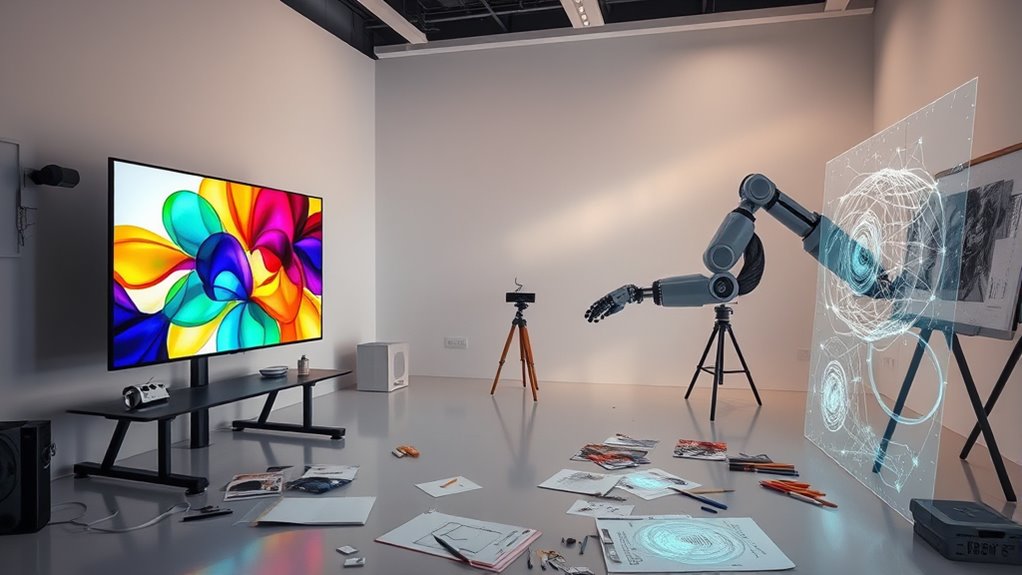
AI-generated art has shifted from being just a tool to becoming a true creative partner. You now collaborate with AI to explore new styles, experiment rapidly, and refine ideas more easily. AI helps handle complex tasks, acting as both assistant and muse. This evolution empowers you to push artistic boundaries and personalize your work like never before. Keep exploring to understand how this partnership can transform your creative process even further.
Key Takeaways
- AI has shifted from simple tools to active collaborators, enhancing creative possibilities and artistic experimentation.
- Artists now work alongside AI as co-creators, blending human intuition with machine-generated outputs.
- AI accelerates the creative process through rapid iteration, enabling diverse styles and quick refinement.
- Ethical considerations and understanding AI vulnerabilities are essential for trustworthy human-AI collaboration.
- The evolving role of artists involves guiding AI through prompts, expanding creative boundaries with shared input.
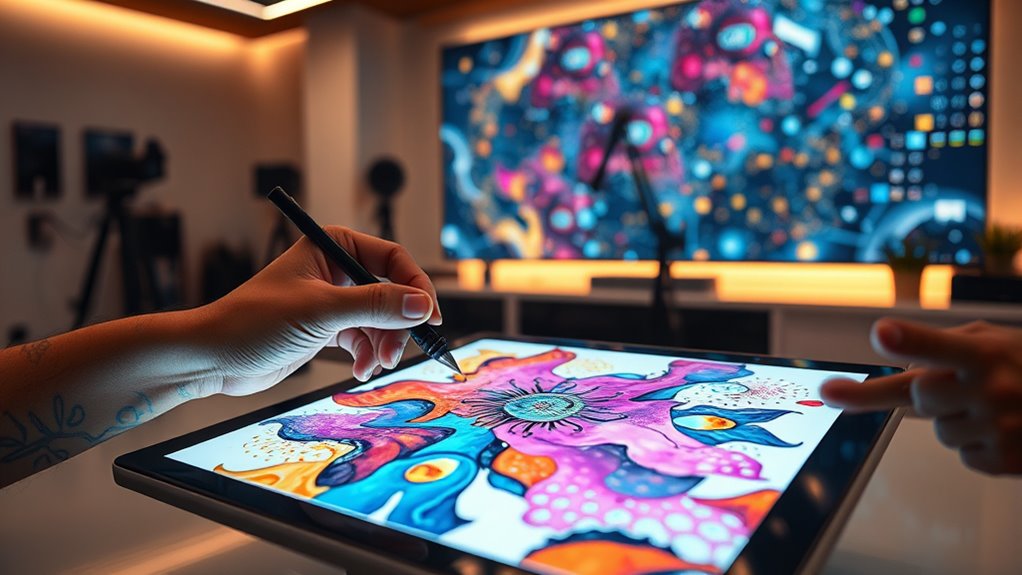
The evolution of AI-generated art has transformed how we create and experience visual creativity. No longer just simple tools, AI systems now serve as partners that expand your artistic possibilities through algorithmic creativity. Instead of replacing human artists, AI enhances their skills, enabling you to experiment with styles, techniques, and concepts that might have been out of reach before. This shift toward human-AI collaboration means you can focus more on your creative vision while the AI handles complex tasks like generating textures, color palettes, or even entire compositions. By working alongside AI, you become a co-creator, blending human intuition with machine precision to produce unique works that reflect both your personal touch and the algorithmic insights of the AI. This synergy accelerates the creative process, reduces technical barriers, and fosters innovation, empowering you to push boundaries you might have previously hesitated to explore.
Algorithmic creativity is at the core of this transformation. It allows AI to generate art that’s not just random but thoughtfully aligned with your input and style preferences. You can input rough ideas, sketches, or themes, and the AI interprets these through complex algorithms to produce refined outputs. This process makes it easier for you to iterate quickly, refining concepts without starting from scratch each time. As a result, your creative flow becomes more fluid, and you gain access to a wellspring of inspiration that adapts to your evolving ideas. The collaborative aspect of human-AI interaction also means you’re no longer confined to traditional methods or limited skill sets. Instead, you’re able to experiment with diverse visual languages and push creative boundaries, all while maintaining control over the final piece. The AI acts as both an assistant and a muse, stimulating ideas and offering unexpected artistic directions you might not have considered alone.
Furthermore, understanding the trustworthiness and vulnerabilities of AI systems like GPT-4 can help artists make informed choices when integrating AI into their creative workflows, ensuring ethical and reliable use of these powerful tools. In this new landscape, your role shifts from solely the originator to an active collaborator. You guide the AI with prompts, select from generated options, and refine outputs until they resonate with your artistic intent. This partnership fosters a sense of shared creativity, where the AI’s algorithmic processes complement your human insights, resulting in more innovative and complex artworks. Over time, as you gain experience working with these tools, you’ll discover new ways to leverage AI’s capabilities, making the creative process more efficient, enjoyable, and expansive. Ultimately, this evolution underscores that AI isn’t just a passive instrument but a dynamic partner that amplifies your artistic voice through algorithmic creativity and human-AI collaboration.
Artifi.AI Art Generator – Anime Free AI Image Generator – Photo Editor – Picture Background Remover
Artifi.AI Art Generator Key Features
As an affiliate, we earn on qualifying purchases.
As an affiliate, we earn on qualifying purchases.
Frequently Asked Questions
How Do AI Tools Influence Traditional Art Education?
Imagine you’re in a Renaissance fair, but today, AI tools revolutionize your art classes. They influence traditional art education by introducing digital techniques that enhance creativity and precision. You can explore visual innovation, experimenting with new styles and concepts. AI acts as a collaborative partner, helping you learn faster and broaden your skills. This blend of old and new pushes you to think beyond traditional boundaries, enriching your artistic journey.
What Ethical Concerns Surround Ai-Generated Art?
You might worry about authenticity concerns, questioning whether AI-generated art truly reflects human creativity. Copyright implications also arise, as it’s unclear who owns the rights to AI-created works—the developer, user, or AI itself. These ethical issues challenge the value of originality and raise questions about the fair use of existing art, pushing you to contemplate how technology should be integrated responsibly into creative fields.
Can AI Create Truly Original Artwork?
AI can’t truly create original artwork because it mimics human creativity through algorithmic originality, lacking genuine inspiration. You might see sophisticated scenes or stunning styles, but AI operates within predefined parameters, limiting creative autonomy. While it produces impressive images, it doesn’t possess personal experiences or emotions that fuel true originality. So, although AI can generate novel combinations, it doesn’t genuinely invent or innovate like a human artist does.
How Does AI Collaboration Impact Artists’ Creative Process?
AI collaboration enhances your creative process by fostering collaborative creativity, allowing you to experiment with new ideas and techniques. It empowers you artistically, giving you tools to push boundaries and explore unique styles. This partnership boosts your confidence, making you feel more empowered in your artistic journey. Instead of replacing your skills, AI acts as a creative partner, expanding your possibilities and deepening your artistic expression.
What Are the Future Technological Advancements in AI Art?
Imagine a future where neural network innovations act as your creative compass, guiding you through uncharted artistic territories. Advancements in generative adversarial networks will allow AI to craft hyper-realistic images and immersive experiences, blurring the lines between reality and imagination. You’ll collaborate seamlessly with these evolving systems, transforming your ideas into stunning visual masterpieces with increased precision and spontaneity, making AI your ultimate creative partner.

3 Panels Large Wall Art Digital Collaboration Tools Pictures Print on Canvas for Living Room Bedroom Wall Decoration, Stretched Framed Gallery-Wrapped Ready to Hang, 60" Wx40 H
【Canvas Prints Size】The product is 40"x20" each piece. You will get 3 panels as a set if order….
As an affiliate, we earn on qualifying purchases.
As an affiliate, we earn on qualifying purchases.
Conclusion
As you reflect on the evolution of AI-generated art, it’s remarkable how tools have transformed into true collaborators. Just as artists once relied solely on their hands, now you find yourself partnering with AI, opening doors you never imagined. It’s a coincidence, really—technology advancing so seamlessly that it feels natural. Together, you and AI are shaping a future where creativity knows no bounds, proving that innovation often arrives when least expected.

Digital Painting with Stable Diffusion: AI-Assisted Art Generation For Beginners (Beginner Guides to AI Art Generation for Artists)
As an affiliate, we earn on qualifying purchases.
As an affiliate, we earn on qualifying purchases.

The Artist’s Language of AI: A Visual Grammar for Prompt-Driven Art (Bussiness Collections)
As an affiliate, we earn on qualifying purchases.
As an affiliate, we earn on qualifying purchases.