
TL;DR

Get art and craft supplies delivered free with Prime
- Fast, free delivery on millions of items
- Prime Video, Amazon Music and more included
- Member-only deals all year
Radiant Geometries: Vectors of Knowledge from the Indigenous Americas is on view at Rice University’s Moody Center for the Arts in Houston through December 19, 2026. Curated by Noor Alé, it brings together contemporary Indigenous artists working across painting, textiles, sculpture, video, and sound to explore knowledge, nature, technology, and cultural heritage.
Rice University’s Moody Center for the Arts is presenting Radiant Geometries: Vectors of Knowledge from the Indigenous Americas, an exhibition of contemporary Indigenous art exploring how ancestral knowledge and technology shape understandings of mathematics, science, architecture, and the natural world. Curated by Noor Alé, the show spans artists from South, Central, and North America and is on view in Houston through December 19.
The exhibition brings together painting, sculpture, textiles, video, and sound, with works addressing mathematical, metaphysical, social, and environmental ideas. According to the exhibition description, the artists draw on distinct cultural backgrounds and heritage while working with a range of contemporary forms and materials.
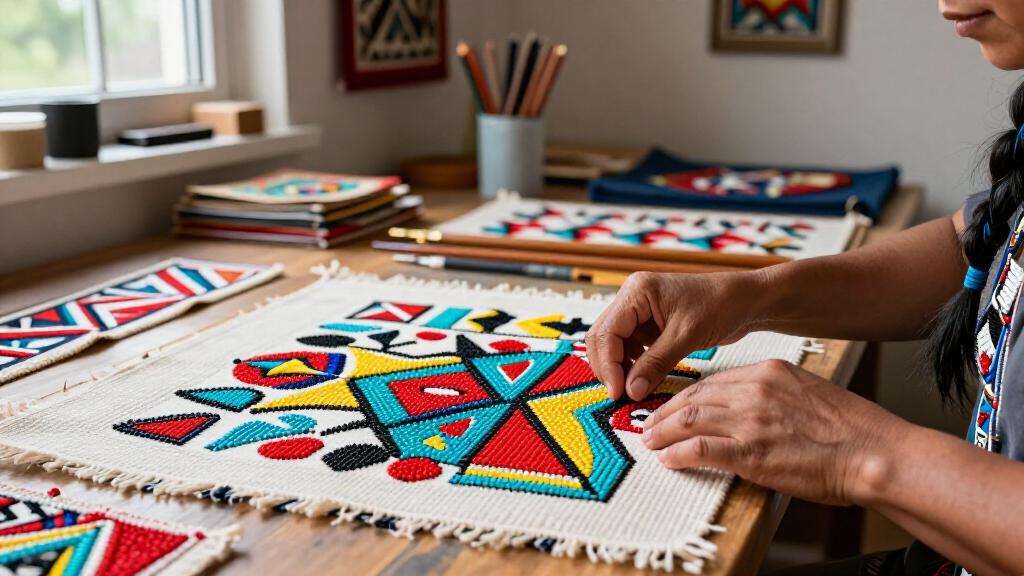
Melissa Cody, a Navajo/Diné artist, combines knowledge passed down through three generations of makers with both a vertical Navajo loom and a mechanized Jacquard machine. Her textile practice brings traditional motifs into dialogue with contemporary designs and messages. The exhibition includes her 2025 work Sunrise Rainbows, a Jacquard weaving with aniline-dyed wool fringe.
Other featured works include geometric abstractions by Eamon Ore-Giron and the four upright mixed-media sculptures in Tótems de emergencia by Aymara artist Natalia Montoya Lecaros. The exhibition also includes artists such as Patricia Domínguez, Jordan Ann Craig, Nanibah Chacon, Caroline Monnet, and Patrick Martinez. The Moody Center says a separate vinyl installation by Sharmistha Ray is scheduled to open October 22 and remain on view through January 29.
Indigenous Knowledge Across Media
The exhibition puts Indigenous knowledge systems at the center of a presentation about science, mathematics, and architecture—fields often discussed through frameworks that can leave cultural and territorial knowledge out of view. Its artists connect formal choices, including geometry and weaving, with histories, relationships to place, and understandings of the natural world.
The works also show how cultural practice can continue through changing tools. Cody’s use of both a traditional upright loom and a Jacquard machine offers a concrete example of ancestral techniques meeting newer technology. The exhibition frames this not as a simple replacement of one method by another, but as part of contemporary artistic practice shaped by inherited teaching and present-day expression.
As an affiliate, we earn on qualifying purchases.
From Looms to Contemporary Art
The exhibition’s themes are grounded in continuing practices as well as historical references. Navajo/Diné weavers have made geometrically patterned rugs and blankets on upright looms, while Maya artists in Mesoamerica produced decorated ceramics more than a millennium ago, including examples with natural motifs such as birds. The source report notes that these forms and cultural practices continue to inform artists today.
Materials and visual traditions also carry histories of exchange. Navajo-Churro sheep, whose wool is used in Diné weaving, were introduced by the Spanish in the 16th century. Montoya Lecaros draws on Aymara clothing traditions that combine Indigenous elements with those introduced by Spanish colonizers. The exhibition presents these histories as part of the varied cultural references informing contemporary work, rather than as a single shared Indigenous tradition.
“At its core, Radiant Geometries centers Indigenous ways of knowing that continue to shape relationships to territories, waterways, and interspecies care.”
— Noor Alé, exhibition curator
As an affiliate, we earn on qualifying purchases.
Details Beyond the Exhibition
The available report identifies the exhibition’s curator, participating artists, selected works, and closing date, but does not provide a full artist and artwork list, visitor numbers, or details about related public programming. It also does not specify whether the exhibition will travel to other venues after its Houston run. Those details are not confirmed in the source material.
The exhibition’s interpretations are presented through the curator’s description and the artists’ practices; the report does not offer individual artist statements for every work. Viewers should not assume that the diverse cultures and histories represented share one uniform perspective or set of teachings.
Contemporary Indigenous art prints
As an affiliate, we earn on qualifying purchases.
As an affiliate, we earn on qualifying purchases.
Houston Exhibition Dates
Radiant Geometries remains on view at the Moody Center for the Arts through December 19, 2026. The center’s separate Sharmistha Ray vinyl installation is scheduled to open on October 22 and run through January 29. The source report directs visitors to the Moody Center’s website for exhibition information; it does not specify additional future announcements about the show.
As an affiliate, we earn on qualifying purchases.
Key Questions
Where is Radiant Geometries on view?
It is at Rice University’s Moody Center for the Arts in Houston, Texas.
When does the exhibition close?
The exhibition is scheduled to remain on view through December 19, 2026.
Who curated Radiant Geometries?
Noor Alé curated the exhibition.
Which artists are included?
Featured artists include Melissa Cody, Eamon Ore-Giron, Natalia Montoya Lecaros, Patricia Domínguez, Jordan Ann Craig, Nanibah Chacon, Caroline Monnet, and Patrick Martinez, among others.
What subjects does the exhibition explore?
The show explores Indigenous perspectives on mathematics, science, architecture, nature, technology, and relationships to territories and waterways through contemporary art in multiple media.
Source: rss
Halloween Picks
halloween
As an affiliate, we earn on qualifying purchases.

![There Will Come Soft Rains (1950) [Pdf]](https://leluxart.com/wp-content/uploads/2026/08/there-will-come-soft-rains-1950-pdf-featured-560x300.jpg)