
TL;DR

Get art and craft supplies delivered free — and shop member deals
- Fast, free delivery on millions of items
- Access to Prime Big Deal Days deals on October 6–7
- Prime Video, Amazon Music and more included
A Hyperallergic art review examines Mala Iqbal’s recent paintings, including works set in subways and scenes filtered through curtains and screens. The review reads them as reflections on how people share public space while remaining separate, and on how mediated images shape perceptions of violence and everyday life.
Hyperallergic has published an art review of Mala Iqbal’s recent paintings at JJ Murphy gallery on Manhattan’s Lower East Side, focusing on subway scenes, urban encounters and images mediated by curtains and screens. The review argues that the works examine how strangers occupy shared spaces while often looking away from one another, and how people make sense of what they see.
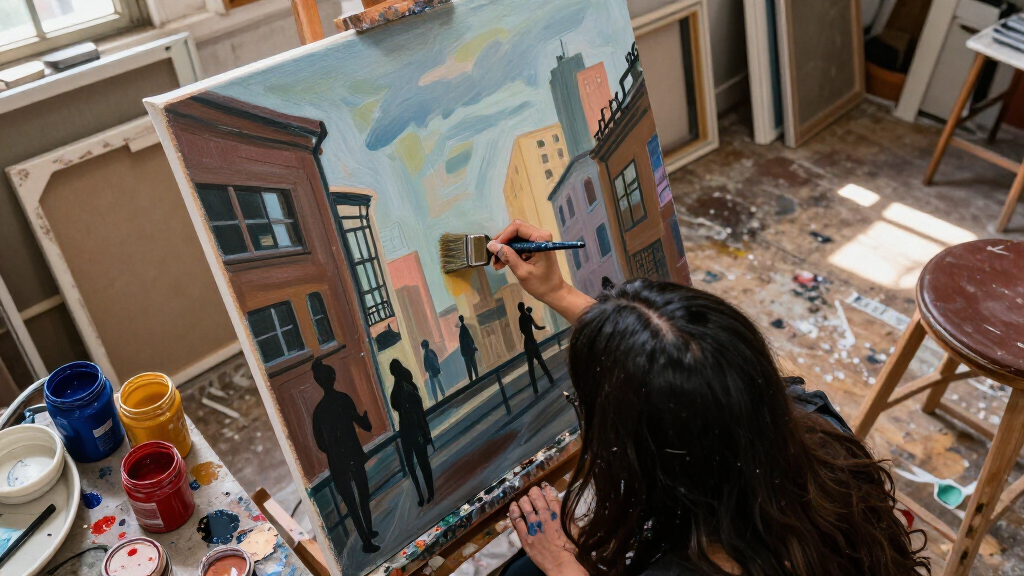
The review describes Iqbal’s canvases as crowded with figures and metropolitan energy. Several paintings use an orange-and-yellow glow that the writer links to life under electric light. Others, including “Through the Curtains” (2026), use layered images rather than that color effect to explore how events are seen, obscured and interpreted.
In “Through the Curtains,” the reviewer identifies a sequence of images: a scene of collapse partly hidden behind a tulle curtain, a figure reacting, and a second curtain marked with a pictograph-like pattern. The writer interprets this arrangement as a metaphor for viewing images of violence and collapse on screens, where new material arrives faster than a viewer can process it. That reading is the reviewer’s interpretation, not a statement attributed to Iqbal.
Other works discussed include “Times Square” (2026) and “Subway Riders” (2026). The review says “Times Square” has a chalky palette associated with painter Ben Shahn, while “Subway Riders” includes a recognizable portrait of Iqbal’s partner, artist Angela Dufresne. In the reviewer’s account, Dufresne looks toward the viewer without meeting their gaze, complicating the boundary between observing someone and being observed.
How the Paintings Frame City Encounters
The review’s central concern is the tension between physical proximity and emotional distance. Subway riders share a confined public setting, but the figures in Iqbal’s paintings often look elsewhere or are partly obscured. The scenes offer a way to consider urban life without treating strangers’ presence as proof of connection or understanding.
The discussion of “Through the Curtains” extends that concern to screen-mediated images. The reviewer sees the work as addressing how repeated exposure to reports and images of violence can be difficult to absorb. The article does not report audience research or make a claim about the paintings’ effect on viewers; its significance lies in the critical interpretation it offers of Iqbal’s imagery and composition.
watercolor paint sets for beginners
As an affiliate, we earn on qualifying purchases.
As an affiliate, we earn on qualifying purchases.
Subways, Screens and Painted Reality
The Hyperallergic piece is an art review, not a report of a newly announced commission or a change in the exhibition’s status. It considers several paintings dated 2025 and 2026, including “Transparent Friend” (2025), “Through the Curtains” (2026), “Times Square” (2026) and “Subway Riders” (2026). The supplied report identifies JJ Murphy gallery as the venue but gives no exhibition title or dates.
The reviewer places Iqbal’s work in relation to social realism, while describing its mood as closer to Matisse’s ease. Those comparisons frame the writer’s account of the paintings’ visual language; they do not establish a formal classification made by the artist. The review also notes that Iqbal’s scenes combine figures, signs and layered images to explore how reality is assembled and perceived.
““the world is a room we share with strangers, most of whom are looking elsewhere.””
— Hyperallergic reviewer
As an affiliate, we earn on qualifying purchases.
Exhibition Details Still Unspecified
The supplied report does not state when the exhibition opened or closes, how many works are included, or whether the gallery has announced related events. It also provides no direct comments from Iqbal about the paintings, so interpretations of their themes and references should be understood as the reviewer’s analysis.
The article’s description of the paintings is limited to the works and details it discusses. Further information about the exhibition’s full installation, availability and any later presentation of the paintings is not established in the source material.
As an affiliate, we earn on qualifying purchases.
Gallery and Exhibition Information
Readers seeking practical details can check JJ Murphy gallery’s current listing for the exhibition schedule and visitor information. The source material does not identify a closing date or describe any upcoming public programs, and it reports no scheduled next development involving the paintings.
For now, the confirmed development is the publication of Hyperallergic’s review and its account of the works on view. Any later exhibition announcement, artist statement or additional reporting would add information not contained in the review supplied here.
As an affiliate, we earn on qualifying purchases.
Key Questions
Where are Mala Iqbal’s paintings being shown?
The review identifies JJ Murphy gallery on Manhattan’s Lower East Side as the venue. It does not provide a full exhibition schedule.
Which paintings does the review discuss?
It discusses “Through the Curtains” (2026), “Times Square” (2026), “Subway Riders” (2026) and “Transparent Friend” (2025), among other details about Iqbal’s work.
What is “Through the Curtains” about?
The review describes a sequence involving a partly obscured scene of collapse, a reacting figure and a patterned curtain. The writer interprets it as a reflection on seeing violence and collapse through screens; that reading is the reviewer’s, not a confirmed statement of the artist’s intent.
Who is shown in “Subway Riders”?
The reviewer identifies one figure as Iqbal’s partner, artist Angela Dufresne, who appears to look toward the viewer without looking directly at them.
When does the exhibition end?
The supplied review does not give a closing date. Check the gallery’s current information for exhibition dates and visiting details.
Source: rss
Fall Picks
fall essentials
As an affiliate, we earn on qualifying purchases.